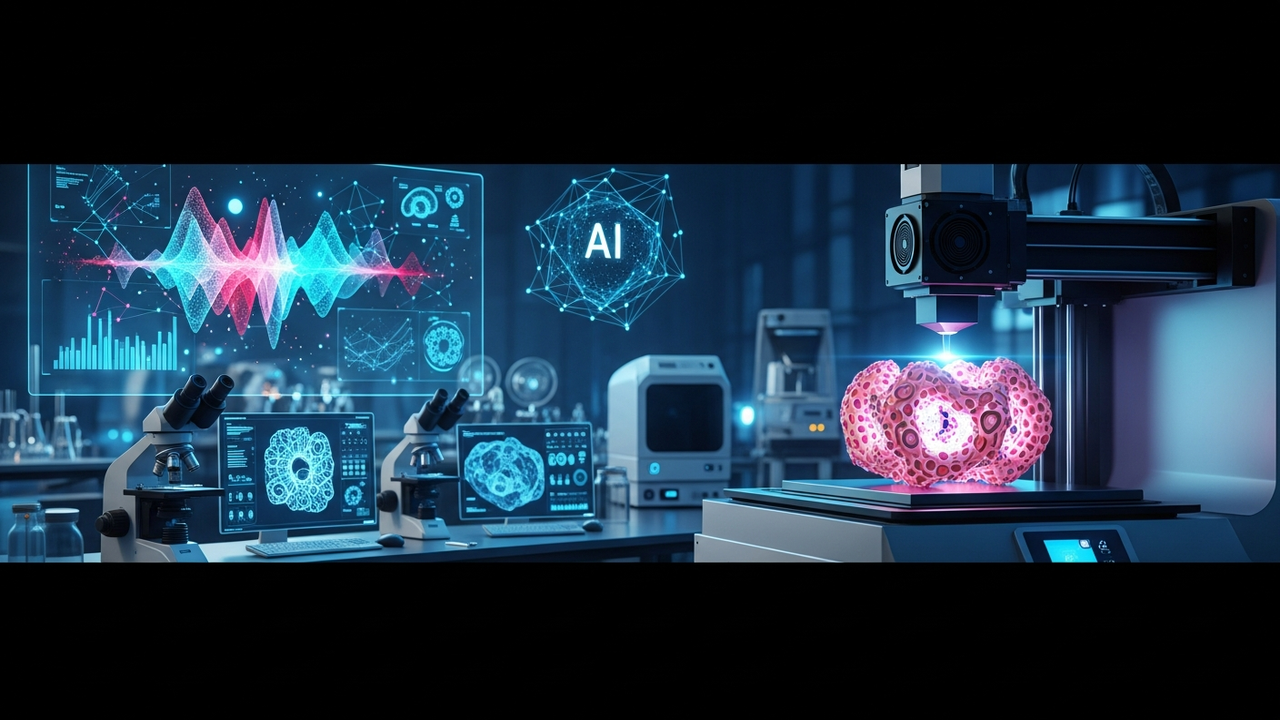
Key Findings: New Platform Accelerates Cancer Drug Discovery with 3D Bioprinting and AI
A research team spearheaded by the VCU Massey Comprehensive Cancer Center has developed an innovative platform that integrates 3D bioprinting, advanced imaging, and artificial intelligence (AI). This novel technology allows for the creation of microscopic, organ-like miniature tumors, or organoids, from cancer cells, and enables real-time, continuous tracking of their responses to multiple drugs. This capability holds the potential to identify promising cancer therapies significantly faster than conventional screening methods and to aid in determining personalized treatment strategies optimized for individual patients.
Technical & Clinical Details: High-Precision Organoids and AI-Driven Drug Response Analysis
The platform first utilizes 3D bioprinting technology to construct organoids from patient-derived cancer cells, accurately mimicking the in vivo tumor microenvironment. This enables drug screening that more faithfully replicates biological conditions compared to traditional 2D cell cultures or animal models. Subsequently, high-resolution imaging techniques are employed to meticulously monitor how these organoids respond to various drugs, observing parameters such as cell proliferation, morphological changes, and apoptosis. The vast imaging data generated is then analyzed by AI algorithms. The AI recognizes complex patterns, automating the screening process and dramatically improving efficiency by predicting which drugs are most effective against specific organoids, often uncovering insights that human researchers might overlook. The research team reports that this approach can accelerate drug screening speeds by several to tens of fold.
Background & Industry Context: Bridging Bottlenecks in Personalized Medicine and Drug Discovery
Cancer treatment is evolving towards personalized medicine, where therapies are optimized based on a patient’s genetic background and tumor molecular profile. However, the process of identifying suitable therapeutic agents remains a time-consuming and costly bottleneck. In traditional drug discovery pipelines, many candidate drugs fail before reaching clinical trials, partly because preclinical models often do not adequately replicate human disease. 3D bioprinting-derived organoids are emerging as a powerful tool to address this issue by providing models that reflect actual patient tumor characteristics. Furthermore, the integration of AI allows for extracting meaningful information from complex experimental data, gaining insights often missed by human researchers, and intelligently accelerating the entire drug discovery process.
Strategic Significance & Outlook: Accelerating Therapeutic Development and Transforming Cancer Care
This new platform has the potential to revolutionize cancer drug development. Through faster and more accurate drug screening, there is an increased likelihood of discovering new therapies for currently difficult-to-treat cancers and specific cancer subtypes. Moreover, by predicting drug sensitivity for individual patient tumors, clinicians can select the most effective agents before initiating treatment, contributing to reduced futile treatment periods and fewer side effects. The research team plans to further refine this technology to accommodate a wider variety of cancer organoids and apply it to large-scale drug screening campaigns. In the future, this platform is expected to become a crucial tool in improving the prognosis for cancer patients and translating personalized cancer medicine into routine clinical practice.
Get our weekly technology intelligence — free
Receive an infographic that lets you judge at a glance whether each field’s analysis report is worth reading.
Subscribe Free — Weekly Tech Intelligence
By subscribing, you’ll receive Troy-Technical’s weekly technology intelligence newsletter.
- Your email and selected fields are used only to deliver the newsletter.
- We never share your information with third parties.
- You can unsubscribe anytime via the link in each email.
See our Privacy Policy for details.
Takes about a minute · Unsubscribe anytime





Comments