Key Findings
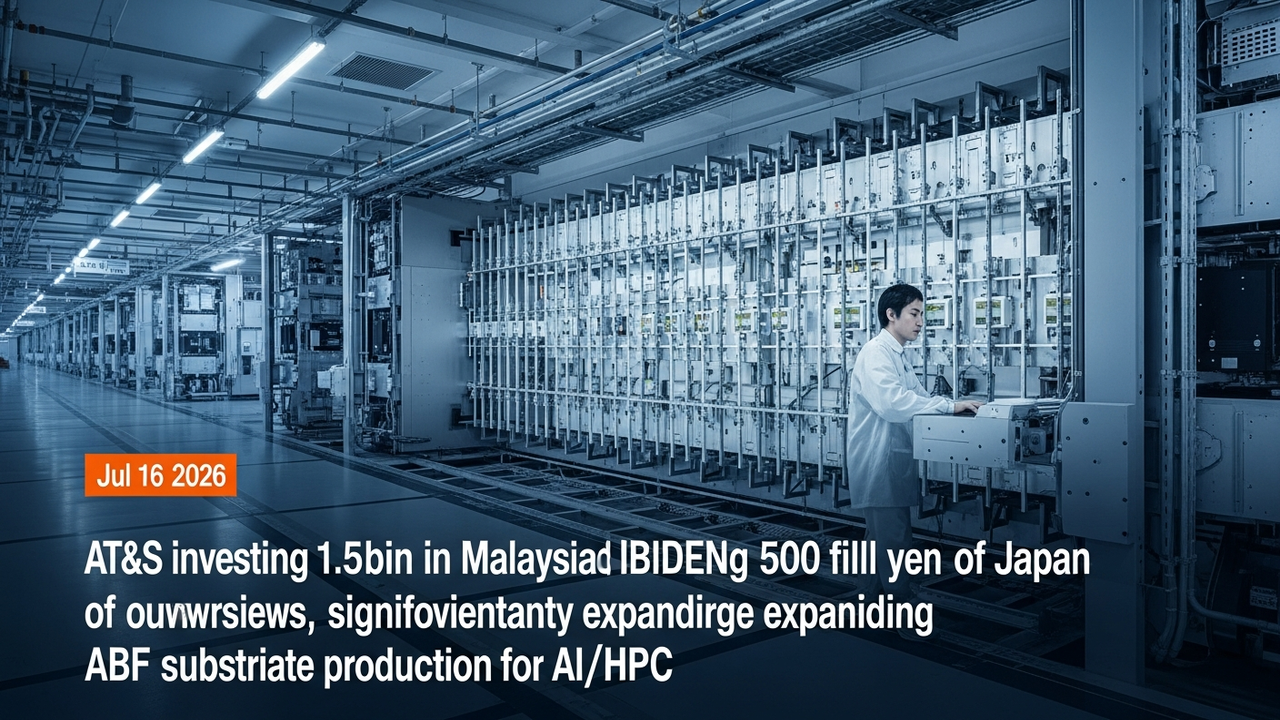
In response to the escalating demand for semiconductors in AI and High-Performance Computing (HPC), leading IC substrate manufacturers AT&S and IBIDEN have announced significant production capacity expansion investments. AT&S plans to inject approximately €1.5-2 billion into its Malaysian facility, while IBIDEN has approved a capital expenditure plan of around ¥500 billion from fiscal years 2026 to 2028. These investments are strategic and essential moves to meet market demand, especially amidst the worsening global shortage of ABF (Ajinomoto Build-up Film) substrates.
Technical & Business Details
- AT&S’s Malaysian Investment: Austrian firm AT&S, backed by long-term commitments from AMD and another undisclosed major technology company, intends to invest approximately €1.5-2 billion (equivalent to ¥250-330 billion) in utilizing its existing Kulim, Malaysia facility and a previously idled second factory building. This investment is geared towards substantially increasing the production capacity of high-end IC substrates for AI and HPC applications, demonstrating strong customer endorsement for this expansion.
- IBIDEN’s Domestic and International Fortification: Japan’s IBIDEN has approved a total capital expenditure plan of approximately ¥500 billion for fiscal years 2026 to 2028. This investment is aimed at expanding the production capacity of IC package substrates for AI and high-performance servers, primarily targeting its existing facilities in Gifu Prefecture and overseas plants. Notably, about ¥220 billion will be allocated to Cell6 of its Gama plant, focusing on the introduction of advanced technologies and enhancement of production efficiency.
- Criticality of ABF Substrates: ABF substrates are an indispensable material for multi-layer packaging substrates that interconnect high-performance semiconductors like CPUs, GPUs, and HBM. As AI chips become more complex and larger, the demand for bigger and higher-definition ABF substrates has exploded, making their supply capacity a critical bottleneck for the entire AI semiconductor market.
Background & Context
The advancement of AI is driving structural changes across the semiconductor industry. With exponentially growing demands for computational power and data bandwidth, advanced packaging technologies have become key to maximizing chip performance. In 2.5D/3D packaging solutions like CoWoS, ABF substrates are a crucial component that dictates overall performance. Consequently, the supply-demand balance of ABF substrates directly impacts the availability of AI chips and, by extension, the deployment speed of AI infrastructure. The substantial investments by AT&S and IBIDEN represent a necessary strategic response to stabilize the supply of this critical material and capture the growth opportunities of the burgeoning AI era.
Strategic Significance & Outlook
The large-scale ABF substrate production capacity expansions by AT&S and IBIDEN will significantly contribute to stabilizing the AI semiconductor supply chain. Crucially, increased investment from multiple suppliers will reduce dependency risks on specific regions or companies, enhancing overall supply chain resilience. This will enable AI chip manufacturers to procure high-performance substrates more consistently, fostering further development and widespread adoption of AI technologies. These investments underscore the vital role that the semiconductor back-end industry plays in the AI era.
Get our weekly technology intelligence — free
Receive an infographic that lets you judge at a glance whether each field’s analysis report is worth reading.
Subscribe Free — Weekly Tech Intelligence
By subscribing, you’ll receive Troy-Technical’s weekly technology intelligence newsletter.
- Your email and selected fields are used only to deliver the newsletter.
- We never share your information with third parties.
- You can unsubscribe anytime via the link in each email.
See our Privacy Policy for details.
Takes about a minute · Unsubscribe anytime





Comments