Key Findings
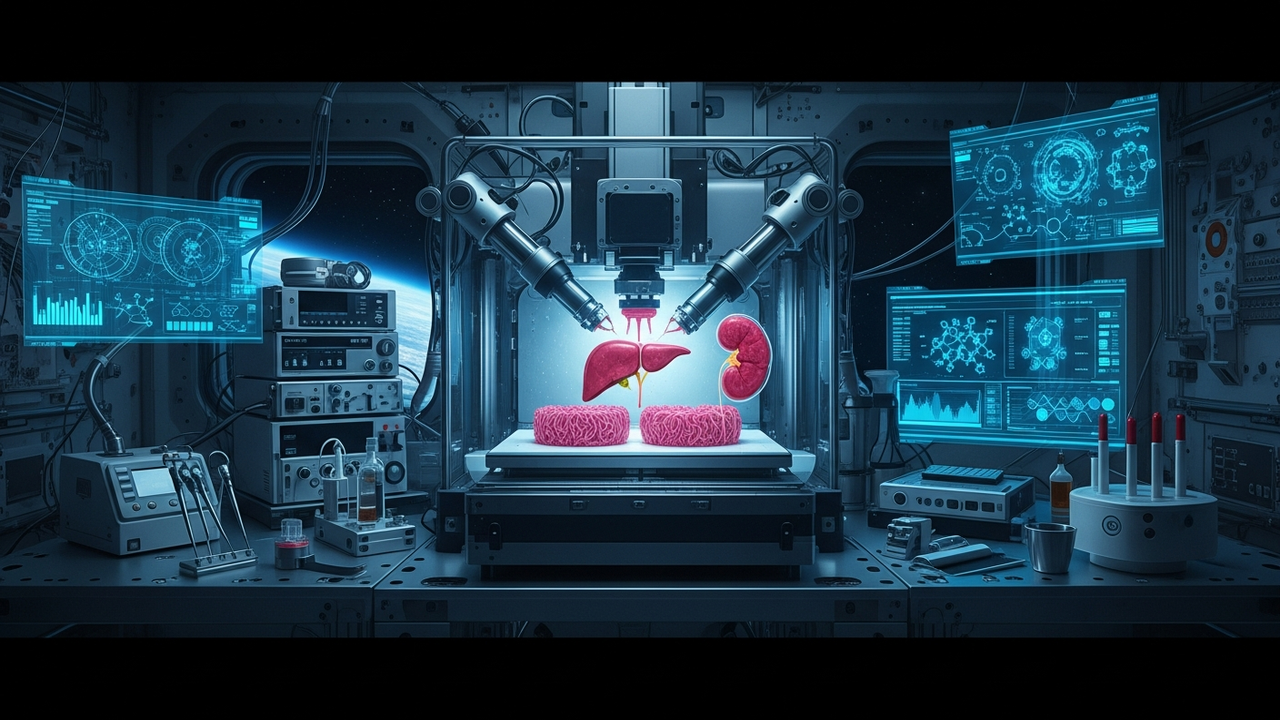
Auxilium Biotechnologies has achieved a historic milestone by successfully bioprinting kidney and liver tissues in orbit aboard the International Space Station (ISS) using its AMP-1 orbital bioprinter. This represents the first time these specific and complex organ tissues have been successfully manufactured in the microgravity environment, demonstrating a significant leap in in-space biomanufacturing capabilities.
Technical / Clinical Details
- California-based Auxilium Biotechnologies collaborated with the Wake Forest Institute for Regenerative Medicine in North Carolina, utilizing their advanced cell and tissue designs for the bioprinting process.
- Beyond kidney and liver tissues, the mission successfully produced cartilage tissue and 28 neural repair implants. This makes it the first single spaceflight to manufacture three different tissue types.
- Notably, it is also the first mission to produce both living biological tissues and implantable medical devices (neural repair implants) using the same manufacturing platform (the AMP-1 orbital bioprinter) in space.
- The microgravity environment is critical as it mitigates gravity-induced structural collapse and deformation that often complicate complex 3D tissue printing on Earth, allowing for the formation of more intricate and robust tissue architectures.
Background & Context
In-space bioprinting holds immense promise for addressing critical challenges in regenerative medicine, such as the global shortage of organ donors for transplantation, and for providing advanced medical solutions for long-duration space missions. On Earth, gravity poses a significant impediment to the stable formation of complex 3D biological structures during bioprinting. The unique microgravity conditions on the ISS offer an ideal environment where cells can aggregate and organize into more natural and functional tissue constructs, validating space as a potential hub for next-generation medical manufacturing.
Strategic Significance & Outlook
This groundbreaking achievement by Auxilium Biotechnologies opens new frontiers for the future of human tissue and organ manufacturing, both for Earth-bound patients and for astronauts undertaking extended space voyages to destinations like Mars. The ability to produce functional human tissues in space could also significantly advance pharmaceutical research by creating more accurate disease models for drug discovery and testing. This fusion of regenerative medicine and space exploration is poised to accelerate innovation, potentially revolutionizing healthcare and establishing new paradigms for off-world bio-production.
Get our weekly technology intelligence — free
Receive an infographic that lets you judge at a glance whether each field’s analysis report is worth reading.
Subscribe Free — Weekly Tech Intelligence
By subscribing, you’ll receive Troy-Technical’s weekly technology intelligence newsletter.
- Your email and selected fields are used only to deliver the newsletter.
- We never share your information with third parties.
- You can unsubscribe anytime via the link in each email.
See our Privacy Policy for details.
Takes about a minute · Unsubscribe anytime


Comments