Key Findings
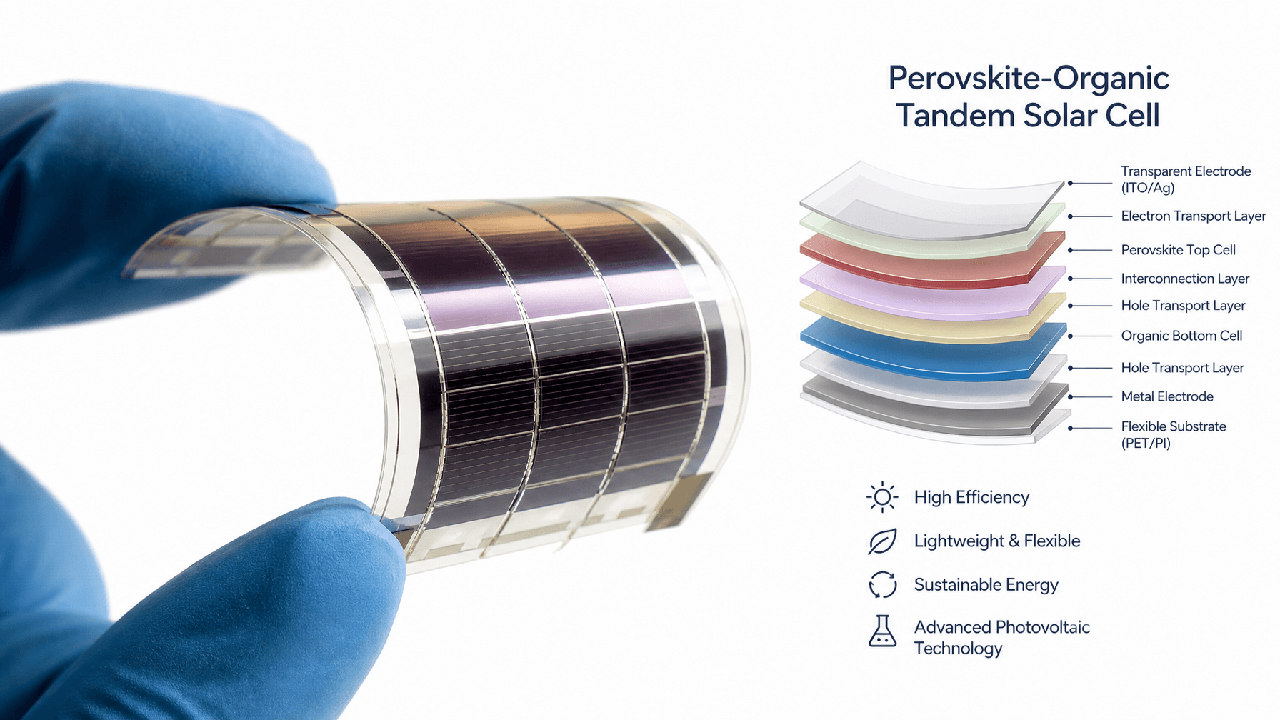
A research team from the Chinese Academy of Sciences Chemistry Institute has achieved a new world record for perovskite-organic tandem solar cells, reaching a certified steady-state power conversion efficiency of 28.04%. This significant advancement, published in Nature, marks a crucial step in pushing the theoretical limits of solar energy conversion and highlights China’s leading role in next-generation photovoltaic research.
Technical Details and Innovation
The record-breaking efficiency was made possible through a novel full-phase regulation strategy that incorporates a photo-convertible additive molecule, TDB. This innovative approach ensures a highly uniform distribution of halides within the perovskite layer, effectively mitigating defect formation that typically compromises cell performance and stability. The resulting devices not only exhibit superior initial efficiency but also demonstrate exceptional operational stability, retaining 90% of their initial efficiency after 625 hours of continuous light soaking under maximum power point tracking. This robust performance is critical for real-world applications where long-term durability is paramount.
Background and Industry Context
Perovskite solar cells are widely regarded as a promising alternative to traditional silicon-based photovoltaics due to their high efficiency, low manufacturing costs, and inherent flexibility. Tandem configurations, which stack multiple absorber layers, are particularly attractive as they can harvest a broader spectrum of sunlight, theoretically surpassing the Shockley–Queisser limit of single-junction cells. The integration of organic materials in this tandem architecture further enhances the devices’ lightweight and flexible characteristics, opening avenues for applications where conventional rigid and heavy solar cells are impractical.
Strategic Significance and Outlook
This world-record efficiency has profound implications for various high-value applications. The lightweight, flexible, and thin nature of these perovskite-organic tandem cells makes them ideal for building-integrated photovoltaics (BIPV), where they can be seamlessly incorporated into architectural elements. Furthermore, their potential extends to portable energy solutions, wearable electronics, and even aerospace applications, where high power-to-weight ratios are essential. While challenges remain in scaling up manufacturing and ensuring long-term stability under diverse environmental conditions, this research unequivocally positions perovskite-organic tandem solar cells as a leading contender in the race for a more efficient and versatile clean energy future. The team aims to further refine the technology and accelerate its path to commercialization, potentially transforming how we generate and utilize solar power globally.
Source: https://pandaily.com/perovskite-organic-tandem-solar-cell-world-record-jul2026
Get our weekly technology intelligence — free
Receive an infographic that lets you judge at a glance whether each field’s analysis report is worth reading.
Subscribe Free — Weekly Tech Intelligence
By subscribing, you’ll receive Troy-Technical’s weekly technology intelligence newsletter.
- Your email and selected fields are used only to deliver the newsletter.
- We never share your information with third parties.
- You can unsubscribe anytime via the link in each email.
See our Privacy Policy for details.
Takes about a minute · Unsubscribe anytime







Comments