Key Findings
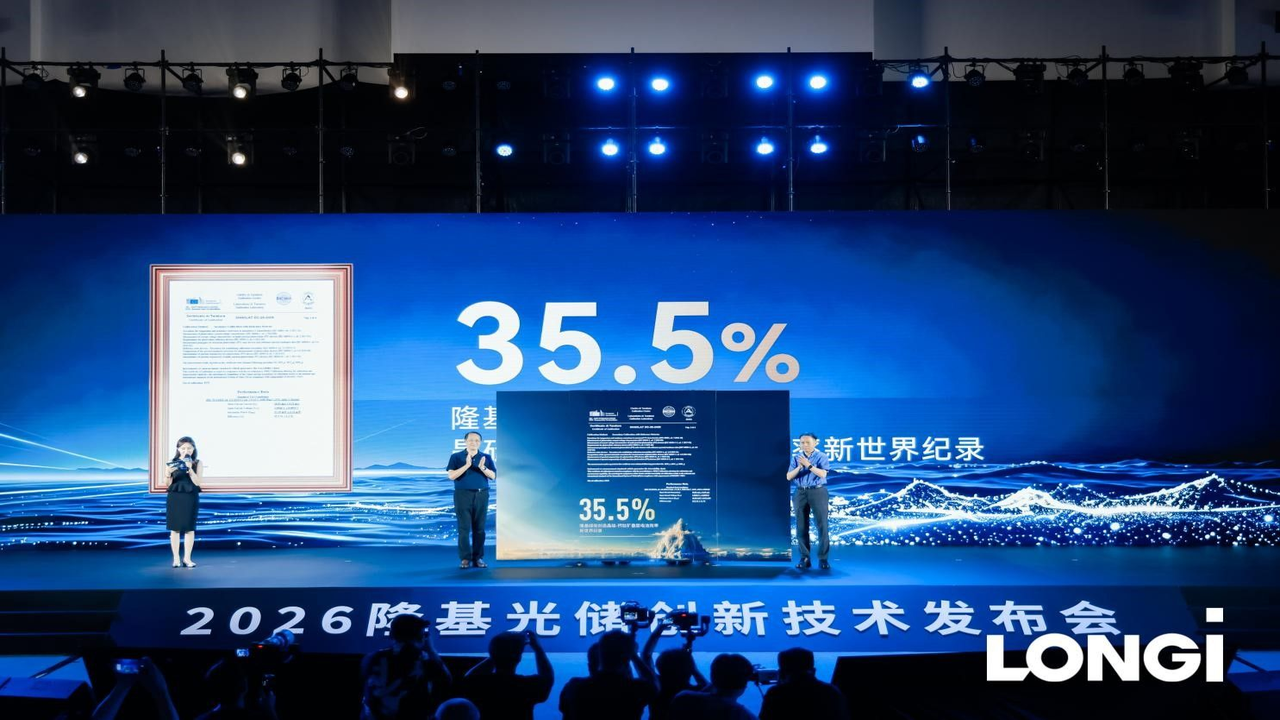
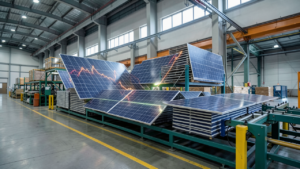
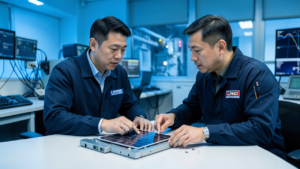
LONGi, a global leader in solar technology, has announced a groundbreaking achievement: a new world record power conversion efficiency of 35.5% for a two-terminal crystalline silicon-perovskite tandem solar cell. This remarkable feat was independently certified by the European Solar Test Installation (ESTI) and was presented at the 2026 Solar and Storage Innovation Technology Conference.
Technical Details and Innovation
This latest record surpasses LONGi’s own previous benchmark of 34.85% achieved in April 2025, demonstrating an accelerated pace of innovation within the company. Tandem solar cells, which integrate multiple light-absorbing layers, are designed to overcome the fundamental Shockley–Queisser limit of single-junction cells (theoretically around 33.7%). By optimally combining a silicon bottom cell with a perovskite top cell, LONGi’s technology maximizes photon absorption and charge separation efficiency across a broader spectrum of sunlight. This continuous improvement highlights the rapid maturation of tandem cell technology and its potential to deliver significantly higher energy yields from a given surface area.
Background and Industry Context
The solar photovoltaic industry is relentlessly pursuing higher efficiencies and lower costs to meet global energy demands and combat climate change. Perovskite solar cells, with their unique properties and high intrinsic efficiencies, are at the forefront of this quest. Integrating perovskites with established, high-performance crystalline silicon technology in a tandem configuration is particularly attractive, offering a clear pathway to efficiencies well beyond what silicon alone can achieve. The consistent breaking of efficiency records by major players like LONGi underscores the intense research and development efforts being poured into this field, signaling its growing readiness for widespread commercialization.
Strategic Significance and Outlook
LONGi’s repeated breakthroughs underscore the immense potential of tandem solar cell technology to redefine the performance benchmarks for photovoltaics. Efficiencies exceeding 35% translate directly into higher power output per unit area, making these cells exceptionally valuable for installations where space is constrained or where maximizing energy yield is critical. This progress holds significant promise for reducing the Levelized Cost of Electricity (LCOE) for solar power, thereby accelerating the global transition to clean energy. LONGi is committed to further advancing its tandem cell research and development, aiming to solidify its leadership in a market segment poised for explosive growth and to contribute substantially to a more sustainable energy future.
Get our weekly technology intelligence — free
Receive an infographic that lets you judge at a glance whether each field’s analysis report is worth reading.
Subscribe Free — Weekly Tech Intelligence
By subscribing, you’ll receive Troy-Technical’s weekly technology intelligence newsletter.
- Your email and selected fields are used only to deliver the newsletter.
- We never share your information with third parties.
- You can unsubscribe anytime via the link in each email.
See our Privacy Policy for details.
Takes about a minute · Unsubscribe anytime

Comments