Key Findings
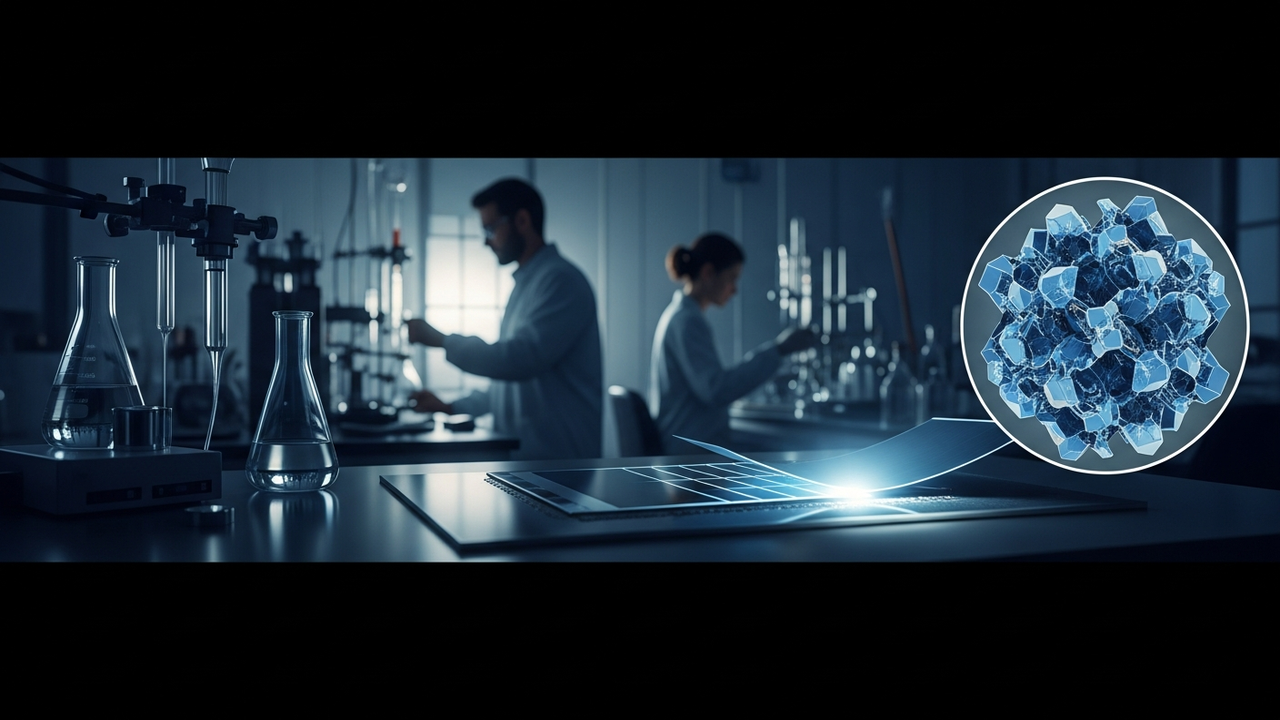
A significant challenge in the performance of lead-tin (Pb-Sn) metal-halide perovskite solar cells, primarily the instability of Sn2+, has been overcome through innovative additive engineering. This research introduced phenylethylammonium iodide (PEAI), 4-fluorophenylethylammonium iodide (4F-PEAI), and 4-fluorophenylethylammonium bromide (4F-PEABr) as additives. This strategy enabled precise control over the crystallization of the Pb-Sn perovskite, leading to a remarkable improvement in its stability. Consequently, the optimized devices achieved a high power conversion efficiency of 21.5%, marking a crucial advancement towards the practical application of all-perovskite tandem solar cells.
Technical / Clinical Details
With a bandgap of approximately 1.24 eV, Pb-Sn perovskites are theoretically ideal bottom cell materials for all-perovskite tandem solar cells. However, a fundamental issue has been the rapid degradation of device performance due to the susceptibility of Sn2+ to oxidation to Sn4+ upon exposure to air and moisture. The research team employed phenylethylammonium halide derivatives as additives to modulate the growth process of the perovskite crystals, thereby reducing defect density. These additives facilitate a passivation effect on the perovskite thin film surface, acting as a protective layer that suppresses the oxidation of Sn2+. Through precise additive formulation and process control, improved carrier transport and suppressed non-radiative recombination were achieved, leading to the simultaneous realization of 21.5% high efficiency and enhanced stability.
Background & Context
All-perovskite tandem solar cells, unlike silicon-based tandem cells, are composed entirely of perovskite materials in both layers, potentially leading to further reductions in manufacturing costs. Specifically, low-bandgap Pb-Sn perovskites, when combined with a high-bandgap perovskite top cell, can efficiently utilize the entire solar spectrum, promising ultra-high efficiencies unattainable by single-junction cells. The instability of Sn2+ has been a major impediment to the commercialization of this promising technology, and the current research outcome significantly lowers this barrier towards practical implementation. The emergence of stable Pb-Sn perovskites further enhances the competitive advantage of all-perovskite tandem technology in the race to develop next-generation solar cells.
Strategic Significance & Outlook
The achievement of enhanced stability and high efficiency in Pb-Sn perovskites through additive engineering significantly advances the commercialization pathway for all-perovskite tandem solar cells. Future R&D efforts will likely focus on further optimizing this additive technology, its application to larger-scale devices, and more rigorous long-term reliability testing. Considering the ongoing move towards lead-free alternatives, the development and integration of less toxic substitute materials may also become a critical area of focus. If stable, high-efficiency all-perovskite tandem solar cells become widely available, they are expected to offer an extremely competitive clean energy solution for a variety of applications, from rooftop installations to large-scale power plants, and even flexible and transparent solar cells. This progress is essential for further lowering the cost of solar electricity and accelerating its global adoption.
Source: https://pubs.acs.org/doi/abs/10.1021/acsenergylett.6c00858
Get our weekly technology intelligence — free
Receive an infographic that lets you judge at a glance whether each field’s analysis report is worth reading.
Subscribe Free — Weekly Tech Intelligence
By subscribing, you’ll receive Troy-Technical’s weekly technology intelligence newsletter.
- Your email and selected fields are used only to deliver the newsletter.
- We never share your information with third parties.
- You can unsubscribe anytime via the link in each email.
See our Privacy Policy for details.
Takes about a minute · Unsubscribe anytime





Comments