Key Findings
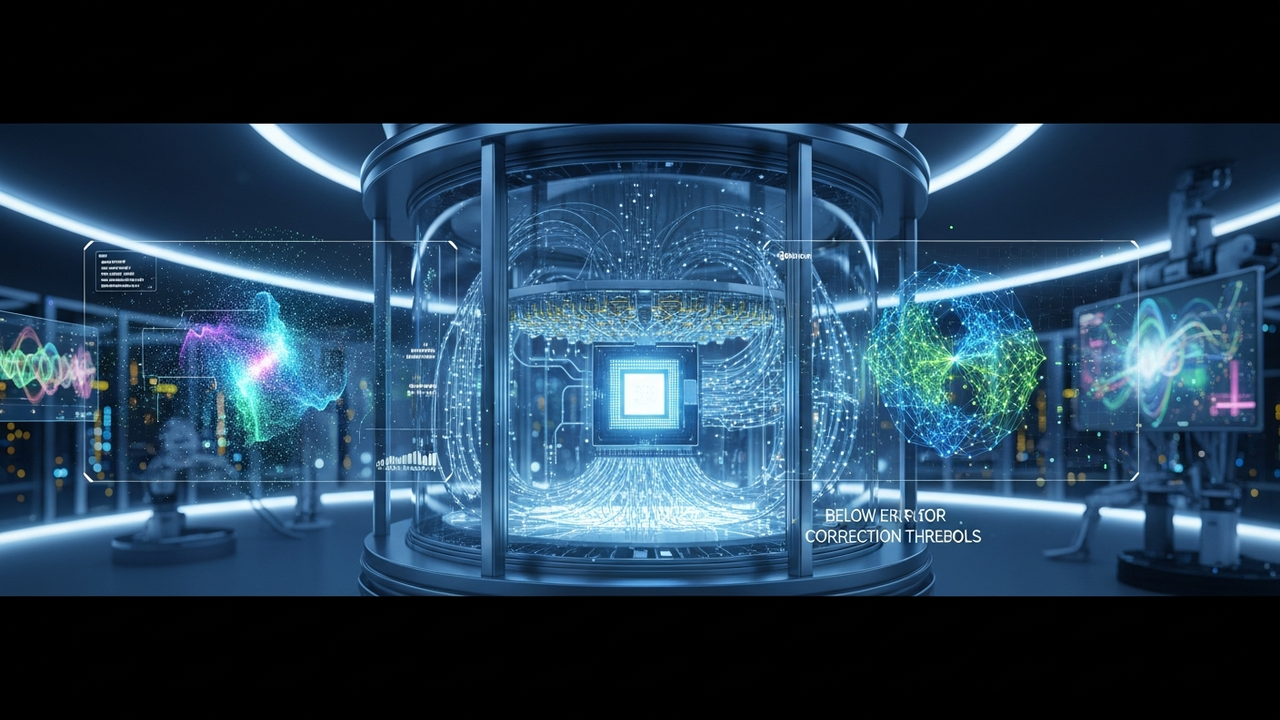
The year 2024 marked a significant pivot in quantum computing, shifting focus from speculative potential to tangible engineering achievements. Notably, Google’s Willow chip demonstrated quantum error correction operating below the threshold, providing compelling evidence that increasing physical components can indeed make a quantum bit more reliable. This milestone is crucial for advancing towards fault-tolerant quantum computation, where even imperfect physical qubits can collectively form stable logical qubits.
Technical Details
- Google’s Willow Processor: Utilizing superconducting qubits, the Willow chip showcased a verifiable reduction in logical error rates by leveraging redundant physical qubits. This experimental validation of error correction principles, where the error rate of a logical qubit decreases as more physical qubits are added, is a foundational step for scaling quantum hardware.
- Microsoft and Quantinuum Collaboration: This partnership has been instrumental in developing more capable logical qubits, achieving increasingly lower error rates for quantum operations. Their work focuses on high-fidelity gates and sophisticated error suppression techniques that are essential for executing complex algorithms reliably.
- IBM’s Deeper Accurate Circuits: IBM continued its trajectory of executing deeper quantum circuits with enhanced accuracy. This involves sophisticated control schemes and improved coherence times, allowing for more extensive and reliable quantum computations, which are vital for pushing the boundaries of quantum advantage demonstrations.
Background & Context
For years, the quantum computing narrative was dominated by the race to increase qubit counts. However, the true utility of quantum computers hinges not merely on quantity but on the quality and stability of these qubits. The results from 2024 underscore a critical industry maturation, where the focus has rightly shifted to achieving robust error correction and high gate fidelities. This change in emphasis reflects the understanding that fault tolerance is the ultimate gateway to unlocking quantum computing’s transformative potential across industries like materials science, drug discovery, and financial modeling.
Strategic Significance & Outlook
The demonstrated progress in error correction is a game-changer, moving quantum computing from a purely scientific endeavor toward a genuine engineering discipline. As logical qubits become more stable and performant, the pathway to achieving quantum advantage in real-world problems becomes clearer. This foundational progress will accelerate the development of applications that can tackle problems intractable for classical supercomputers. The coming years are expected to see continued advancements in error-corrected logical qubits, bringing the industry closer to commercially viable quantum solutions and fundamentally reshaping technological landscapes.
Source: https://twilightmag.com/latest-breakthroughs-in-quantum-computing-2024/
Get our weekly technology intelligence — free
Receive an infographic that lets you judge at a glance whether each field’s analysis report is worth reading.
Subscribe Free — Weekly Tech Intelligence
By subscribing, you’ll receive Troy-Technical’s weekly technology intelligence newsletter.
- Your email and selected fields are used only to deliver the newsletter.
- We never share your information with third parties.
- You can unsubscribe anytime via the link in each email.
See our Privacy Policy for details.
Takes about a minute · Unsubscribe anytime






Comments