Key Findings
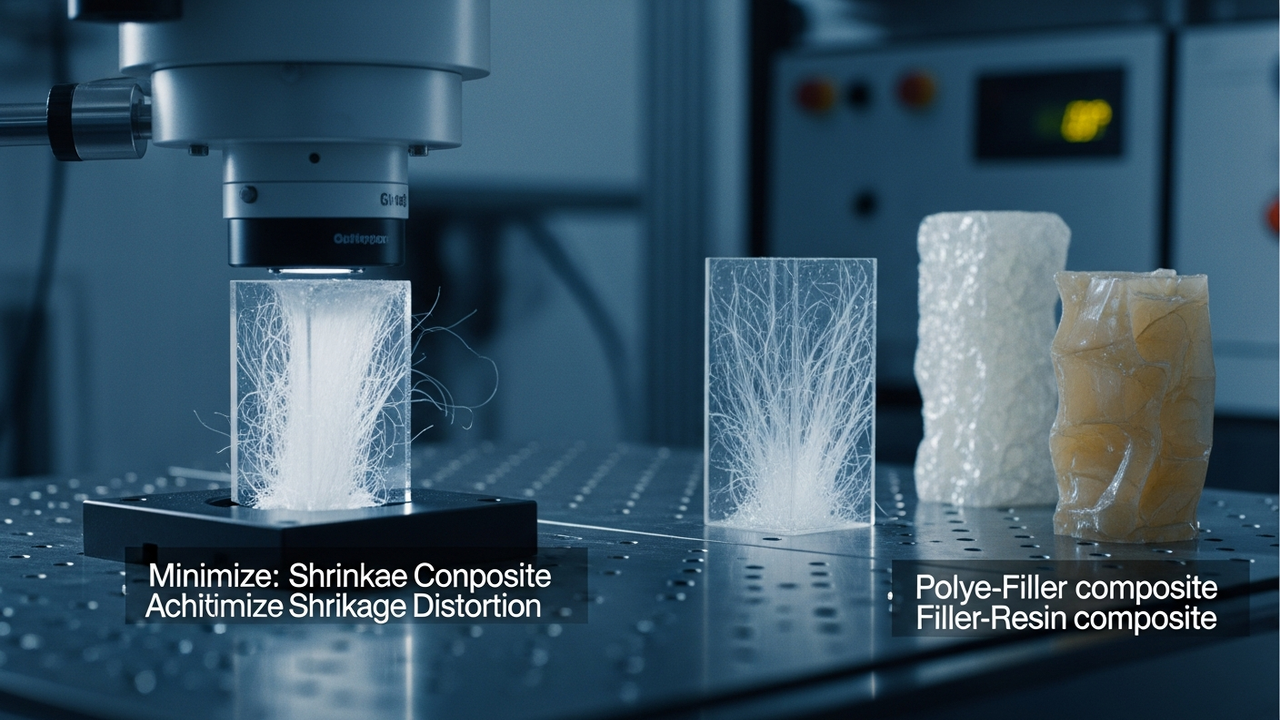
A recent in-vitro study has successfully demonstrated that integrating long polyethylene fibers into conventional resin composites significantly reduces polymerization shrinkage strain, a persistent challenge in dental restorative materials. The resulting composite exhibits shrinkage properties comparable to established short-fiber-reinforced bulk-fill composites, without negatively impacting the essential degree of monomer conversion.
Technical / Clinical Details
This in-vitro investigation meticulously evaluated the effects of incorporating long polyethylene fibers into resin composites on two critical parameters: polymerization shrinkage strain and the degree of monomer conversion. The results revealed that the inclusion of long fibers effectively mitigates the volumetric contraction that occurs during polymerization. Specifically, the observed polymerization shrinkage levels were found to be comparable to those achieved by short-fiber-reinforced bulk-fill composites, which are designed to address this very issue. Furthermore, a key finding was that the presence of both long and short fibers did not adversely affect the degree of monomer conversion, which remained within clinically acceptable ranges. This is crucial because a high degree of monomer conversion is directly correlated with the mechanical strength, durability, and biocompatibility of the restorative material. The study provides quantitative evidence that this new composite formulation maintains robust material integrity while offering superior shrinkage control.
Background & Context
Polymerization shrinkage is a long-standing clinical problem in dentistry, often leading to marginal gaps between the restoration and tooth structure. These gaps can result in secondary caries, postoperative sensitivity, and premature failure of the restoration, particularly in large and deep cavities. To combat this, various strategies, including the use of bulk-fill composites and short-fiber reinforcement, have been developed. The current study introduces long polyethylene fibers as an innovative approach to manage this shrinkage. This research builds upon the understanding of how fiber reinforcement can create a stress-absorbing network within the composite matrix, thus minimizing the overall stress transferred to the tooth structure and improving the longevity of dental restorations.
Strategic Significance & Outlook
The findings of this study hold significant promise for advancing dental restorative materials. By offering a composite with reduced polymerization shrinkage while preserving optimal monomer conversion, it could lead to more durable and less problematic dental fillings. This innovation could enable dentists to place larger and more complex restorations with greater confidence, potentially reducing the need for re-interventions and improving patient outcomes. From an engineering perspective, the successful integration of long fibers opens new avenues for designing advanced polymer composites not just for dental applications, but also for other biomedical fields where controlled shrinkage and robust mechanical properties are paramount. Future research will likely focus on optimizing fiber content and orientation, as well as conducting in-vivo studies to validate these promising in-vitro results.
Source: https://pubmed.ncbi.nlm.nih.gov/38994503/
Get our weekly technology intelligence — free
Receive an infographic that lets you judge at a glance whether each field’s analysis report is worth reading.
Subscribe Free — Weekly Tech Intelligence
By subscribing, you’ll receive Troy-Technical’s weekly technology intelligence newsletter.
- Your email and selected fields are used only to deliver the newsletter.
- We never share your information with third parties.
- You can unsubscribe anytime via the link in each email.
See our Privacy Policy for details.
Takes about a minute · Unsubscribe anytime








Comments