Key Findings
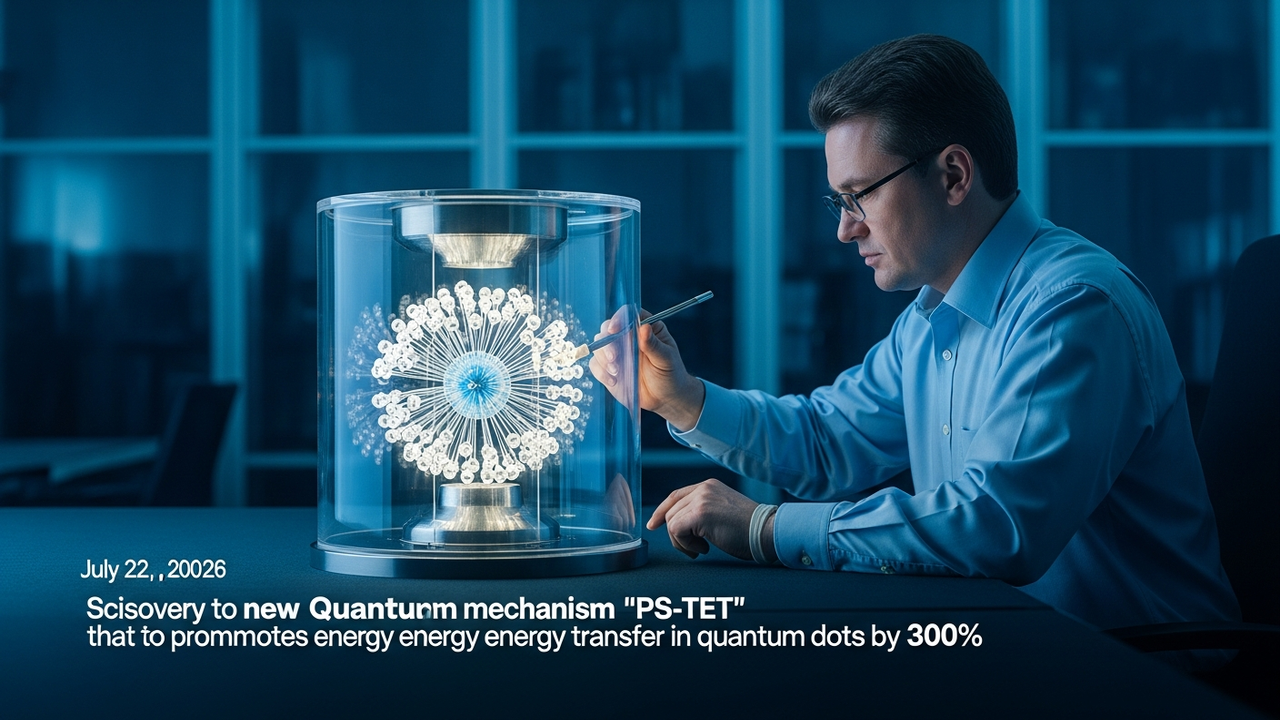
Scientists at the Dalian Institute of Chemical Physics have reported a groundbreaking discovery: a novel proton-assisted mechanism, termed ‘Proton Shuttle-assisted Triplet Energy Transfer’ (PS-TET), that significantly enhances the efficiency of triplet energy transfer (TET) in quantum dots. This quantum effect boosts energy transfer from quantum dots to neighboring molecules by up to 300%, achieving unprecedented levels of efficiency previously deemed challenging.
Technical / Clinical Details
The PS-TET mechanism facilitates triplet exciton energy transfer by utilizing protons as dynamic shuttles between quantum dots (QDs) and energy-acceptor molecules. Traditional TET processes are often hindered by spin selection rules, leading to lower efficiencies. However, the transient binding of a proton to the acceptor molecule alters its electronic structure, effectively bypassing these restrictions and optimizing the energy transfer pathway. This process has been confirmed to operate with high efficiency and stability at room temperature, eliminating the need for complex cooling systems. The precise control over proton movement and its impact on electronic coupling represents a significant advance in understanding and manipulating quantum-mechanical phenomena at interfaces.
Background & Context
Triplet energy transfer is a critical process in various fields, including solar energy conversion, photocatalysis, organic light-emitting diodes (OLEDs), and photodynamic therapy. However, the inherent limitations in its efficiency have posed a long-standing challenge. The discovery of PS-TET directly addresses this fundamental barrier, potentially ushering in a new paradigm in energy materials science. This mechanism holds particular promise for improving the light-harvesting efficiency of solar cells and accelerating chemical reactions under low energy input, addressing pressing global needs for sustainable energy and chemical production. Compared to conventional approaches, which often rely on heavy atoms or complex molecular designs, the PS-TET offers a simpler yet highly effective route.
Strategic Significance & Outlook
This breakthrough in PS-TET mechanism has the potential to revolutionize the design of light-energy conversion devices. For instance, it could lead to the development of significantly more efficient and stable quantum dot-based solar cells, as well as novel photocatalysts capable of achieving high-yield chemical reactions with minimal light energy. Furthermore, applications in highly sensitive probes for bioimaging and medical diagnostics are also anticipated. The research team plans to further optimize this mechanism and advance materials design and device integration towards practical applications, paving the way for a new generation of high-performance functional materials across multiple industries.
Source: https://www.sciencedaily.com/releases/2026/07/260722131908.htm
Get our weekly technology intelligence — free
Receive an infographic that lets you judge at a glance whether each field’s analysis report is worth reading.
Subscribe Free — Weekly Tech Intelligence
By subscribing, you’ll receive Troy-Technical’s weekly technology intelligence newsletter.
- Your email and selected fields are used only to deliver the newsletter.
- We never share your information with third parties.
- You can unsubscribe anytime via the link in each email.
See our Privacy Policy for details.
Takes about a minute · Unsubscribe anytime









Comments