
Key Findings
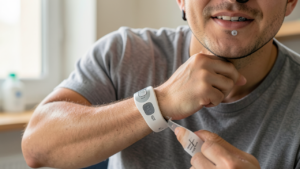
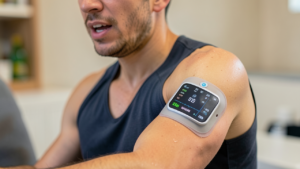
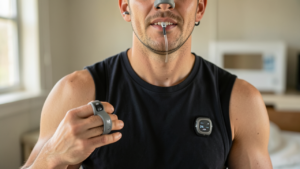
A research team from Shanghai Jiao Tong University has developed a Nepenthes-inspired Janus electronic skin (SPTL), demonstrating active sweat management, high breathability, and waterproof capabilities. This advanced electronic skin exhibits an impressive stretchability of 627% and possesses multimodal sensing abilities, simultaneously detecting electroencephalogram (EEG), electromyogram (EMG), electrocardiogram (ECG), and electrooculogram (EOG) signals. Notably, when integrated with machine learning algorithms, SPTL successfully achieved high-fidelity EMG control of a quadruped robot and over 95% accuracy in letter recognition, even under conditions of profuse perspiration.
Technical and Clinical Details
The Janus structure of SPTL mimics the unidirectional liquid transport capability of Nepenthes pitcher plants; one side is hydrophobic, and the other is hydrophilic, effectively wicking sweat away from the skin. This mechanism optimally maintains the epidermal microenvironment between the sensor and skin, enabling stable biosignal acquisition over prolonged wear. The sensor itself is composed of conductive materials embedded within a flexible polymer matrix, and its high stretchability allows it to conform to body movements, minimizing signal distortion. The collected EMG signals are analyzed in real-time by machine learning models, translating them into precise commands for robot movement or human-intended character recognition. The demonstrated recognition accuracy exceeding 95% underscores the potential of this technology to function as a highly reliable human-machine interface.
Background and Industry Context
In the field of wearable sensors, challenges related to skin adhesion, comfort, and particularly signal degradation due to sweat have been persistent issues. Stable biosignal acquisition is indispensable, especially for high-precision applications such as medical diagnostics and robot control. Electronic skins with active sweat management, like SPTL, offer a solution to these challenges, promising to revolutionize sports science, medical monitoring, human-machine interfaces in VR/AR devices, and soft robotics. Conventional electronic skins often suffer performance degradation from sweat, whereas SPTL provides a fundamental approach to address this problem.
Strategic Significance and Outlook
The success of SPTL is expected to significantly influence the development of next-generation wearable devices and human-machine interfaces. Researchers are aiming to further miniaturize this technology and enhance its durability to enable broader applications in daily life. For instance, it holds potential for medical wearables that monitor fatigue and stress levels, sports devices that optimize performance during exercise, or precise control of prosthetics. Furthermore, its potential for integration with other biosignals (e.g., heart rate, body temperature, blood pressure) could lead to more comprehensive health monitoring systems, marking a crucial step towards making human-machine interaction more intuitive and highly accurate.
Source: https://www.eurekalert.org/news-releases/1136729?utm_source=radaislice.com
Get our weekly technology intelligence — free
Receive an infographic that lets you judge at a glance whether each field’s analysis report is worth reading.
Subscribe Free — Weekly Tech Intelligence
By subscribing, you’ll receive Troy-Technical’s weekly technology intelligence newsletter.
- Your email and selected fields are used only to deliver the newsletter.
- We never share your information with third parties.
- You can unsubscribe anytime via the link in each email.
See our Privacy Policy for details.
Takes about a minute · Unsubscribe anytime



Comments