Key Findings
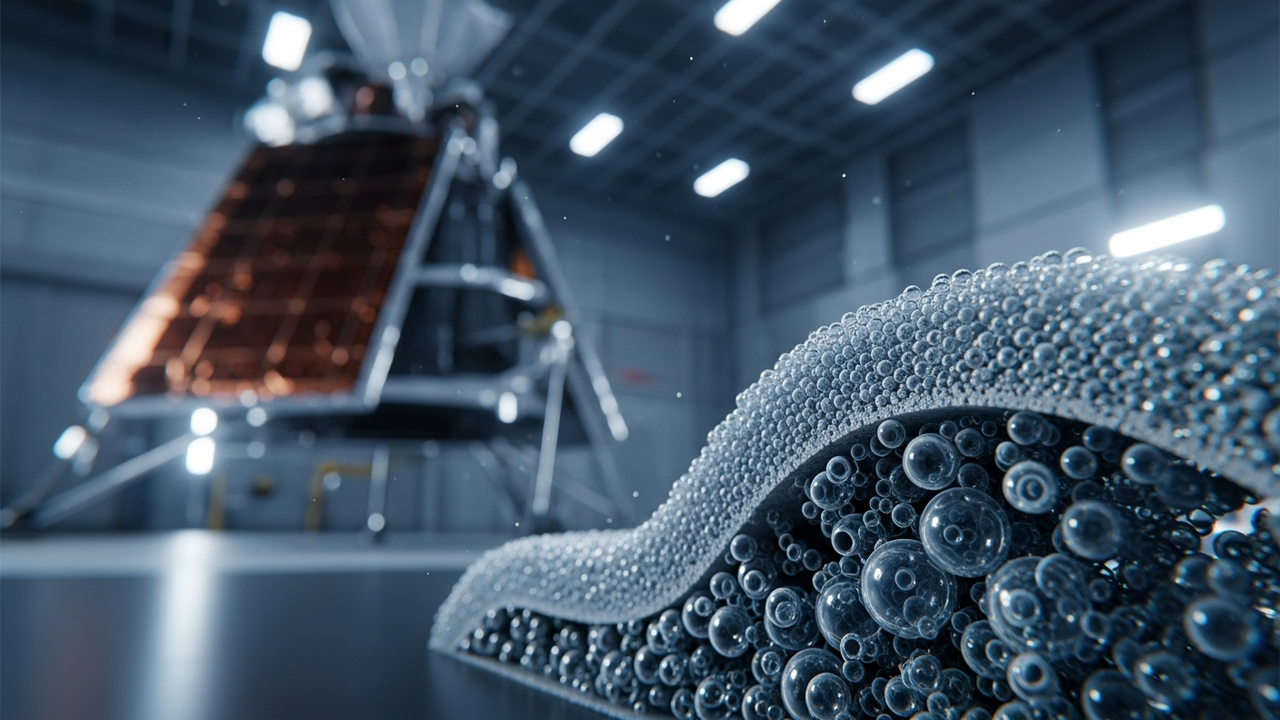
In the field of spacecraft Thermal Protection Systems (TPS), glass bubbles, which are hollow microspheres, are garnering significant attention as a crucial material due to their innovative properties. This material has been demonstrated to not only dramatically enhance the ability to protect spacecraft from extreme temperatures during re-entry but also to contribute substantially to the overall weight reduction of composite structures.
Technical Details
Glass bubbles are extremely fine spherical particles with internal cavities, a structure that imparts excellent thermal insulation properties and low density. Incorporating glass bubbles into TPS designs significantly reduces the density of composite materials while suppressing thermal conductivity. This enhances spacecraft durability in high-temperature environments, which can reach over 1400°C during re-entry, and simultaneously enables lightweight designs that contribute to reduced launch costs. Furthermore, glass bubbles contribute to thermal management and weight reduction in other spacecraft applications, such as satellite thermal insulation, cryogenic fuel storage systems, and advanced composite structures.
Background & Context
Weight reduction and thermal protection have always been critical challenges in spacecraft design. With the increasing number of reusable space transportation systems and long-duration missions, the demands for TPS performance and durability have intensified. Traditional thermal protection materials have faced issues related to weight, manufacturing costs, and reusability. The introduction of advanced materials like glass bubbles offers the potential to overcome these limitations. This is considered an essential technological innovation as the space industry strives for sustainability and cost-efficiency.
Strategic Significance & Outlook
The application of glass bubble technology is poised to revolutionize next-generation spacecraft TPS design, accelerating the development of human exploration missions to Mars and other planets, advanced re-entry technologies, and frequently reusable rocket components. The combination of lightweight properties and superior thermal insulation directly contributes to enhancing spacecraft payload capacity, reducing operational costs, and diversifying mission capabilities. Further material science research and manufacturing process optimization are expected to position glass bubbles as a key enabler for opening new frontiers in space exploration.
Source: https://www.glass-bubble.com/news/Glass-Bubbles-for-Spacecraft-Thermal-Protection-Systems-642.html
Get our weekly technology intelligence — free
Receive an infographic that lets you judge at a glance whether each field’s analysis report is worth reading.
Subscribe Free — Weekly Tech Intelligence
By subscribing, you’ll receive Troy-Technical’s weekly technology intelligence newsletter.
- Your email and selected fields are used only to deliver the newsletter.
- We never share your information with third parties.
- You can unsubscribe anytime via the link in each email.
See our Privacy Policy for details.
Takes about a minute · Unsubscribe anytime