Key Findings
Intellivation LLC has reported that recent advancements in Physical Vapor Deposition (PVD) coating technology within roll-to-roll (R2R) manufacturing processes offer a decisive solution to the long-standing challenge of long-term stability, a major barrier to the commercialization of flexible perovskite solar cells (PSCs). This innovative PVD coating significantly enhances the reliability, operational lifetime, and overall power generation performance of flexible PSCs through high-performance environmental barrier films and optimized current collector materials. This is hailed as a critical manufacturing technological breakthrough for the mass production of perovskite solar cells.
Technical / Clinical Details
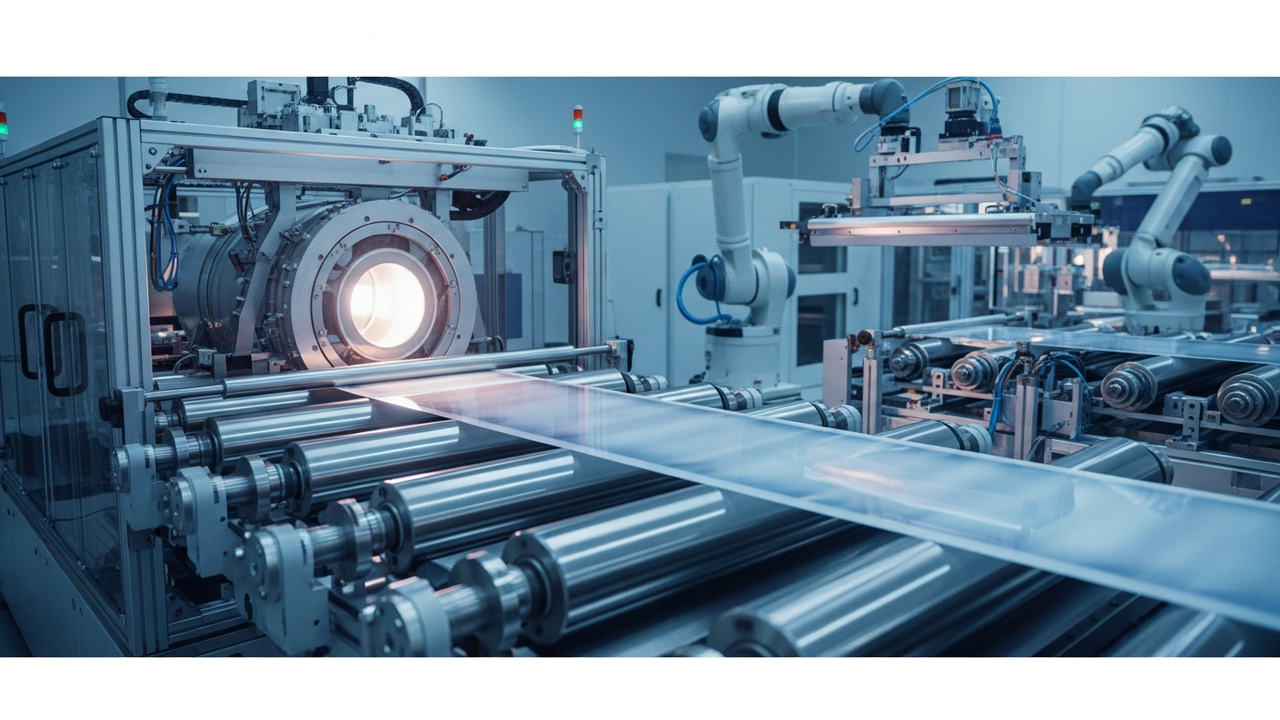
Flexible perovskite solar cells hold immense promise for diverse applications such as Building-Integrated Photovoltaics (BIPV), wearable devices, and IoT sensors, owing to their lightweight, flexibility, and high-efficiency potential. However, the inherent vulnerability of perovskite materials to moisture and oxygen, coupled with their limited long-term stability against light and heat stress, has been a primary obstacle to their commercialization. The PVD coating advancements highlighted by Intellivation LLC directly address this challenge. PVD technology involves evaporating and depositing materials in a vacuum to form extremely dense and uniform thin films. Applying this technology to R2R processes offers several benefits:
- Enhanced Environmental Barrier Films: High-quality PVD barrier layers effectively block the ingress of water vapor and oxygen to extreme levels, suppressing perovskite layer degradation. This is crucial for ensuring the long-term stability of devices.
- Optimized Current Collector Materials: PVD-formed current collectors (electrodes) provide excellent conductivity and good ohmic contact with the perovskite layer, contributing to efficient charge carrier collection and reduced internal resistance.
- Improved Uniformity and Reproducibility: The combination of R2R processing and PVD technology enables high-speed, continuous deposition of uniform thickness and composition films over large-area flexible substrates, leading to improved manufacturing yields and cost reduction.
These technological advancements pave the way for flexible PSCs to transition from the laboratory to the market.
Background & Context
To broaden the application scope of solar power and provide sustainable energy solutions in diverse forms, lightweight and flexible power generation devices, distinct from conventional rigid solar panels, are essential. Perovskite solar cells have attracted attention as a next-generation thin-film PV technology, but establishing manufacturing scalability and long-term stability has been the primary impediment to their commercialization. Intellivation LLC’s report, from the perspective of a manufacturing equipment supplier, suggests that the evolution of PVD technology is crucial for overcoming these barriers. This underscores how critical innovations in manufacturing process technology, in addition to materials development, are in shaping the future of perovskite solar cells.
Strategic Significance & Outlook
Advances in roll-to-roll PVD coating technology are set to significantly accelerate the commercialization of flexible perovskite solar cells. With more reliable and durable flexible PSCs becoming a reality, countless applications previously challenging for solar power—such as building facades, tents, automotive, aerospace, and IoT devices—will become feasible. Such announcements from manufacturing equipment suppliers like Intellivation LLC indicate the maturation of production technologies across the industry, marking a crucial step towards gigawatt-scale production of perovskite solar cells. Future efforts are expected to focus on further optimizing this technology and reducing manufacturing costs to establish competitiveness in the flexible solar cell market.
Get our weekly technology intelligence — free
Receive an infographic that lets you judge at a glance whether each field’s analysis report is worth reading.
Subscribe Free — Weekly Tech Intelligence
By subscribing, you’ll receive Troy-Technical’s weekly technology intelligence newsletter.
- Your email and selected fields are used only to deliver the newsletter.
- We never share your information with third parties.
- You can unsubscribe anytime via the link in each email.
See our Privacy Policy for details.
Takes about a minute · Unsubscribe anytime