Background
The global demand for higher energy density batteries is accelerating, driven by the critical need for extended electric vehicle (EV) ranges and increased storage capacity for integrating renewable energy sources. Silicon anodes stand out as one of the most promising candidates for next-generation lithium-ion batteries, boasting a theoretical capacity of approximately 4200 mAh/g—nearly ten times that of conventional graphite anodes. However, this high capacity comes with a significant challenge: silicon undergoes extreme volume expansion (up to 300%) during lithiation and delithiation cycles. This expansion leads to an unstable Solid Electrolyte Interphase (SEI) layer, causing continuous electrolyte decomposition and irreversible lithium loss, which drastically shortens both the cycle life and calendar life of the battery. These inherent lifespan limitations have long been a major barrier to the widespread commercialization of silicon anode technology.
Key Findings
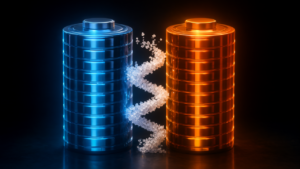
A recent scientific study has unveiled a breakthrough technology that effectively mitigates the parasitic reactions severely limiting the lifespan of high-energy-density silicon-based anodes. This innovation introduces Localized High-Concentration Electrolytes (LHCEs), which have been demonstrated to significantly enhance both the cycling stability and calendar life of silicon-based battery cells. The LHCE strategy works by locally increasing the concentration of the electrolyte solvent, thereby strengthening the interaction between solvent molecules and lithium ions. This enhanced interaction improves the stability and integrity of the SEI layer, addressing the root cause of silicon anode degradation.
Remarkably, experimental validation showed that even in electrolytes containing a relatively high water content of 200 ppm—a factor often problematic for battery performance—the LHCEs enabled the cells to retain 8% higher capacity (1200-1300 mAh/g Si) after 200 days of calendar aging compared to conventional electrolyte formulations. This result is particularly noteworthy as it suggests a potential relaxation of stringent moisture control requirements during battery manufacturing, which could lead to significant cost reductions in production. The sustained capacity of 1200-1300 mAh/g Si after 200 days of calendar aging indicates that silicon anode batteries utilizing LHCEs are nearing practical viability for demanding, long-term applications such as electric vehicles and grid-scale energy storage systems, where extended reliability is paramount.
This LHCE breakthrough is highly significant for the industry, offering a direct pathway to overcome silicon’s inherent weaknesses without requiring radical changes to existing electrolyte systems. This technology not only accelerates the practical adoption of silicon anodes but also holds potential for application in other high-capacity anode materials and more advanced electrolyte systems. An 8% increase in capacity retention over 200 days of calendar life directly translates to tangible benefits like longer warranty periods for EV batteries and reduced operational costs for large-scale energy storage. Future research is expected to focus on comprehensive long-term performance evaluations, scalability to various battery formats, and optimization for mass production. This innovation is poised to significantly propel the commercialization of next-generation batteries, delivering both high energy density and extended lifespan, thereby reshaping the landscape of energy storage.
Get our weekly technology intelligence — free
Receive an infographic that lets you judge at a glance whether each field’s analysis report is worth reading.
Subscribe Free — Weekly Tech Intelligence
By subscribing, you’ll receive Troy-Technical’s weekly technology intelligence newsletter.
- Your email and selected fields are used only to deliver the newsletter.
- We never share your information with third parties.
- You can unsubscribe anytime via the link in each email.
See our Privacy Policy for details.
Takes about a minute · Unsubscribe anytime