Key Findings
The U.S. Natural Resources Conservation Service (NRCS) issued its latest Water & Climate Update on July 24, 2026, which included detailed data from the Eastview Farm Soil Climate Analysis Network (SCAN) site in Tennessee. The report highlighted the precipitation and soil moisture conditions over the preceding 30 days, unequivocally demonstrating that soil sensors placed at various depths recorded significant increases in moisture levels following recent rainfall events. This effectively validates the crucial role of sensor technology in environmental monitoring within agricultural contexts.
Technical / Clinical Details
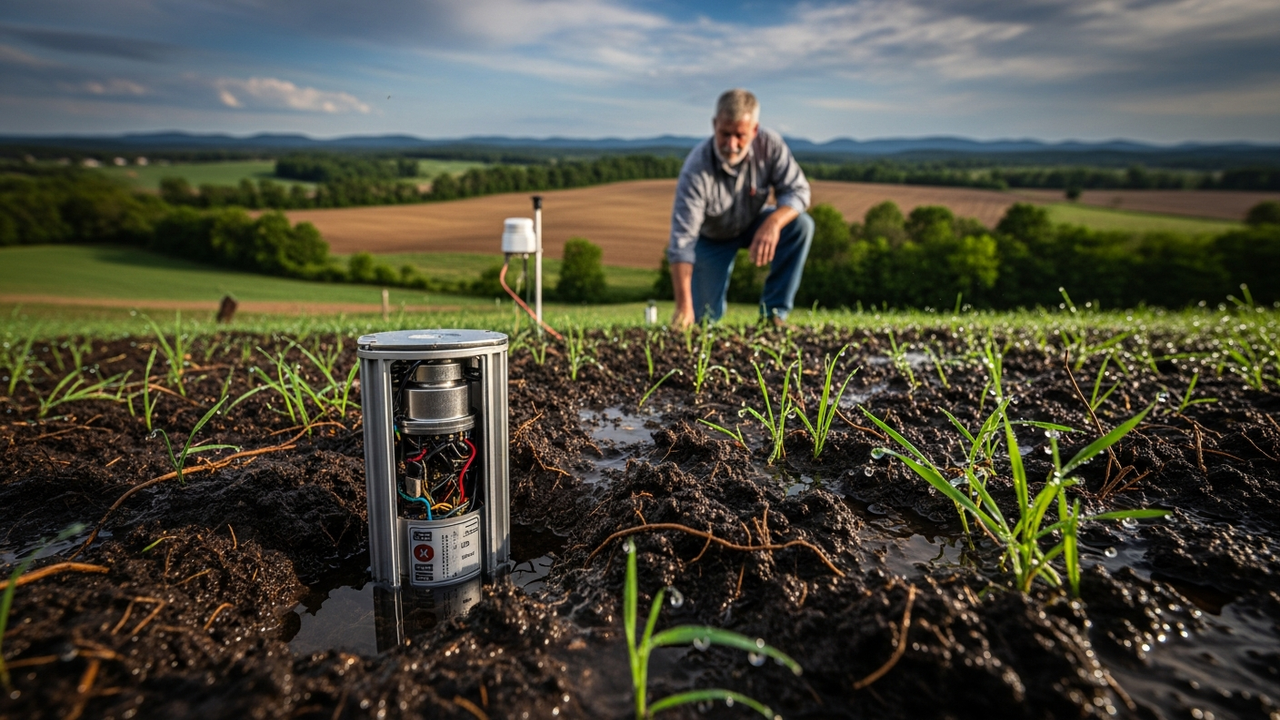
The SCAN sites, operated by the NRCS, are equipped with multiple soil moisture sensors strategically positioned at different depths (e.g., 5cm, 10cm, 20cm, 50cm, 100cm). These sensors continuously monitor the volumetric water content of the soil using principles such as dielectric permittivity, automatically collecting and transmitting data. The Eastview Farm data clearly illustrated consistent increases in soil moisture at each monitored depth after specific rainfall events, providing a precise temporal and spatial understanding of water infiltration and retention. This granular data is invaluable for farmers to accurately gauge crop water demand, optimize irrigation schedules, and assess soil health, infiltration capacity, and water stress. By providing real-time, site-specific conditions, this technology enables more informed and adaptive agricultural management strategies, moving beyond generalized regional data.
Background & Context
Global agriculture faces pressing challenges from climate change, including increasingly unpredictable rainfall patterns and dwindling water resources. Efficient water management is paramount for maximizing crop yields while minimizing environmental impact. Traditionally, agricultural practices often relied on empirical knowledge or visual inspection for soil moisture assessment, leading to inefficient water use. The integration of soil sensors and other environmental biosensors is a cornerstone of Precision Agriculture, aiming to optimize the use of resources like water, fertilizers, and pesticides through data-driven insights. The publication of such data by governmental bodies like the NRCS provides invaluable information for researchers, policymakers, and farmers to understand climate impacts and develop more sustainable agricultural practices, enhancing resilience against climatic shifts.
Strategic Significance & Outlook
Soil sensor technology will play an increasingly central role in sustainable agriculture and climate change adaptation strategies. Initiatives like the NRCS Water & Climate Update underscore the importance of widespread sensor networks for regional and national environmental assessment. In the future, soil sensors are expected to become even smaller, more accurate, and cost-effective, with enhanced integration with wireless communication technologies and artificial intelligence. This will enable more sophisticated predictive analytics and automated irrigation systems, allowing farmers to dramatically improve water-use efficiency and bolster resilience against extreme weather events such as droughts. Long-term, this technology has the potential to contribute significantly to global food security and environmental conservation, transforming how we manage natural resources and ensuring agricultural sustainability for future generations.
Get our weekly technology intelligence — free
Receive an infographic that lets you judge at a glance whether each field’s analysis report is worth reading.
Subscribe Free — Weekly Tech Intelligence
By subscribing, you’ll receive Troy-Technical’s weekly technology intelligence newsletter.
- Your email and selected fields are used only to deliver the newsletter.
- We never share your information with third parties.
- You can unsubscribe anytime via the link in each email.
See our Privacy Policy for details.
Takes about a minute · Unsubscribe anytime