Key Findings
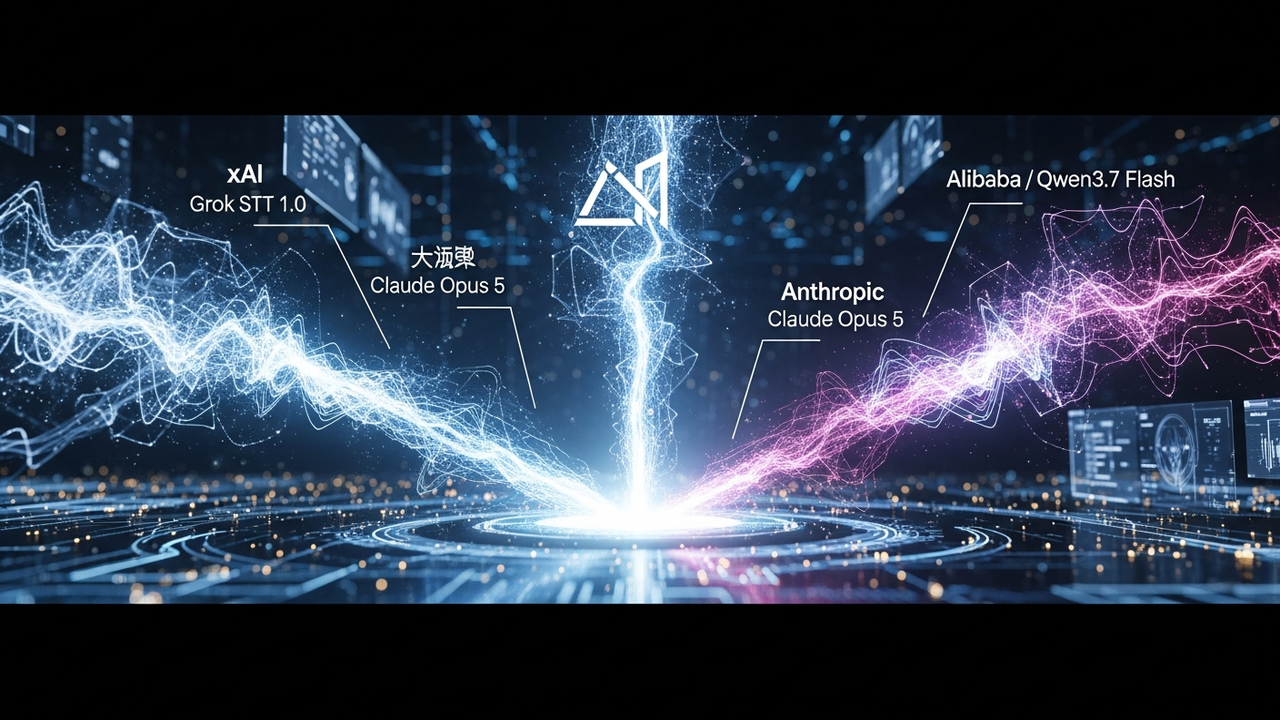
In July 2026, leading AI companies such as xAI, Anthropic, and Alibaba successively announced their latest large language models (LLMs), intensifying the competitive landscape of the market. These models represent significant advancements in specific areas, including speech recognition, general AI performance, and high-speed processing.
Technical and Clinical Details
Firstly, xAI released ‘Grok STT 1.0’ on July 23, 2026. STT, short for Speech-to-Text, is set to become the new foundation for speech recognition technology within the Grok series. Grok STT 1.0 is expected to dramatically improve the reliability of AI assistants and voice interfaces by delivering highly accurate speech-to-text conversion even in noisy environments and across diverse accents. This will enable users to interact with AI in a more natural and seamless manner.
Next, Anthropic announced its flagship model, ‘Claude Opus 5,’ on July 24, 2026. This model shows substantial improvements in reasoning capabilities, comprehension, and generation quality compared to existing Claude models. Of particular note are its expanded context window and enhanced ability to follow complex instructions. This enables unprecedented performance in tasks requiring long document analysis, complex programming, and multi-step reasoning.
Furthermore, Alibaba introduced ‘Qwen3.7 Flash’ on July 27, 2026. The Qwen series is a highly regarded LLM, particularly dominant in the Chinese market, and the Flash version is specifically optimized for high-speed processing and efficiency. It achieves near real-time response speeds while maintaining high performance with fewer computational resources, making it suitable for large-scale web applications, chatbots, and AI deployments on edge devices. This contributes to improving user experience and reducing operational costs.
Background and Industry Context
The field of large language models remains at the forefront of technological innovation, with OpenAI’s GPT series, Google’s Gemini, and Anthropic’s Claude leading the market. These companies are engaged in fierce competition across various aspects, including performance, efficiency, and optimization for specific tasks. The improvement in speech recognition technology, in particular, is crucial for the widespread adoption of AI assistants, while Chinese technology giants like Alibaba are focusing on developing fast and efficient models to cater to their vast domestic market and diverse linguistic environments.
Strategic Significance and Outlook
These model releases clearly demonstrate the relentless evolution of AI technology. Grok STT 1.0 will enhance the quality of voice interfaces, Claude Opus 5 will push the boundaries of general AI capabilities, and Qwen3.7 Flash will bring AI deployment to a broader range of applications and devices. As each company leverages its strengths to evolve models that address specific needs, the LLM market will become even more diversified, offering users more choices. This competition will contribute to further breakthroughs in AI technology and accelerate its societal implementation.
Source: https://llmgateway.io/timeline
Get our weekly technology intelligence — free
Receive an infographic that lets you judge at a glance whether each field’s analysis report is worth reading.
Subscribe Free — Weekly Tech Intelligence
By subscribing, you’ll receive Troy-Technical’s weekly technology intelligence newsletter.
- Your email and selected fields are used only to deliver the newsletter.
- We never share your information with third parties.
- You can unsubscribe anytime via the link in each email.
See our Privacy Policy for details.
Takes about a minute · Unsubscribe anytime