Background
Kirchhoff’s law, a cornerstone of thermal physics, posits that a body in thermal equilibrium exhibits equal emissivity and absorptivity. For decades, achieving a material that consistently and significantly violates this fundamental law has been a major scientific pursuit, with previous attempts yielding only limited or conditional deviations. The ability to precisely control thermal behavior independent of this equilibrium holds immense implications across diverse sectors, including high-efficiency solar energy systems, thermoelectric devices, aerospace engineering, and advanced building energy management, potentially enabling a new class of smart thermal surfaces.
Key Findings
A recent study has unveiled a groundbreaking layered nanomaterial designed to independently control its heat absorption and emission properties. This innovative material not only demonstrates a remarkable deviation from Kirchhoff’s law of thermal radiation, reaching up to 43%, but also possesses a unique ‘memory’ function, maintaining its thermal settings even after power is removed. This achievement challenges fundamental principles of thermodynamics and opens new avenues for energy science.
Technical Details
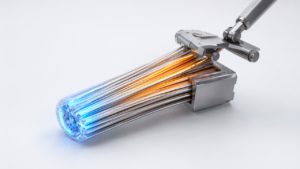
The nanomaterial’s intricate architecture is meticulously structured with multiple layers, each engineered to selectively absorb and emit specific wavelengths of light. This design enables precise tuning of the material’s thermal characteristics. Experimental results confirm its ability to efficiently absorb heat at one set point and effectively emit it at another. The material’s crucial ‘memory’ function is attributed to a sophisticated combination of molecular structures and integrated phase-change materials. Crucially, unlike conventional thermal emitters where absorption and emission are intrinsically linked, this new material actively decouples these processes, introducing a novel degree of freedom in thermal engineering.
Strategic Significance and Outlook
This technology is poised to accelerate the development of next-generation high-efficiency solar collectors, smart thermal coatings, and autonomous cooling systems. Its potential applications extend to critical areas such as energy management in extreme environments and advanced electronics requiring precise thermal control. Future research will focus on scaling up production, optimizing cost-effectiveness, and ensuring long-term stability for commercial viability. Ultimately, the fundamental shift in thermal control offered by this material promises a transformative impact on global energy technologies, potentially setting new benchmarks for thermal efficiency and autonomy.
Source: https://go.aps.org/4lwRZzG
Get our weekly technology intelligence — free
Receive an infographic that lets you judge at a glance whether each field’s analysis report is worth reading.
Subscribe Free — Weekly Tech Intelligence
By subscribing, you’ll receive Troy-Technical’s weekly technology intelligence newsletter.
- Your email and selected fields are used only to deliver the newsletter.
- We never share your information with third parties.
- You can unsubscribe anytime via the link in each email.
See our Privacy Policy for details.
Takes about a minute · Unsubscribe anytime