Key Findings
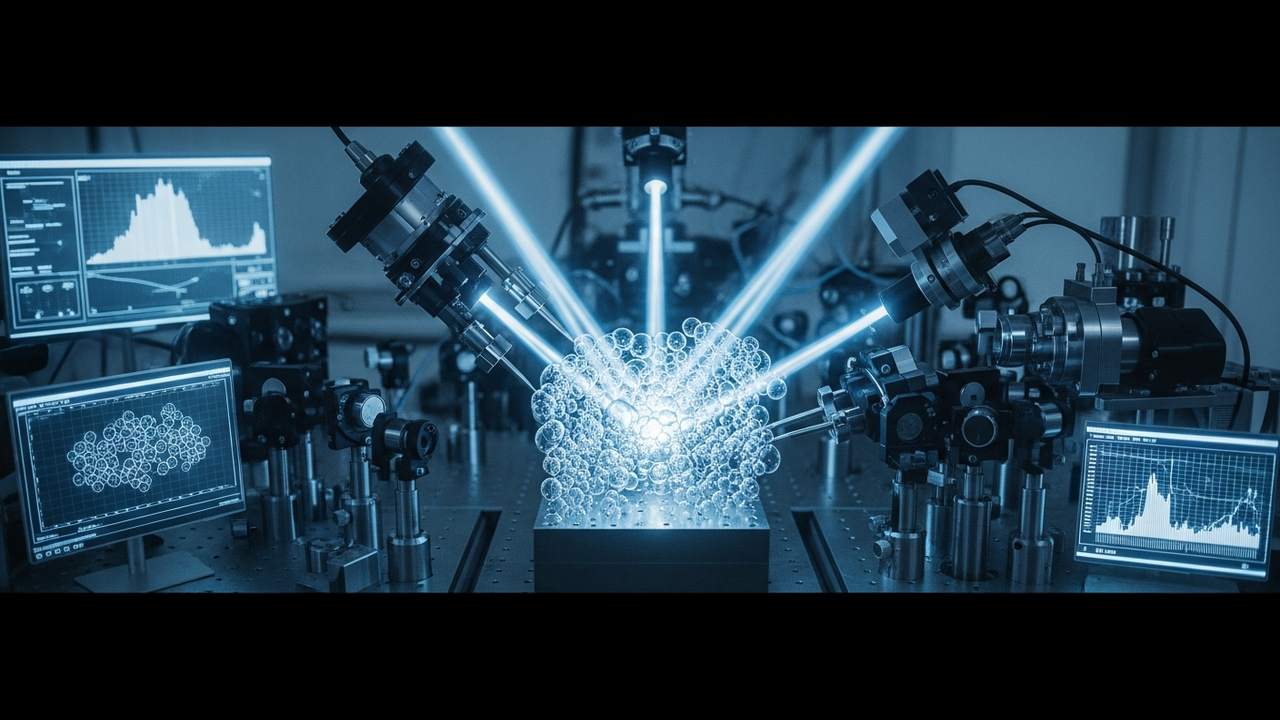
A research team at Flinders University has uncovered a groundbreaking and previously unknown mechanism by which light can control the electronic states of nanoscale ‘bubble domains’ within ferroelectric crystals. Remarkably, the most significant change in this electronic state was observed to occur *temporarily after* the light was switched off, challenging conventional wisdom regarding photo-responsive materials. This discovery deepens our understanding of the interaction between light and ferroelectric materials, potentially opening new avenues for future energy-efficient memory devices and advanced computing technologies.
Technical / Clinical Details
Ferroelectric materials are characterized by their spontaneous electric polarization in the absence of an external electric field, making them widely applicable in non-volatile memories, sensors, and actuators. The research team exposed a specific ferroelectric crystal (material unspecified in the summary, thus general terms are used) to a short pulse of laser light and meticulously tracked the subsequent changes in its electronic state. Surprisingly, the most pronounced changes in the behavior of nanoscale ‘bubble domains’ (minute regions with differing polarization directions) formed within the crystal, and a temporary switching of the crystal’s surface electronic state, were observed immediately after the light was turned off, rather than during illumination. This suggests that light induces a transient non-equilibrium state in the material, and upon its relaxation, a complex interaction between electrons and the lattice (crystal structure) triggers the rearrangement of these magnetic domains. This phenomenon, which can be termed ‘indirect optical control,’ is based on a new physical principle distinct from conventional direct electronic excitation via light absorption. By understanding this mechanism, researchers have gained a novel means to precisely control the electronic properties of the material by adjusting the timing and duration of light exposure.
Background & Context
Modern computing and data storage face limitations in terms of power consumption and processing speed. Ideally, memory devices should combine both high speed and non-volatility (the ability to retain data even when power is off), but these properties are often in a trade-off relationship. Ferroelectric RAM (FeRAM) offers the advantage of non-volatility but has faced challenges with write speeds and endurance. Technologies that control electronic states with light are gaining significant attention as next-generation memory and sensor technologies, as they can enable ultra-high-speed operation in the terahertz band and wireless control without external wiring. Flinders University’s discovery demonstrates a new potential for light-based control, potentially resolving bottlenecks in these technologies and driving significant innovation.
Strategic Significance & Outlook
This novel light-switching mechanism is poised to bring innovation to a wide array of fields, including data storage, optical communications, sensors, and neuromorphic computing (brain-inspired computing). Particularly, the characteristic of electronic state change *after* the light is switched off may enable the development of devices with novel functionalities impossible with conventional electronic devices (e.g., memory where information is encoded by light pulses but read only in the subsequent dark state). This could accelerate the realization of ultra-low-power, ultra-fast non-volatile memories, highly sensitive optical sensors, or entirely new computational paradigms. Flinders University’s research is recognized as one of the global breakthroughs in the interdisciplinary field of materials science and photonics, promising profound impacts on future technological landscapes.
Source: https://news.flinders.edu.au/blog/2026/08/03/lightbulb-way-to-switch-e-materials/
Get our weekly technology intelligence — free
Receive an infographic that lets you judge at a glance whether each field’s analysis report is worth reading.
Subscribe Free — Weekly Tech Intelligence
By subscribing, you’ll receive Troy-Technical’s weekly technology intelligence newsletter.
- Your email and selected fields are used only to deliver the newsletter.
- We never share your information with third parties.
- You can unsubscribe anytime via the link in each email.
See our Privacy Policy for details.
Takes about a minute · Unsubscribe anytime