Background
Perovskite solar cells are widely recognized as a transformative next-generation photovoltaic technology, celebrated for their high power conversion efficiency and potential for low-cost manufacturing. However, a significant barrier to their widespread commercialization has been ensuring long-term reliability in real-world outdoor conditions. A critical challenge arises from partial shading or faulty cells within a solar module, which can force affected cells into a reverse-bias state. In this state, these cells transition from power generators to power consumers, often leading to localized hot-spot phenomena, severe overheating, accelerated material degradation, and even potential fire hazards. Historically, perovskite solar cells have demonstrated considerable vulnerability to such reverse-bias stress, impacting their durability and suitability for diverse applications.
Key Findings
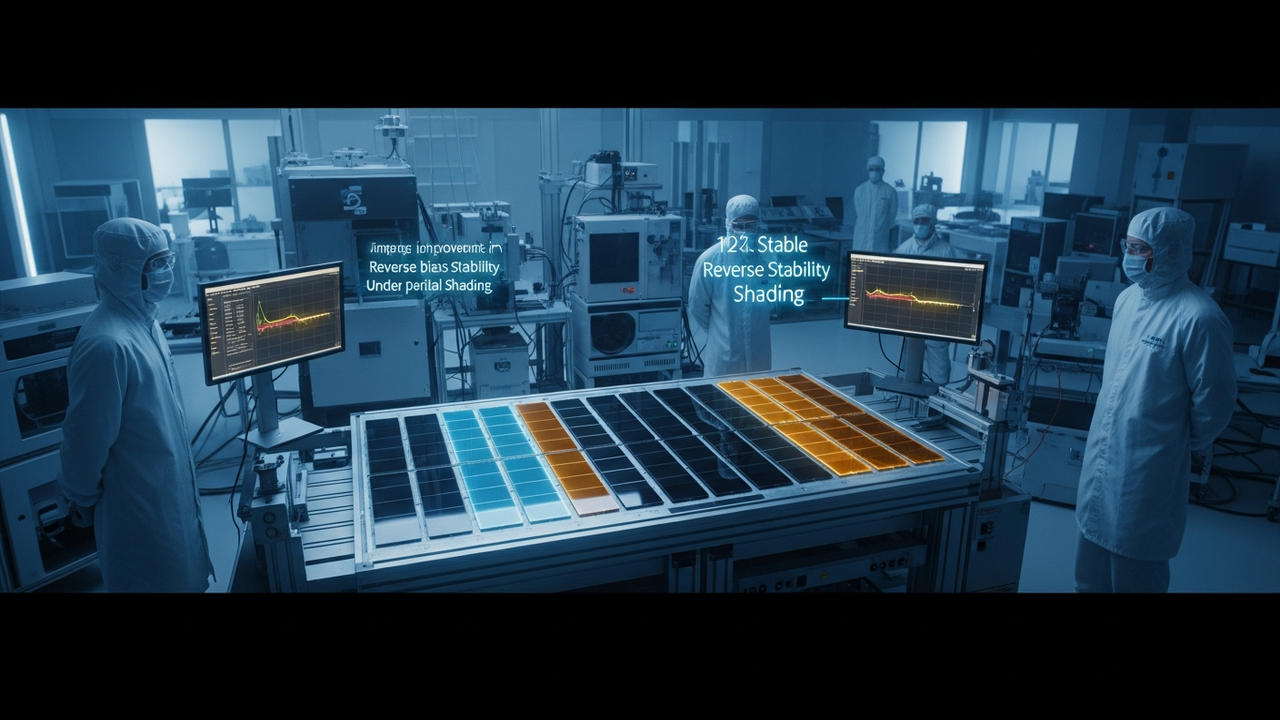
Researchers at Hong Kong Polytechnic University have engineered a perovskite-organic tandem solar cell that achieves dramatically enhanced reverse-bias stability, directly confronting the critical industry challenge of reliability degradation caused by partial shading. The team’s breakthrough was achieved through a meticulous redesign of the interfacial structure between the perovskite and organic layers, coupled with the strategic introduction of novel charge transport layer materials. This optimized architecture effectively stabilized charge flow under reverse-bias conditions, successfully suppressing localized overheating and material degradation within the cell.
Critically, the innovative device showcased exceptional resilience, sustaining over 90% of its initial power conversion efficiency even under an extremely severe -40V reverse-bias stress. Furthermore, it retained a remarkable 97% efficiency after 2,000 hours of continuous operation at a more typical -4.5V reverse bias. This robust performance profoundly enhances the overall durability and reliability of the module, enabling stable and long-term operation in diverse real-world outdoor environments.
This significant advance marks a crucial milestone for the commercialization of perovskite solar cells. By dramatically mitigating the risk of performance loss due to partial shading, this technology opens avenues for deployment in more intricate array configurations and challenging installation sites, including Building-Integrated Photovoltaics (BIPV) and flexible solar cell applications. This achievement represents an indispensable step towards establishing the foundational reliability required for perovskite solar cells to solidify their position as a mainstay in the global clean energy market, potentially offering durability comparable to, or even surpassing, traditional silicon-based photovoltaics.
Get our weekly technology intelligence — free
Receive an infographic that lets you judge at a glance whether each field’s analysis report is worth reading.
Subscribe Free — Weekly Tech Intelligence
By subscribing, you’ll receive Troy-Technical’s weekly technology intelligence newsletter.
- Your email and selected fields are used only to deliver the newsletter.
- We never share your information with third parties.
- You can unsubscribe anytime via the link in each email.
See our Privacy Policy for details.
Takes about a minute · Unsubscribe anytime