Key Findings
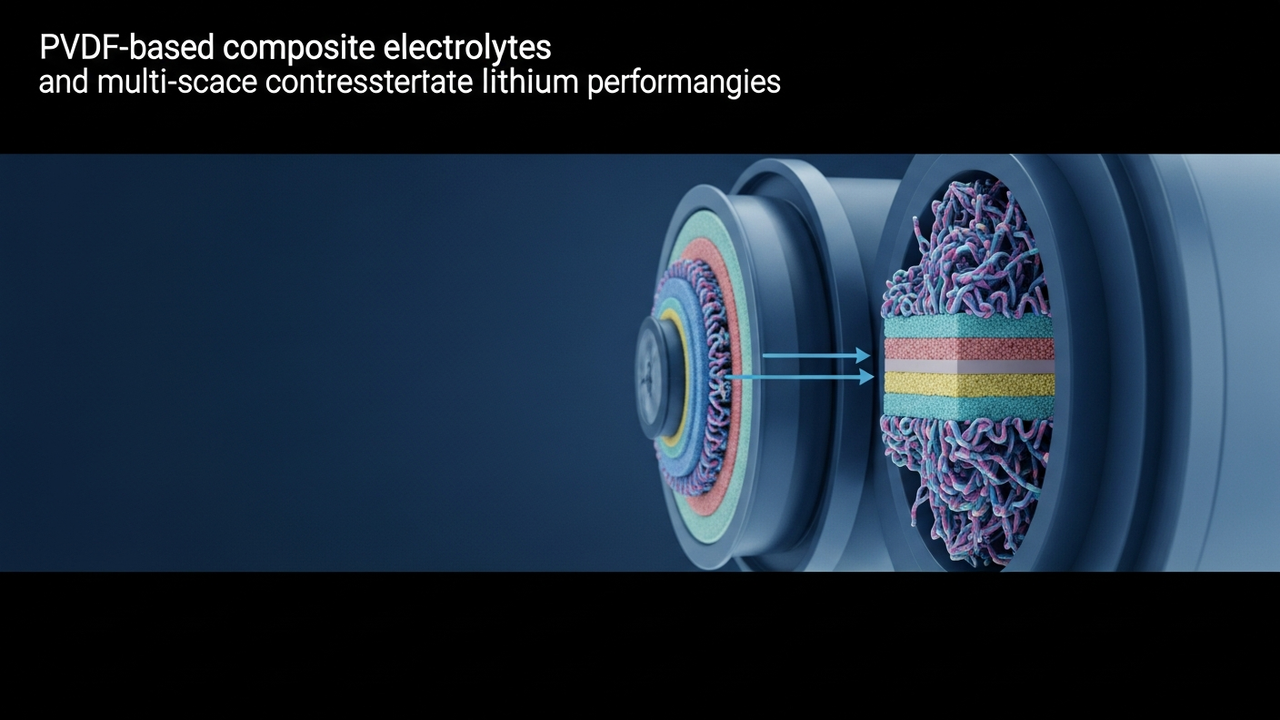
A recent review article published by OAE Publishing focuses on multi-scale interface regulation strategies for polyvinylidene fluoride (PVDF)-based composite electrolytes to significantly improve the performance of all-solid-state lithium batteries. This study systematically analyzes four main approaches—organic polymer modification, inorganic filler incorporation, liquid additive modification, and structural design—detailing how these methods enhance ionic conductivity, mechanical strength, and interfacial compatibility with electrodes. This comprehensive analysis offers crucial guidance for the design and development of next-generation all-solid-state batteries.
Technical and Research Details
- Advantages of PVDF-Based Composite Electrolytes: PVDF is extensively studied as a foundational material for polymer electrolytes due to its excellent mechanical strength, electrochemical stability, and ease of processing. However, its ionic conductivity alone is often insufficient. Hybridization strategies aim to overcome this limitation, leveraging PVDF’s benefits while achieving both high ionic conductivity and high stability.
- Multi-Scale Interface Regulation Strategies: The review discusses four main strategies in detail:
- Organic Polymer Modification: Blending or grafting PVDF with other polymers enhances the segmental motion of polymer chains, thereby facilitating lithium ion transport.
- Inorganic Filler Incorporation: Dispersing inorganic ceramic fillers such as garnet-type oxides (LLZO), NASICON-type materials (LLZTO), or sulfides (LPS) into the PVDF matrix. These fillers can create lithium ion conduction pathways, reduce polymer crystallinity, or lower interfacial impedance with electrodes. Incorporating inorganic fillers significantly improves ionic conductivity while maintaining the electrolyte’s mechanical stability.
- Liquid Additive Modification: Introducing small amounts of liquid additives, such as ionic liquids or plasticizers, enhances the flexibility of the polymer matrix and improves ionic conductivity.
- Structural Design: Morphological designs, including porous structures, layered structures, or nanofiber networks, are employed to optimize interfacial contact and ion transport efficiency within the electrolyte.
- Overcoming Single-Component Electrolyte Limitations: Composite solid electrolytes, by embedding inorganic ceramic fillers into a polymer matrix, can combine the advantages of both inorganic solid electrolytes (high ionic conductivity) and polymer electrolytes (flexibility and interfacial compatibility). This enables a performance balance that is difficult to achieve with single-component electrolytes.
Background and Industry Context
All-solid-state lithium batteries are considered the most promising candidates for electric vehicles (EVs) and next-generation electronic devices, offering advantages over conventional liquid-electrolyte lithium-ion batteries in terms of safety, energy density, and lifespan. However, the ionic conductivity of solid electrolytes, poor interfacial contact with electrodes, mechanical properties, and manufacturing costs have been major hurdles to their practical implementation. This review on PVDF-based composite electrolytes presents multi-faceted solutions to these challenges, emphasizing the importance of interface regulation, thereby providing fundamental insights to accelerate the commercialization of all-solid-state batteries.
Future Outlook
This review on multi-scale interface regulation for PVDF-based composite electrolytes clearly outlines directions for future research and development. In particular, breakthroughs are needed to further improve the chemical and mechanical stability of interfaces and ensure long-term compatibility with high-voltage cathodes and lithium metal anodes. The development of cost-effective, large-scale manufacturing techniques for these composite electrolytes will also be a critical challenge for commercialization. The insights from this review are expected to help all-solid-state batteries maximize their potential in a wide range of applications and shape the future of sustainable energy storage technologies.
Source: https://www.oaepublish.com/articles/energymater.2026.80
Get our weekly technology intelligence — free
Receive an infographic that lets you judge at a glance whether each field’s analysis report is worth reading.
Subscribe Free — Weekly Tech Intelligence
By subscribing, you’ll receive Troy-Technical’s weekly technology intelligence newsletter.
- Your email and selected fields are used only to deliver the newsletter.
- We never share your information with third parties.
- You can unsubscribe anytime via the link in each email.
See our Privacy Policy for details.
Takes about a minute · Unsubscribe anytime