Key Findings
Nanoparticle-based drug delivery systems (DDS) have seen considerable advancements, enabling controlled drug release and targeted tissue accumulation. However, a critical bottleneck in their translation to clinical success has been the limited predictive power of traditional preclinical evaluation methods. A novel and highly promising solution is emerging: the integration of nanoparticles with organ-on-a-chip platforms, which seamlessly bridges materials science with microphysiological engineering. This synergistic approach aims to more accurately mimic the dynamic complexity of human biology, thereby reducing reliance on animal models and establishing a far more predictive framework for next-generation DDS development.
Technical / Clinical Details
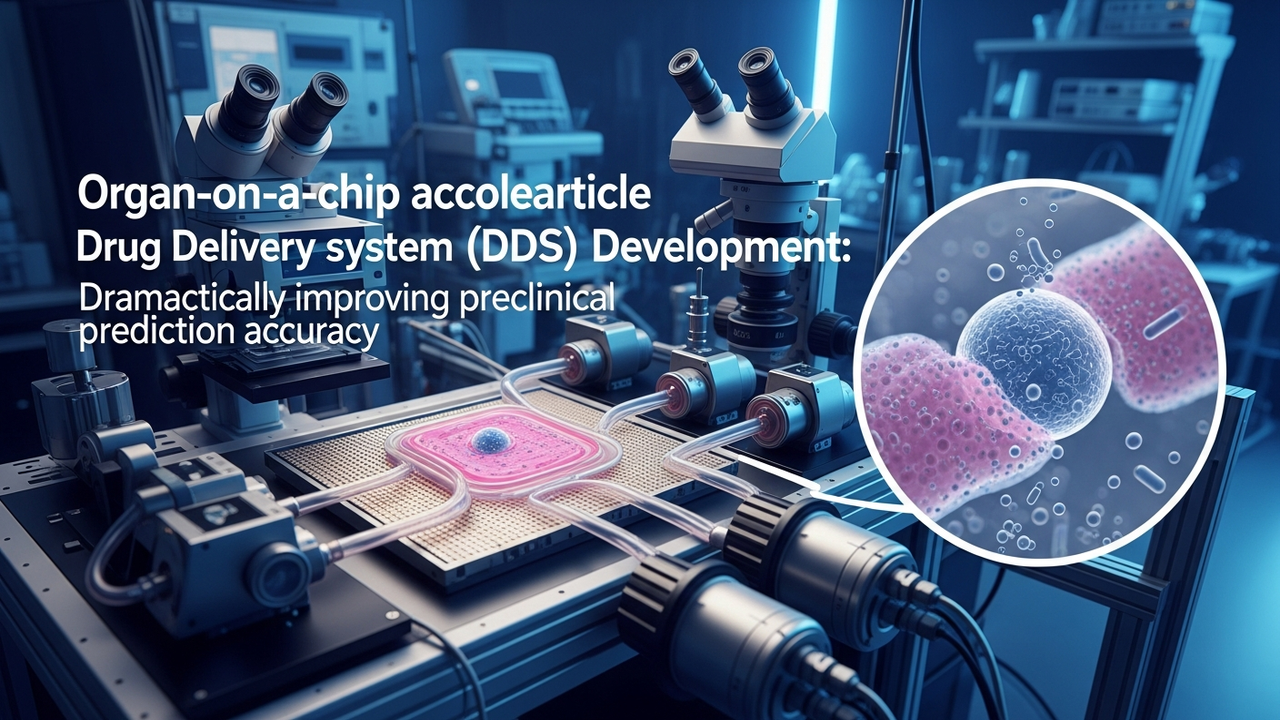
Organ-on-a-chip systems are microfluidic devices that recapitulate the cellular architecture and physiological functions of human organs, incorporating essential features like tissue interfaces, fluid flow, and mechanical stimuli. By integrating nanoparticles into these platforms—for instance, within blood-brain barrier-on-a-chip models, liver-on-a-chip systems, or lung-on-a-chip models—researchers can precisely study nanoparticle permeability, cellular uptake, toxicity, and drug release kinetics in a human-relevant context. This allows for early and efficient evaluation and optimization of DDS, addressing challenges such as the predominant hepatic accumulation of conventional LNPs or inefficient delivery to specific extrahepatic organs. The ability to precisely control the microenvironment, including flow rates, shear stress, and nutrient gradients, provides unprecedented insights into the pharmacokinetics and pharmacodynamics of nanomedicines. This approach is instrumental in screening drug candidates, assessing toxicology, and advancing personalized medicine applications of DDS, offering a significant leap beyond static 2D cell cultures or often non-predictive animal models.
Background & Context
Nanoparticle DDS hold immense promise for various therapeutic areas, including cancer treatment (e.g., nanodrugs exploiting the EPR effect), gene therapy (e.g., LNP-mediated mRNA delivery), and neurological disorders (e.g., BBB penetration strategies). However, animal models often fail to accurately replicate human physiological responses, leading to a high attrition rate of promising DDS candidates in human clinical trials. This translational gap has driven the demand for more human-relevant in vitro models. Organ-on-a-chip technology, propelled by advancements in microfluidics, cell biology, and materials science, has rapidly evolved to meet this need. The fusion of nanoparticles with organ-on-a-chip systems not only reduces the cost and time of drug discovery but also addresses ethical concerns related to animal experimentation, aligning with the 3Rs principles (Replace, Reduce, Refine).
Strategic Significance & Outlook
The integration of organ-on-a-chip technology with nanoparticles represents a major paradigm shift in next-generation DDS development. Moving forward, these platforms will be indispensable tools for researching precise extrahepatic LNP targeting, mucosal delivery, and bio-inspired systems like cell membrane-coated nanoparticles. The development of multi-organ-on-a-chip systems (human-on-a-chip) will enable a more comprehensive assessment of systemic pharmacokinetics and inter-organ interactions. The maturation of this technology is expected to significantly increase the success rate of new nanoparticle DDS in clinical trials, leading to safer and more effective treatments for patients. The pharmaceutical industry is poised to accelerate investment in these highly predictive platforms, improving the efficiency and reliability of drug discovery and delivering innovative therapies to patients globally at a faster pace.
Get our weekly technology intelligence — free
Receive an infographic that lets you judge at a glance whether each field’s analysis report is worth reading.
Subscribe Free — Weekly Tech Intelligence
By subscribing, you’ll receive Troy-Technical’s weekly technology intelligence newsletter.
- Your email and selected fields are used only to deliver the newsletter.
- We never share your information with third parties.
- You can unsubscribe anytime via the link in each email.
See our Privacy Policy for details.
Takes about a minute · Unsubscribe anytime