Key Findings
Organ-on-chip (OoC) technology holds immense potential to bring about revolutionary advancements in nanoparticle-based drug development. By replicating the complex human physiological environment, which has been challenging to reproduce in traditional animal or in vitro models, OoC systems—comprising human cells within microfluidic channels—enable more accurate assessment of drug pharmacokinetics and pharmacodynamics at the nano-bio interface. This is expected to allow more efficient validation of improved drug release, reduced toxicity, and enhanced targeting for nanoparticle therapeutics, thereby accelerating the development process.
Technical and Development Details
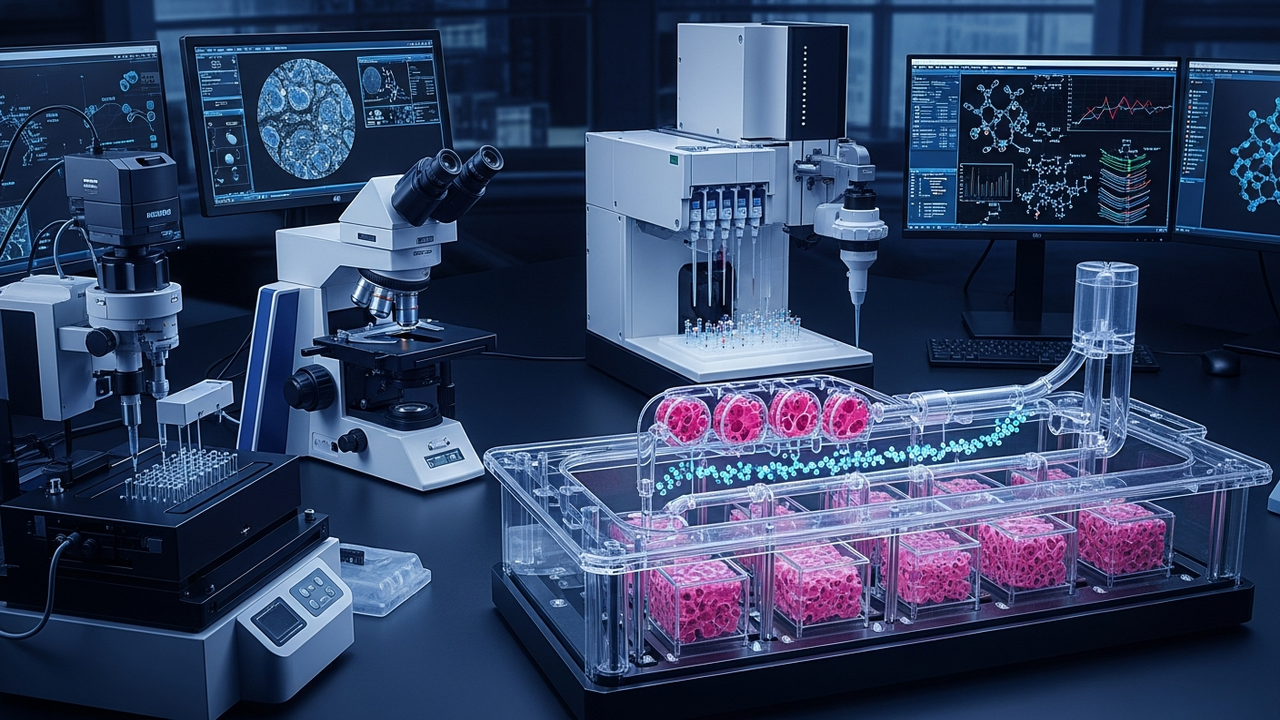
- How Organ-on-Chip Works: OoC devices are micro-scale platforms designed to mimic the minimal functional units of biological tissues or organs. Microfluidic channels and chambers are constructed on silicon or polymer chips, within which specific human cells (e.g., lung, liver, intestinal cells) are cultured. These cells are supplied with nutrients via microfluidic flow that mimics blood circulation or tissue fluid dynamics, allowing them to function in a physiologically relevant environment. By linking multiple organ models, systemic interactions can also be reproduced.
- Application to Nanomedicine Development:
- Pharmacokinetic Assessment: OoC can evaluate the absorption, distribution, metabolism, and excretion (ADME) profiles of nanoparticles under more human-like conditions. This allows detailed analysis of nanoparticle blood circulation half-life, accumulation in target organs, and distribution to non-target organs.
- Improved Toxicity Evaluation Accuracy: OoC enables highly sensitive and precise evaluation of the toxic effects of nanoparticles on specific organ cells. With greater human translatability than traditional animal experiments, it can reduce the risk of unexpected toxicity in clinical trials.
- Targeting Optimization: OoC allows systematic study of how nanoparticle surface modifications, size, and shape influence targeting efficiency to specific cells or tissues. This facilitates the design of more effective and less toxic nano-drugs.
- Modeling Biological Barriers: Key biological barriers that impede drug delivery, such as the blood-brain barrier and intestinal barrier, can be recreated on OoC to evaluate how efficiently nanoparticles traverse these obstacles.
Background and Industry Context
Nanoparticle-based drug delivery systems hold significant promise across many medical fields, including cancer therapy, infectious diseases, and gene therapy, due to their high targeting capabilities and potential for reducing side effects. However, in vitro cell cultures and animal models often fail to fully reproduce the complexities of human physiology (e.g., immune responses, hemodynamics, cell-to-cell interactions), leading to numerous promising nanodrugs failing during clinical development. OoC technology has the potential to overcome this “translation barrier” and dramatically increase the accuracy of preclinical drug evaluation, thereby reducing the time and cost of new drug development.
Future Outlook
While OoC technology is still in its early stages of development, its potential is enormous. Future advancements will likely include the development of multi-organ chips capable of reproducing even more complex physiological functions, and the integration with AI and machine learning for advanced data analysis. This is expected to create a more seamless bridge from in silico design of nanoparticle drugs to rapid validation on OoC and subsequent clinical trials. OoC holds the potential to become a new ethical and efficient standard in broad drug development processes, not just nanomedicine, and will be an indispensable tool for realizing personalized medicine.
Get our weekly technology intelligence — free
Receive an infographic that lets you judge at a glance whether each field’s analysis report is worth reading.
Subscribe Free — Weekly Tech Intelligence
By subscribing, you’ll receive Troy-Technical’s weekly technology intelligence newsletter.
- Your email and selected fields are used only to deliver the newsletter.
- We never share your information with third parties.
- You can unsubscribe anytime via the link in each email.
See our Privacy Policy for details.
Takes about a minute · Unsubscribe anytime