Key Findings
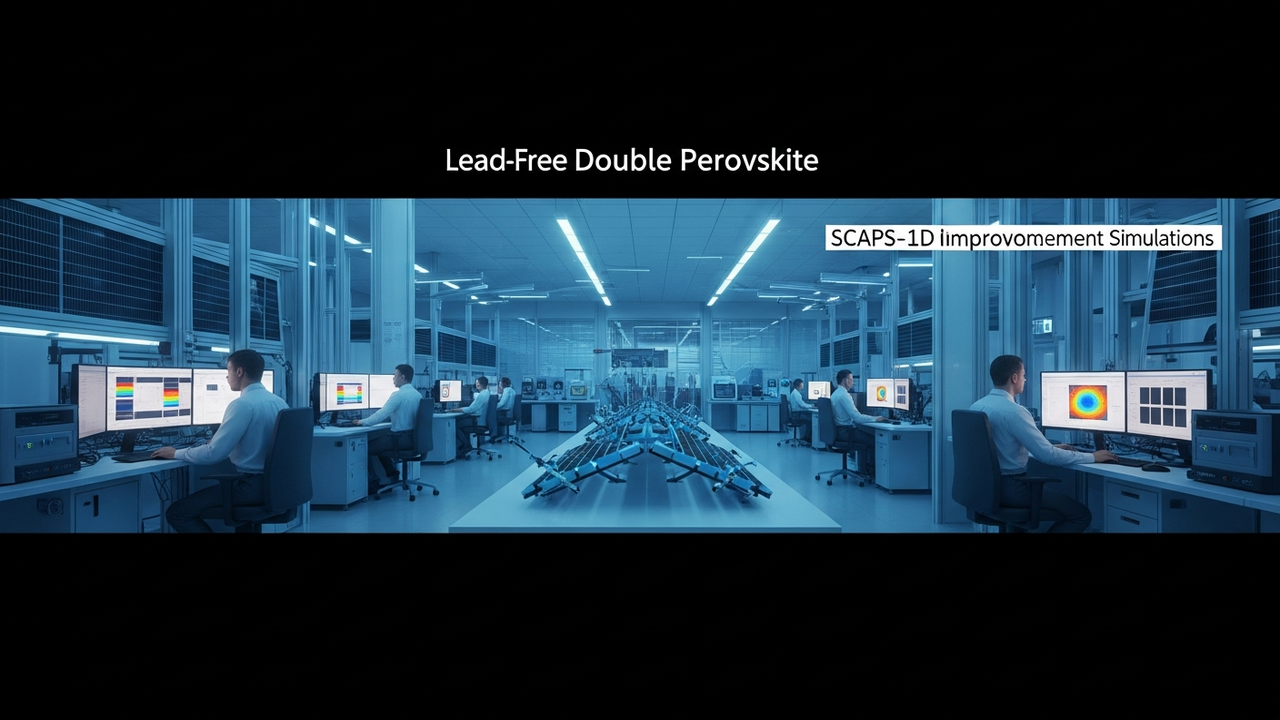
According to a preprint published on arXiv, a performance analysis of lead-free double perovskite solar cells was conducted using SCAPS-1D simulation, with the results outlined. This research highlighted the advantages of lead-free perovskites, including their low toxicity, inherent stability, and high photoelectric potential, while simultaneously exposing the primary challenge of currently lower power conversion efficiencies compared to lead-based perovskites at the experimental stage.
Technical / Clinical Details
- SCAPS-1D (Solar Cell Capacitance Simulator in 1 Dimension) is a powerful tool for modeling the electrical characteristics of solar cells. This simulation method allows for a detailed analysis of how different material compositions, layer thicknesses, doping concentrations, and defect densities impact device performance.
- The study specifically evaluated how the bandgap, charge carrier transport properties, and interface characteristics of lead-free double perovskite materials influence the overall efficiency of the device. The simulations suggest potential pathways for improving efficiency through the optimization of specific material parameters.
- While lead-free perovskites are promising as environmentally friendly alternatives, they currently do not match the high efficiencies exceeding 25% achieved by lead-based perovskites. The simulation aids in identifying structural and material improvements needed to close this efficiency gap.
Background & Context
Perovskite solar cells are garnering attention as a next-generation photovoltaic technology due to their high power conversion efficiency. However, the toxicity of lead, a primary constituent, raises environmental and health concerns. Therefore, the development of lead-free perovskites is a crucial research direction to ensure the technology’s practical application and sustainability. Nevertheless, lead-free materials generally exhibit lower efficiencies, necessitating new design and material science approaches to overcome this challenge. Simulation tools like SCAPS-1D are indispensable for reducing experimental trial-and-error and accelerating the development process.
Strategic Significance & Outlook
This simulation-based performance analysis provides a roadmap for improving the efficiency of lead-free double perovskite solar cells. By leveraging a cost-effective simulation approach, researchers can rapidly evaluate the impact of new device architectures and material modifications prior to physical synthesis and testing in the laboratory. This is expected to shorten development cycles and efficiently identify and overcome technological barriers towards the commercialization of lead-free perovskites. In the long term, this will significantly contribute to the realization of environmentally friendly and highly efficient next-generation solar cells, fostering sustainable energy solutions globally.
Get our weekly technology intelligence — free
Receive an infographic that lets you judge at a glance whether each field’s analysis report is worth reading.
Subscribe Free — Weekly Tech Intelligence
By subscribing, you’ll receive Troy-Technical’s weekly technology intelligence newsletter.
- Your email and selected fields are used only to deliver the newsletter.
- We never share your information with third parties.
- You can unsubscribe anytime via the link in each email.
See our Privacy Policy for details.
Takes about a minute · Unsubscribe anytime