Key Findings
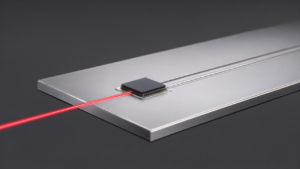
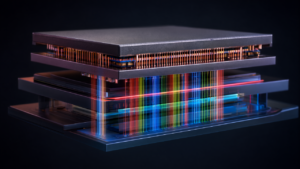
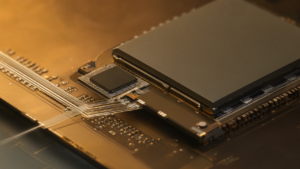
A team of scientists has developed an innovative photonic chip equipped with a ‘quad-lane optical highway,’ capable of simultaneously transmitting four independent optical signals through parallel waveguides on a single chip. This new technology successfully achieves a dramatic increase in data capacity while significantly reducing both energy consumption and signal interference during information transmission.
Technical / Clinical Details
The core of this photonic chip lies in its design of multiple parallel waveguides. While traditional optical communication often relies on single optical paths or uses Wavelength Division Multiplexing (WDM) to multiplex multiple signals at different wavelengths, this ‘quad-lane optical highway’ physically arranges four independent optical waveguides in parallel. By transmitting different optical signals through each lane, it effectively quadruples data processing capability. Optical signals inherently offer higher speeds, lower heat generation, and less susceptibility to electromagnetic interference compared to electrical signals. This parallel processing approach increases the amount of information transferable per unit time while minimizing crosstalk between signals. Furthermore, chip-level integration contributes to a smaller overall system footprint and reductions in manufacturing costs and power consumption.
Background & Context
Modern information society faces an explosive increase in data volume, demanding ever-greater capacity and speed from data centers, AI computing, and high-speed internet communication infrastructures. Conventional electronic circuits have been challenged by physical limitations and increasing power consumption. Optical communication technologies, particularly silicon photonics, are actively researched and developed as key solutions to these challenges. This ‘quad-lane optical highway’ represents a groundbreaking advancement in directly increasing data capacity, expected to alleviate interconnect bottlenecks in AI workloads and strengthen the foundation for next-generation communication networks like 5G/6G.
Strategic Significance & Outlook
This novel photonic chip has the potential to bring revolutionary speed and efficiency to internal data center communications, interconnects between AI processors, and endpoint devices in optical fiber networks. Key challenges moving forward will include further increasing integration density, establishing mass production processes, and ensuring compatibility with existing network infrastructure. If commercialized, this technology is expected to accelerate the realization of various applications such as improved cloud computing performance, enhanced real-time processing capabilities for autonomous driving, and high-speed delivery of virtual reality/augmented reality (VR/AR) content, thereby enriching our digital lives.
Source: https://www.facebook.com/groups/1095219274973573/posts/1804824587346368/
Get our weekly technology intelligence — free
Receive an infographic that lets you judge at a glance whether each field’s analysis report is worth reading.
Subscribe Free — Weekly Tech Intelligence
By subscribing, you’ll receive Troy-Technical’s weekly technology intelligence newsletter.
- Your email and selected fields are used only to deliver the newsletter.
- We never share your information with third parties.
- You can unsubscribe anytime via the link in each email.
See our Privacy Policy for details.
Takes about a minute · Unsubscribe anytime