Key Findings
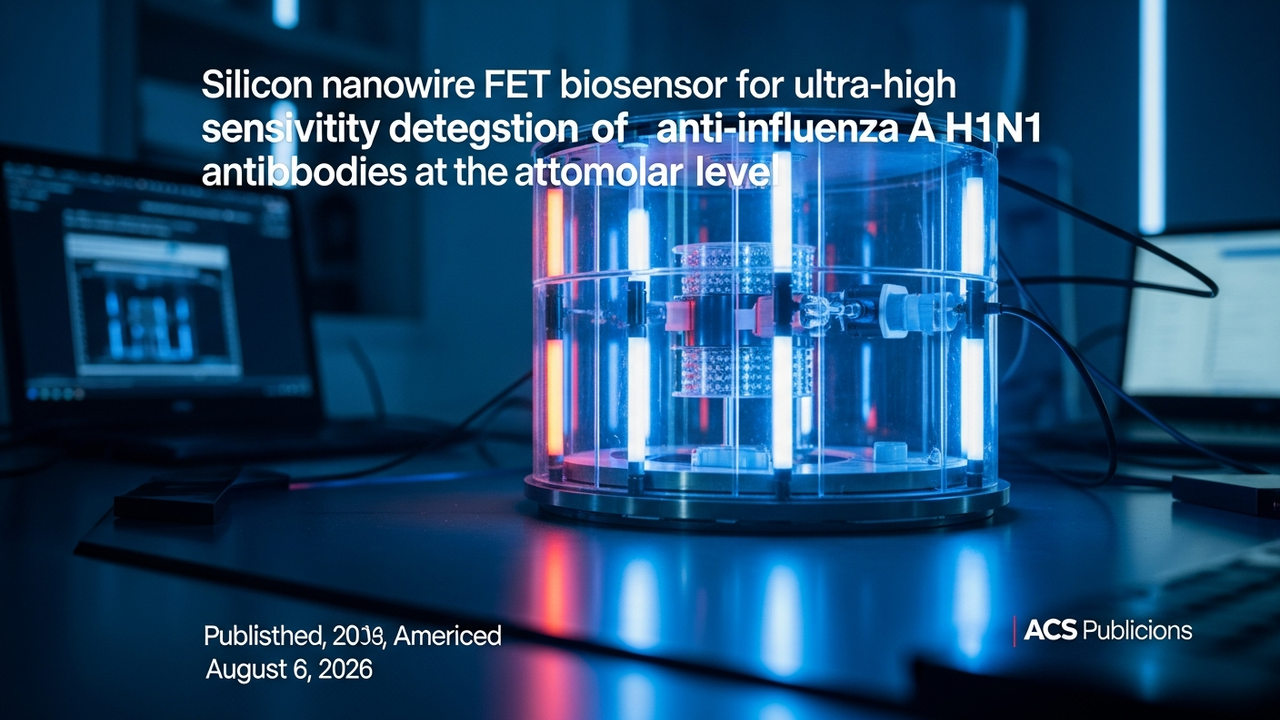
Silicon nanowire (SiNW) Field Effect Transistor (FET) biosensors have demonstrated unprecedented ultrasensitive and specific detection of anti-influenza A H1N1 hemagglutinin monoclonal antibody at an astonishingly low concentration of 1 attomolar (aM). This innovative sensor, owing to its high surface-to-volume ratio and precise surface functionalization, is capable of detecting influenza A virus particles at 5 × 10^4 particles/mL and H5N2 influenza virus at 10^4 viruses/mL (approximately 16 aM). This achievement marks a significant advancement in the fields of ultra-early infection detection, pandemic control, and monitoring immune responses post-vaccination.
Technical and Clinical Details
SiNW FET biosensors function by immobilizing bioreceptors (in this case, antibodies) onto the surface of semiconductor silicon nanowires. When target molecules (influenza virus antibodies or virus particles) bind to these bioreceptors, they induce changes in the nanowire’s surface potential or conductivity, which are then detected as electrical signals. The nanometer-scale diameter of SiNWs provides an extremely large surface-to-volume ratio, allowing for high sensitivity even to trace amounts of target molecules. In this study, the nanowire surface was modified using an amine-functionalized self-assembled monolayer (SAM) and a thiol cross-linker, followed by H1N1 hemagglutinin immobilization, to achieve high specificity and sensitivity for anti-H1N1 antibodies. Furthermore, blocking with bovine serum albumin (BSA) minimized non-specific adsorption. This sensor enables rapid and straightforward real-time detection compared to conventional PCR or ELISA methods, making it ideal for point-of-care (POC) diagnostics in the field. For instance, it has the potential for high-sensitivity, non-invasive tracking of low viral loads in the early stages of infection or dynamic changes in antibody levels after vaccination.
Background and Industry Context
Early detection of infectious diseases like influenza is critically important for preventing disease spread and enabling prompt therapeutic intervention. Particularly during novel influenza outbreaks or pandemics, rapid and highly sensitive diagnostic technologies are key to effective public health measures. Traditional viral detection methods have faced challenges including invasive sample collection, lengthy testing times, and the need for specialized equipment and personnel. Ultrasensitive and portable technologies like SiNW FET biosensors address these issues, improving healthcare access by enabling advanced diagnostics even in resource-limited settings. Furthermore, accurate monitoring of antibody responses after vaccination or immunotherapy provides crucial information for evaluating an individual’s immune status and determining optimal re-vaccination timing.
Strategic Significance and Outlook
SiNW FET biosensor technology is expected to expand beyond influenza to the highly sensitive detection of other diverse viruses and bacteria, as well as cancer biomarkers. In the future, it may evolve into multiplexed sensors capable of simultaneously detecting multiple pathogens or biomarkers, providing more comprehensive diagnostic information. Integration with wearable devices and smartphones could lead to ‘personal health guard’ systems, allowing individuals to easily monitor their health status and infection risk at home. For commercialization, scalability of manufacturing processes, long-term device stability, biocompatibility, and clinical validation through rigorous trials are indispensable. Overcoming these challenges will position SiNW FET biosensors to play a central role at the forefront of infectious disease control and personalized medicine.
Source: https://pubs.acs.org/aabmcb/article/8/2/1038/3750785/Ultrasensitive-Specific-Detection-of-Anti
Get our weekly technology intelligence — free
Receive an infographic that lets you judge at a glance whether each field’s analysis report is worth reading.
Subscribe Free — Weekly Tech Intelligence
By subscribing, you’ll receive Troy-Technical’s weekly technology intelligence newsletter.
- Your email and selected fields are used only to deliver the newsletter.
- We never share your information with third parties.
- You can unsubscribe anytime via the link in each email.
See our Privacy Policy for details.
Takes about a minute · Unsubscribe anytime