Key Findings
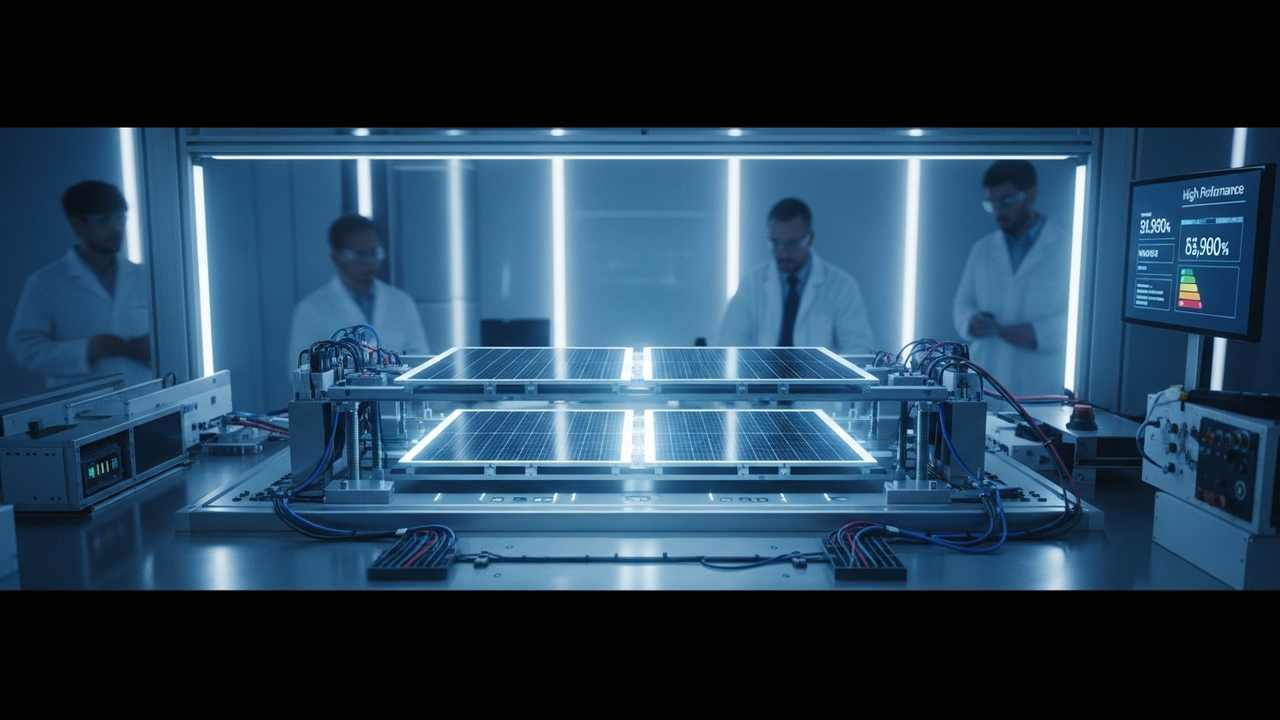
Trina Solar has achieved a new world record with its perovskite-crystalline silicon tandem module, demonstrating an astonishing 29.2% full-area conversion efficiency and a peak power output of 907 watts. This groundbreaking achievement has been independently verified by the internationally recognized certification body TÜV SÜD, ensuring its credibility and robust measurement. Such high performance for a commercial solar module is unprecedented and marks a significant step towards the realization of next-generation solar cell technology.
Technical Details
The record-breaking tandem module employs a sophisticated architecture, featuring a high-performance perovskite solar cell as the top layer and a well-established crystalline silicon solar cell as the bottom layer. The perovskite layer efficiently absorbs high-energy photons in the blue region of the spectrum, while the underlying silicon layer effectively captures transmitted lower-energy red and near-infrared light. This tandem configuration inherently allows for the conversion of a broader spectrum of sunlight into electricity compared to conventional single-junction solar cells. Trina Solar achieved this by optimizing its proprietary process and material development, meticulously maximizing overall module efficiency while also integrating considerations for long-term stability into its design.
Background & Context
The global solar photovoltaic industry faces continuous pressure to enhance efficiency and reduce costs, driven by urgent climate change mitigation goals and increasing energy security concerns. While crystalline silicon solar cells represent a mature and dominant technology, their theoretical efficiency is approaching inherent physical limits. Perovskite tandem technology is widely regarded as the most promising candidate to surpass these limitations, leading to intense development competition among research institutions and corporations worldwide. Trina Solar’s latest record clearly signifies a crucial transition from laboratory-scale achievements to the module level, signaling that commercialization is becoming a tangible and imminent reality.
Strategic Significance & Outlook
While Trina Solar’s record powerfully showcases the profound commercial potential of perovskite tandem technology, several critical challenges must be addressed for its widespread market adoption. Beyond achieving high efficiency, indispensable factors include demonstrating robust long-term durability (ideally exceeding 25 years), stabilizing manufacturing yield at gigawatt-scale production, and achieving cost competitiveness on par with or even below existing crystalline silicon panels. Furthermore, navigating and addressing environmental regulations pertaining to the use of lead-containing materials remains a crucial consideration. Successfully overcoming these multifaceted hurdles could enable perovskite tandem modules to catalyze a significant transformation in the global solar power market within the coming years.
Get our weekly technology intelligence — free
Receive an infographic that lets you judge at a glance whether each field’s analysis report is worth reading.
Subscribe Free — Weekly Tech Intelligence
By subscribing, you’ll receive Troy-Technical’s weekly technology intelligence newsletter.
- Your email and selected fields are used only to deliver the newsletter.
- We never share your information with third parties.
- You can unsubscribe anytime via the link in each email.
See our Privacy Policy for details.
Takes about a minute · Unsubscribe anytime