Key Findings
Enzyme engineering is undergoing a significant transformation from classical methods to AI-driven biocatalyst design. Advances in high-throughput sequencing, computational modeling, and machine learning have dramatically improved the ability to predictively explore enzyme sequence-structure-function relationships, enabling the rapid design of novel enzymes tailored to specific industrial needs.
Technical / Clinical Details
This review details the specific impacts of AI on enzyme engineering:
- **High-Throughput Sequencing and Data-Driven Approaches**: The development of next-generation sequencing technologies generates vast amounts of enzyme gene sequence data. Machine learning models can analyze this data to predictively identify enzymes with specific functions.
- **Structure Prediction and Molecular Dynamics Simulations**: AI-based protein structure prediction tools (ee.g., AlphaFold) predict highly accurate 3D structures from unknown sequences, identifying enzymatic active sites and substrate binding pockets. Combining this with molecular dynamics simulations allows for understanding enzyme catalytic mechanisms at the atomic level and incorporating this into design.
- **Novel Enzyme Design via Generative AI Models**: Generative AI models, such as Large Language Models (LLMs) and Variational Autoencoders (VAEs), learn from existing enzyme data to ‘generate’ enzymes with entirely new sequences. These novel enzymes are designed to possess high specificity, stability, and efficiency for particular chemical reactions, optimized for a wide range of industrial applications.
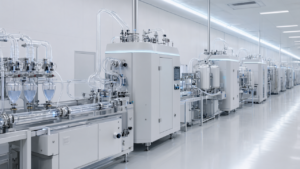
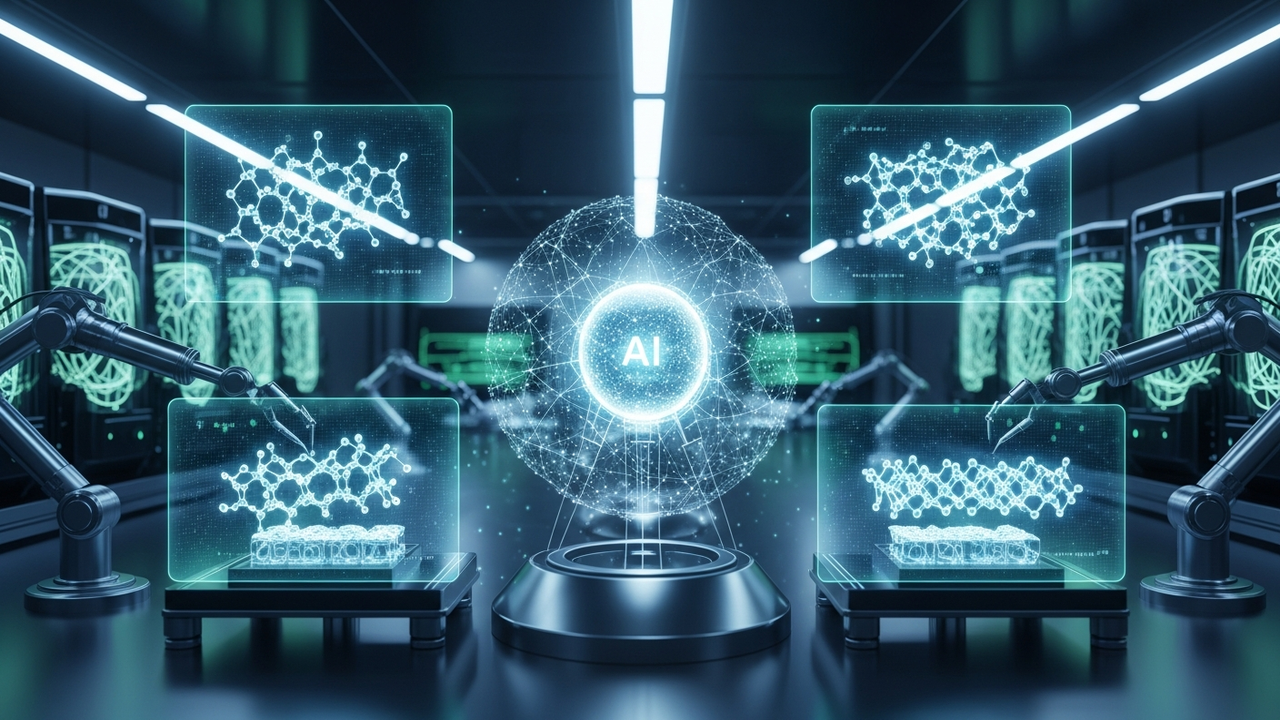
- **Automation of DBTL Cycles**: Combining AI with the automation of Design-Build-Test-Learn (DBTL) cycles (e.g., high-throughput screening using robotics and synthetic biology platforms) creates a closed-loop system where the entire process from enzyme design to evaluation and learning is efficiently iterated, rapidly discovering optimized biocatalysts.
These technological advancements are crucial for reducing production costs, greening processes, and developing new bio-based products in biomanufacturing.
Background & Context
Enzymes are utilized as biocatalysts in various industries, including chemical, pharmaceutical, food, and biofuel, with their efficiency and specificity directly impacting product costs and quality. Traditional enzyme engineering primarily relied on trial-and-error approaches like random mutagenesis and site-directed mutagenesis, making development time-consuming and laborious. However, the advent of AI and machine learning has transformed these processes into data-driven and predictive ones. This has enabled the more rapid and efficient design of enzymes that match specific industrial needs (e.g., high thermal stability, high activity at specific pH, novel substrate specificity).
Strategic Significance & Outlook
Advances in AI-driven enzyme engineering will bring groundbreaking progress in biocatalyst design and application, ushering in a new golden age of biomanufacturing. New enzyme solutions are expected to contribute to solving global challenges, such as the sustainable production of chemicals, degradation of recalcitrant waste, and efficient biofuel manufacturing. In the future, systems like ‘smart enzyme factories’ where AI autonomously designs and optimizes enzymes are also envisioned. Investors and industries are focusing on the enormous market opportunities created by this technological innovation and the generation of high-value products with reduced environmental impact, anticipating further acceleration in the convergence of AI and biotechnology.
Get our weekly technology intelligence — free
Receive an infographic that lets you judge at a glance whether each field’s analysis report is worth reading.
Subscribe Free — Weekly Tech Intelligence
By subscribing, you’ll receive Troy-Technical’s weekly technology intelligence newsletter.
- Your email and selected fields are used only to deliver the newsletter.
- We never share your information with third parties.
- You can unsubscribe anytime via the link in each email.
See our Privacy Policy for details.
Takes about a minute · Unsubscribe anytime