Background
Perovskite solar cells (PSCs) continue to garner significant attention as a next-generation photovoltaic technology, owing to their remarkable high-efficiency potential and cost-effective manufacturing prospects. However, their widespread commercialization has been significantly hampered by persistent challenges with long-term stability, primarily their susceptibility to environmental factors such as humidity, oxygen, heat, and light. A critical source of this instability lies in the intrinsic degradation mechanisms at the device interfaces, particularly concerning defect formation and charge recombination at the buried interfaces between the perovskite and charge transport layers.
Addressing these fundamental barriers, a collaborative research endeavor involving scientists from Kaunas University of Technology (KTU) and their Chinese partners has made a pivotal advancement. This interdisciplinary international collaboration underscores the complex, multifaceted nature of these challenges, which necessitate diverse expertise to overcome.
Key Findings
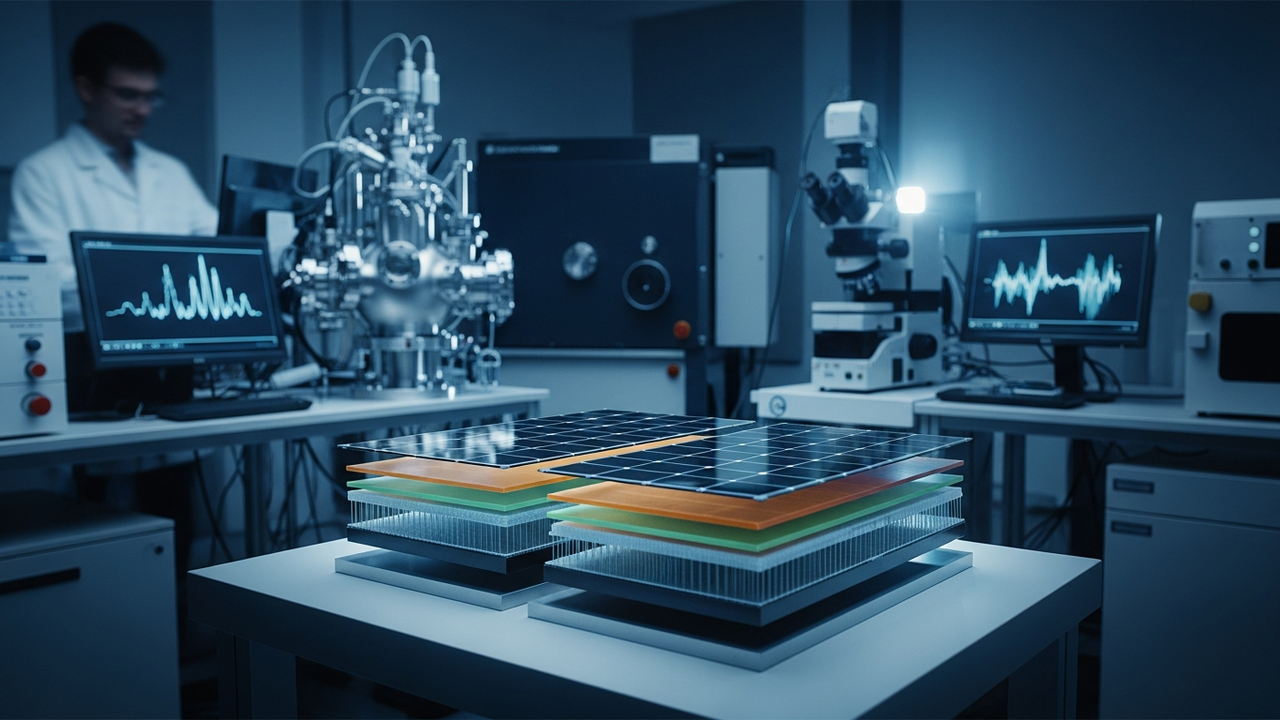
The KTU-led team has engineered a stable interfacial engineering strategy that effectively mitigates the primary cause of intrinsic device degradation. This novel interface technology precisely optimizes contact between the perovskite layer and adjacent functional layers, facilitating highly efficient charge carrier transport. Crucially, it simultaneously passivates defect sites, thereby suppressing non-radiative recombination and minimizing power losses within the device. Additionally, the enhanced interface serves as a robust barrier against deleterious ion migration, a key contributor to perovskite instability, fundamentally improving the device’s structural and chemical integrity over extended operational periods.
- Record Efficiency in Tandem Devices: This advanced interfacial design has enabled the creation of perovskite tandem solar cells boasting over 29% power conversion efficiency (PCE). This achievement significantly surpasses the practical efficiency limits of conventional single-junction silicon solar cells, underscoring the formidable potential of perovskite technology as a high-performance alternative.
- Scalability for Industrial Application: A critical aspect of this new methodology is its proven capability to facilitate uniform and high-quality layer deposition on large-area modules. This is a crucial step for transitioning laboratory successes to industrial-scale commercial production, ensuring high yields and consistent reliability in manufacturing processes.
These findings are poised to significantly accelerate the commercialization of perovskite solar cells. By directly addressing the root causes of degradation and demonstrating large-area uniformity, the research reduces manufacturing complexities and enhances product reliability. The stable interface technology is now anticipated for implementation in large-scale production lines and will undergo rigorous long-term validation under real-world outdoor conditions. This progress is vital for positioning perovskite solar cells as a more durable, higher-performance solution, essential for meeting global renewable energy demands and targets.
Get our weekly technology intelligence — free
Receive an infographic that lets you judge at a glance whether each field’s analysis report is worth reading.
Subscribe Free — Weekly Tech Intelligence
By subscribing, you’ll receive Troy-Technical’s weekly technology intelligence newsletter.
- Your email and selected fields are used only to deliver the newsletter.
- We never share your information with third parties.
- You can unsubscribe anytime via the link in each email.
See our Privacy Policy for details.
Takes about a minute · Unsubscribe anytime