Key Findings
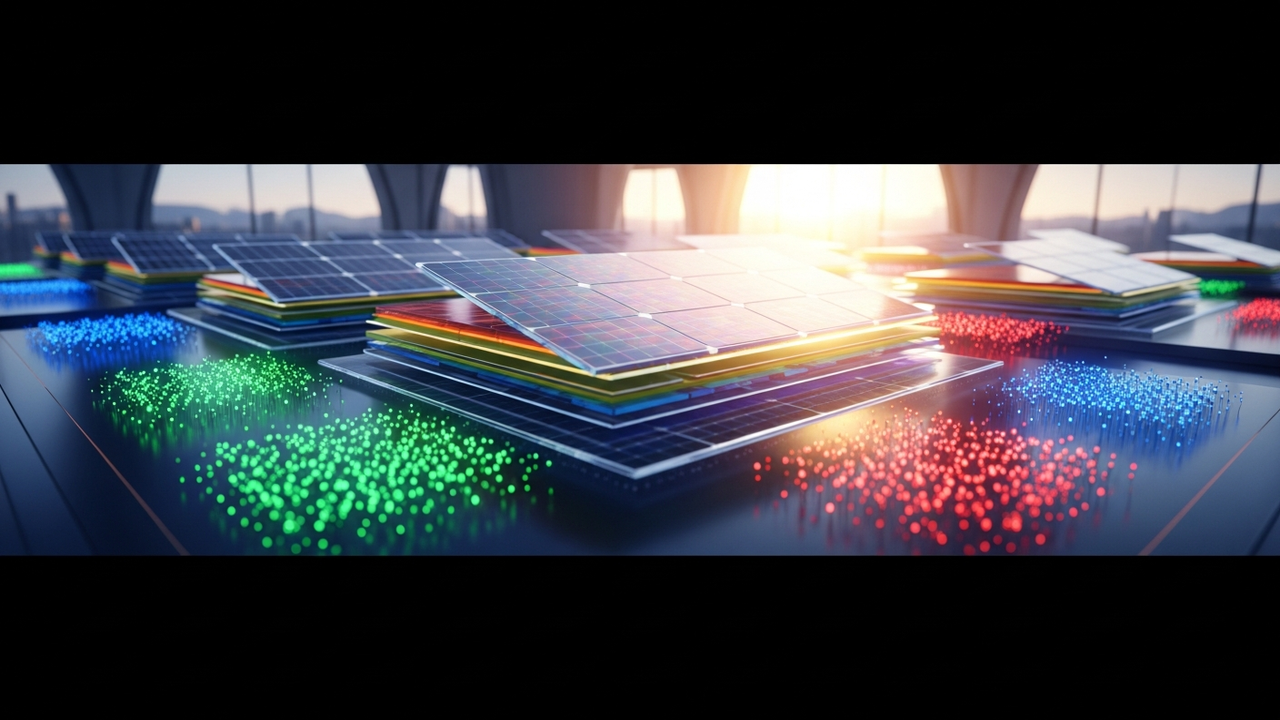
Perovskite-silicon tandem solar cells are widely considered the most likely and impactful near-term upgrade for existing solar technology. By stacking a thin perovskite layer on top of conventional silicon, these cells are capable of capturing a broader spectrum of light, effectively breaking through the intrinsic efficiency ceiling of single-junction silicon. This innovative approach holds the potential to push conversion efficiencies beyond 37%. Looking further ahead, the long-term roadmap for photovoltaic innovation includes advanced concepts such as all-perovskite tandems, multi-junction cells combining three or more distinct materials, and nascent technologies like quantum dot cells, signaling a sustained trajectory for efficiency gains in solar energy.
Technical and Manufacturing Details
- Perovskite-Silicon Tandem Cells: This hybrid approach combines the established stability of silicon technology with the superior light absorption and conversion capabilities of perovskites. The perovskite layer absorbs high-energy photons (e.g., blue light), while the silicon layer absorbs lower-energy photons (e.g., infrared light). This complementary absorption maximizes the utilization of the solar spectrum, leading to significantly enhanced overall efficiency. Both two-terminal (2T) and four-terminal (4T) configurations are under active development.
- All-Perovskite Tandems: The next evolution involves constructing both the top and bottom cells from perovskite materials with different bandgaps. This approach seeks even higher efficiencies and offers greater flexibility in manufacturing processes, potentially enabling fully solution-processed tandem cells. Research also explores lead-free perovskites for this configuration to address toxicity concerns.
- Multi-Junction Cells: Beyond tandems, multi-junction cells incorporate three or more distinct semiconductor materials to finely segment and absorb the solar spectrum. While offering the highest theoretical efficiencies, they present challenges in manufacturing complexity and cost. III-V semiconductor-based multi-junction cells are already used in niche applications like space, but perovskite and quantum dot combinations are being explored for terrestrial use.
- Quantum Dot Cells: Quantum dots are nanoscale semiconductors whose optical properties (light absorption and emission wavelengths) can be tuned by their size. Quantum dot solar cells have the potential to efficiently utilize both visible and infrared light, promising high efficiencies similar to multi-junction cells. This emerging technology explores novel conversion mechanisms, such as hot carrier extraction, distinct from traditional approaches.
Background and Context
Improving solar cell efficiency is paramount for increasing power output per unit area and reducing the overall cost of electricity generation. As conventional silicon solar cells approach their theoretical limits, new breakthroughs are necessary. Perovskite technology, with its high efficiency and potential for low-cost manufacturing, has emerged as the most promising candidate to address this challenge. The tandem architecture, which leverages existing silicon infrastructure while significantly boosting performance, has garnered substantial industry attention.
Strategic Significance and Outlook
Perovskite-silicon tandem cells are expected to dominate the market in the coming years, with efficiencies steadily climbing from the high 20s to the high 30s. Furthermore, more advanced technologies like all-perovskite tandems, multi-junction cells, and quantum dot cells will continue to evolve along the research and development roadmap. These technological innovations are anticipated to dramatically improve the cost-performance ratio of solar photovoltaics and play an indispensable role in accelerating the global transition to clean energy, ultimately shaping the future of sustainable power generation.
Source: https://maxeonsolarpanels.com/whats-next-solar-cell-technology-after-perovskite/
Get our weekly technology intelligence — free
Receive an infographic that lets you judge at a glance whether each field’s analysis report is worth reading.
Subscribe Free — Weekly Tech Intelligence
By subscribing, you’ll receive Troy-Technical’s weekly technology intelligence newsletter.
- Your email and selected fields are used only to deliver the newsletter.
- We never share your information with third parties.
- You can unsubscribe anytime via the link in each email.
See our Privacy Policy for details.
Takes about a minute · Unsubscribe anytime