Key Findings
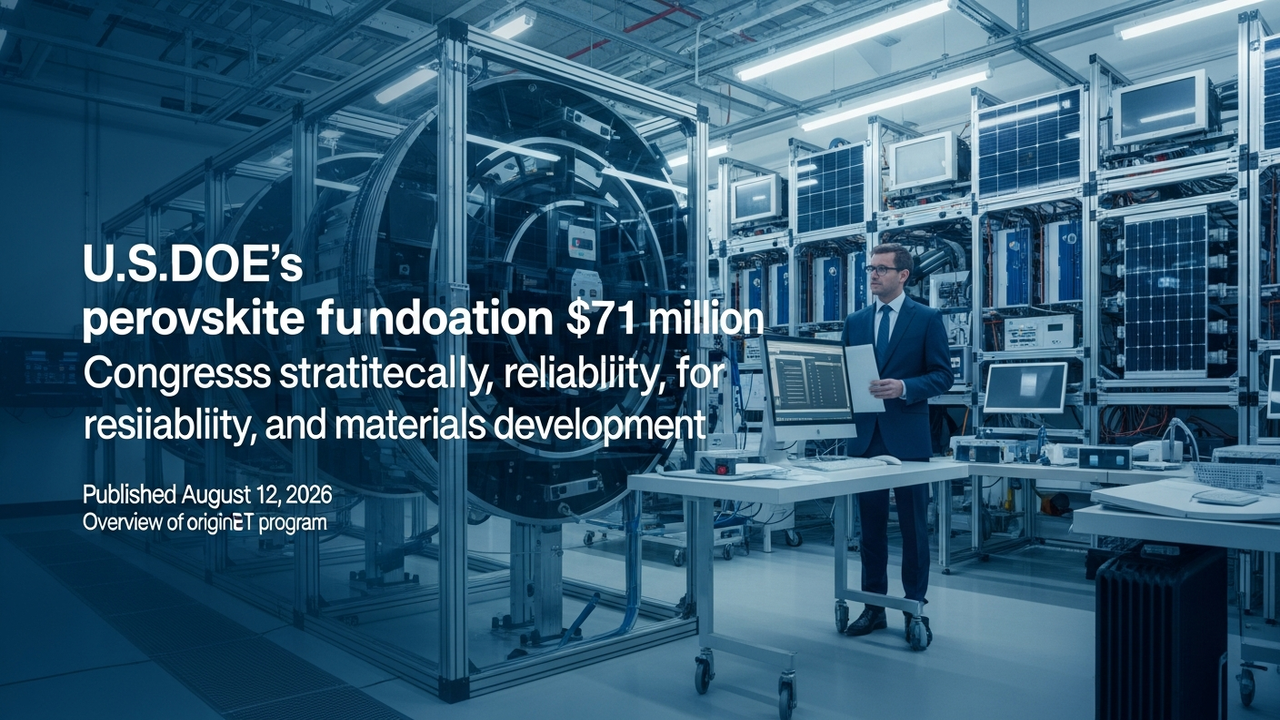
According to Garrett Nilsen, former deputy director at the U.S. Department of Energy’s (DOE) Solar Energy Technologies Office (SETO), the substantial $71 million in congressional funding allocated for perovskite solar cell research and development is being strategically distributed across existing laboratory research and prior commitments. This allocation is designed to bolster critical areas essential for the commercialization of perovskite technology, including enhancing efficiency, ensuring long-term reliability, improving durability, and fostering the development of new materials. This nuanced approach clarifies why individual funding opportunity announcements might appear smaller than the total congressional appropriation, reflecting a comprehensive strategy to support the multifaceted advancement of perovskite technology.
Technical and Manufacturing Details
- Purpose of Funding Allocation: The DOE’s primary objective for this funding is to accelerate the commercialization of perovskite technology by addressing the following key technical challenges:
- Efficiency Enhancement: Supporting fundamental and applied research aimed at scaling up world-record laboratory efficiencies to practical module-level performance.
- Long-Term Reliability: Developing a deeper understanding of material degradation mechanisms and developing mitigation strategies to ensure perovskite solar cells can operate stably in outdoor environments for extended periods (e.g., 25+ years). This includes advancements in encapsulation, interface engineering, and defect passivation.
- Durability Improvement: Pursuing material science approaches to enhance resistance against environmental stressors such as moisture, heat, and UV radiation.
- New Material Development: Investing in research for lead-free perovskites, more stable perovskite compositions, and novel charge transport or electrode materials.
- Integration with Existing Research: SETO supports these areas not only through new funding opportunities but also via ongoing research contracts with national laboratories (like NREL), universities, and private sector companies. This ensures that continuity of research and accumulated expertise are leveraged to their maximum potential.
- Strategic Reallocation: The total congressional allocation is not disbursed entirely through new, open solicitations. A portion is designated for extending ongoing projects, fulfilling previously made funding commitments, or supporting specific strategic initiatives (e.g., American-Made Challenges), thereby providing systematic support across the entire research ecosystem.
Background and Context
Perovskite solar cells are globally recognized as a next-generation technology with the potential to significantly improve the efficiency and cost-effectiveness of solar power. The United States is strongly supporting this field at a governmental level to maintain international competitiveness and strengthen its domestic clean energy manufacturing base. The substantial congressional funding underscores the national importance of this technology, and its allocation process is complex, considering the long-term perspective of R&D and the utilization of existing research networks.
Strategic Significance and Outlook
The DOE’s strategic allocation of funding for perovskite solar cell research is crucial for comprehensively addressing the technology’s key challenges and solidifying its path to commercialization. Continuous investment in diverse areas such as efficiency, reliability, durability, and material development will enable U.S. research institutions and companies to remain at the forefront of perovskite technology. Ultimately, these efforts are expected to lead to high-efficiency, low-cost perovskite solar cells making significant contributions to the U.S. energy mix and accelerating the achievement of renewable energy goals.
Source: https://innovationwaypoints.substack.com/p/where-does-the-money-actually-go
Get our weekly technology intelligence — free
Receive an infographic that lets you judge at a glance whether each field’s analysis report is worth reading.
Subscribe Free — Weekly Tech Intelligence
By subscribing, you’ll receive Troy-Technical’s weekly technology intelligence newsletter.
- Your email and selected fields are used only to deliver the newsletter.
- We never share your information with third parties.
- You can unsubscribe anytime via the link in each email.
See our Privacy Policy for details.
Takes about a minute · Unsubscribe anytime