Key Findings
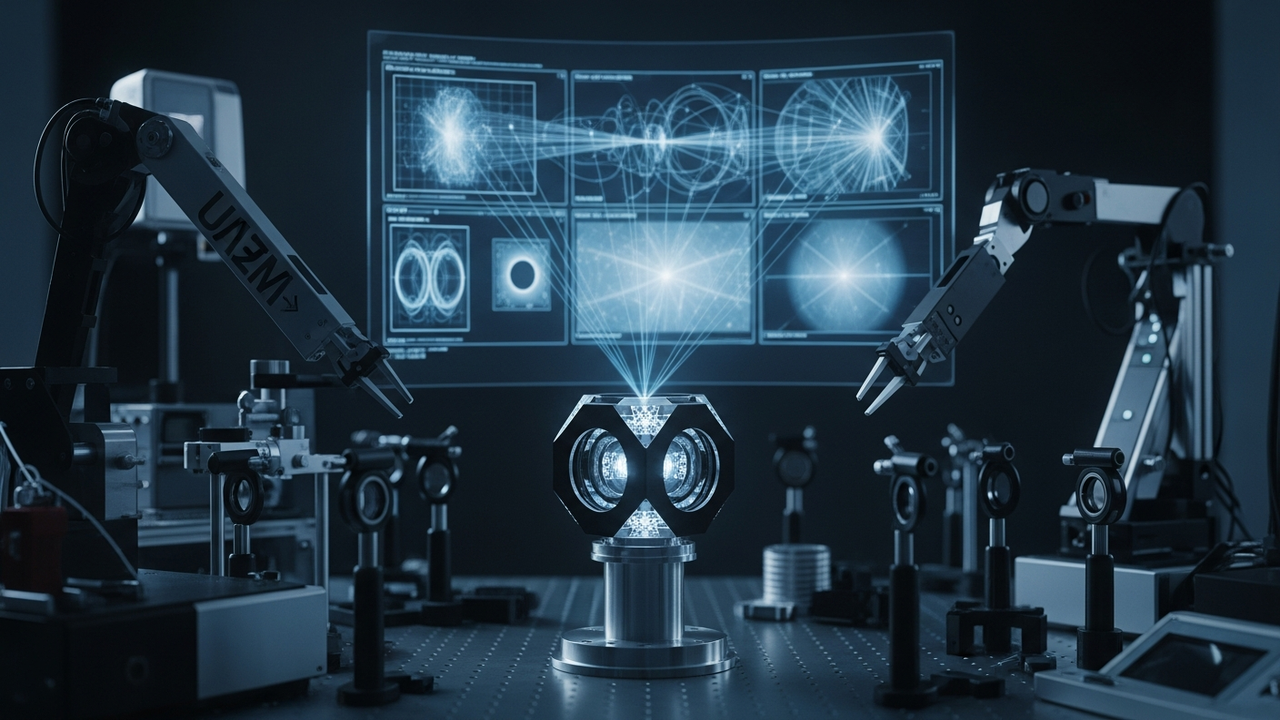
Researchers at the University of Science and Technology of China have developed an innovative flat optical device, dubbed the “cubic-metalens,” which integrates both conventional optical lens and sophisticated focus-correcting functionalities into a single ultrathin metasurface. This pioneering technology promises to overcome the inherent limitations of conventional cameras, enabling the capture of sharp images across a significantly wider range of distances without the need for constant mechanical refocusing.
Technical / Clinical Details
The cubic-metalens achieves its advanced capabilities by employing nanoscale silicon structures to precisely manipulate the path of light. This allows for the simultaneous focusing of multiple wavelengths of light, resulting in clear image formation for objects located at varying depths. Unlike traditional camera lens systems that often require a complex array of multiple lenses to adjust focal length, this metalens accomplishes superior or equivalent functionality with just a single, ultrathin surface. Furthermore, its polarization-insensitive design ensures stable performance across diverse lighting conditions. The specific design of this metalens integrates a lens and a wavefront-coding phase mask into a single ultrathin metasurface, thereby achieving its unique defocus-resistant properties.
Background & Context
The evolution of camera technology demands both miniaturization and enhanced performance across various applications, from smartphones and drones to satellites. However, the fundamental physical principles of traditional optical lenses necessitate a certain thickness and complex structural configurations, which inherently limit device miniaturization and design flexibility. Maintaining a wide depth of field while consistently producing sharp images is particularly crucial for fields such as biomedical imaging, machine vision, and autonomous driving technologies. Metalens technology has emerged as a promising next-generation optical element capable of transcending the limitations of conventional optical systems.
Strategic Significance & Outlook
The cubic-metalens holds the potential to fundamentally transform the future of camera technology. In biomedical imaging, for instance, it could lead to the development of higher-resolution and more compact endoscopes and microscopes, thereby improving diagnostic accuracy and advancing minimally invasive treatments. For machine vision and autonomous driving, it promises accurate real-time distance measurement and object recognition, enhancing safety and efficiency. Future integration into smartphones and wearable devices is also anticipated, paving the way for thinner, more robust, and higher-performance cameras. This technology has the capacity to drastically reduce the overall footprint of optical systems and accelerate the creation of novel applications.
Get our weekly technology intelligence — free
Receive an infographic that lets you judge at a glance whether each field’s analysis report is worth reading.
Subscribe Free — Weekly Tech Intelligence
By subscribing, you’ll receive Troy-Technical’s weekly technology intelligence newsletter.
- Your email and selected fields are used only to deliver the newsletter.
- We never share your information with third parties.
- You can unsubscribe anytime via the link in each email.
See our Privacy Policy for details.
Takes about a minute · Unsubscribe anytime