Key Findings
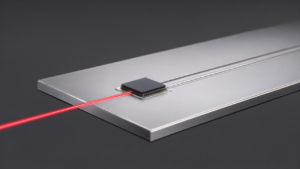
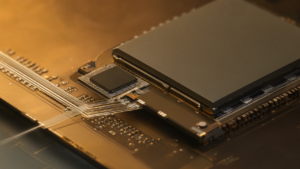
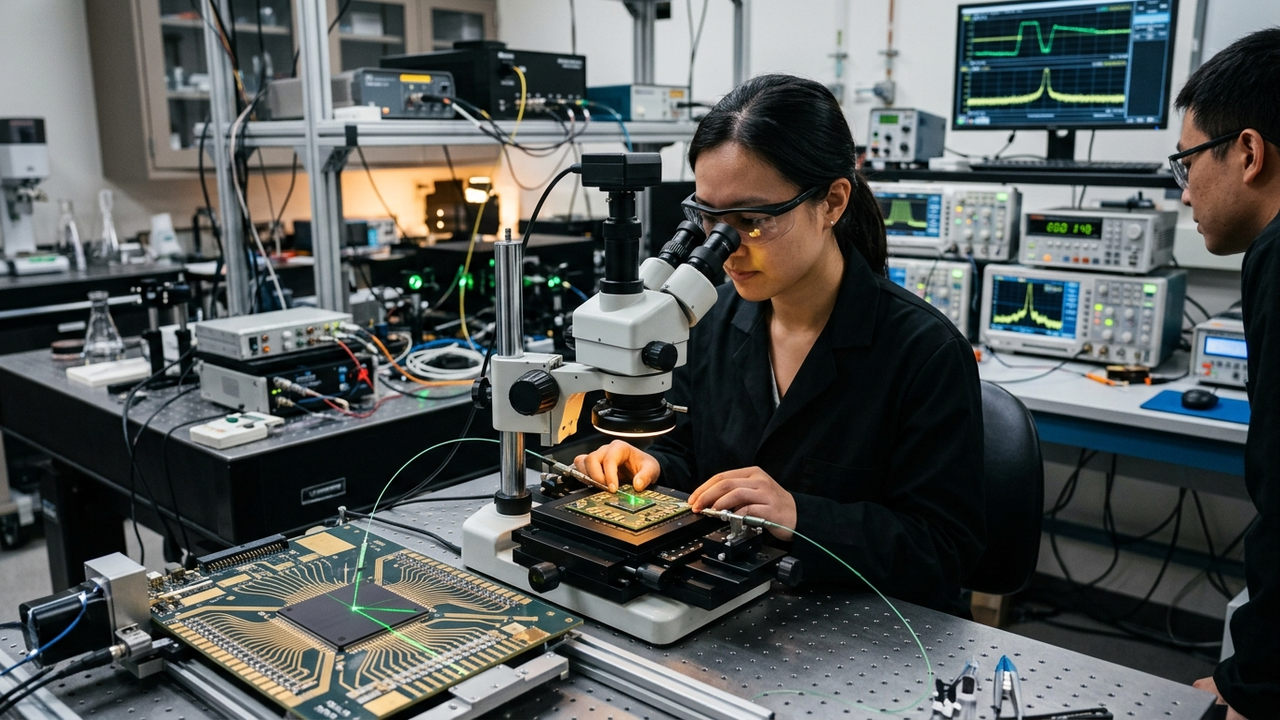
Researchers at the California Institute of Technology (Caltech) have developed a groundbreaking technique for transmitting light on silicon chips with extremely low signal loss, achieving performance comparable to optical fibers in the visible light wavelength range. This breakthrough effectively bridges the gap between optical communication and semiconductor integrated circuits, fields often treated as distinct, and holds the potential to dramatically enhance the performance of next-generation photonic integrated circuits (PICs).
Technical / Clinical Details
- Ultra-Low Loss Optical Transmission: The research team successfully reduced signal loss during light propagation within silicon chips to a level on par with optical fibers. This implies that signals can maintain their quality over long distances when traveling on a chip.
- Performance in Visible Light Wavelengths: While many silicon photonics technologies operate in the infrared spectrum, this achievement demonstrates high performance in the visible light range. This expands the applicability to fields where visible light properties are crucial, such as optical clocks and high-precision gyroscopes.
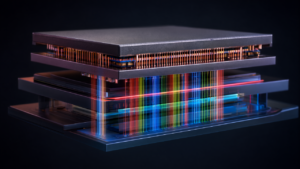
- Broad Application Potential: This technology is expected to find applications across a multitude of sectors, including ultra-high-speed and low-power optical interconnects in AI data centers, control of optical qubits in quantum computing, and highly sensitive sensing devices. Efficiently handling high-coherence optical signals on a chip can push the performance boundaries in these fields.
- Enhanced Energy Efficiency: Reducing signal loss directly translates to improved energy efficiency in optical systems. By minimizing the number of optical-to-electrical signal conversions and lowering power consumption during transmission, this technology can significantly reduce the operational costs of large-scale computing infrastructures like AI data centers.
Background & Context
The advancement of AI and quantum computing has dramatically increased the demand for data processing capabilities and communication speeds, pushing conventional electrical circuits to their limits. Silicon photonics has emerged as a promising technology to address this challenge, but reducing on-chip optical loss has been a long-standing hurdle. Caltech’s achievement represents a significant breakthrough against this technical barrier, paving the way for high-performance optical systems on silicon platforms.
Strategic Significance & Outlook
This breakthrough by Caltech has the potential to revolutionize the design and manufacturing of photonic integrated circuits (PICs). While further development is required to transition from research to commercialization, in the future, smaller, higher-performing, and more energy-efficient optical devices are expected to permeate every aspect of our digital lives. Specifically, this technology is anticipated to play a decisive role in addressing the power consumption issues of AI data centers and in hardware development for the realization of quantum computing.
Source: https://www.sciencedaily.com/releases/2026/08/260814235905.htm
Get our weekly technology intelligence — free
Receive an infographic that lets you judge at a glance whether each field’s analysis report is worth reading.
Subscribe Free — Weekly Tech Intelligence
By subscribing, you’ll receive Troy-Technical’s weekly technology intelligence newsletter.
- Your email and selected fields are used only to deliver the newsletter.
- We never share your information with third parties.
- You can unsubscribe anytime via the link in each email.
See our Privacy Policy for details.
Takes about a minute · Unsubscribe anytime