Key Findings
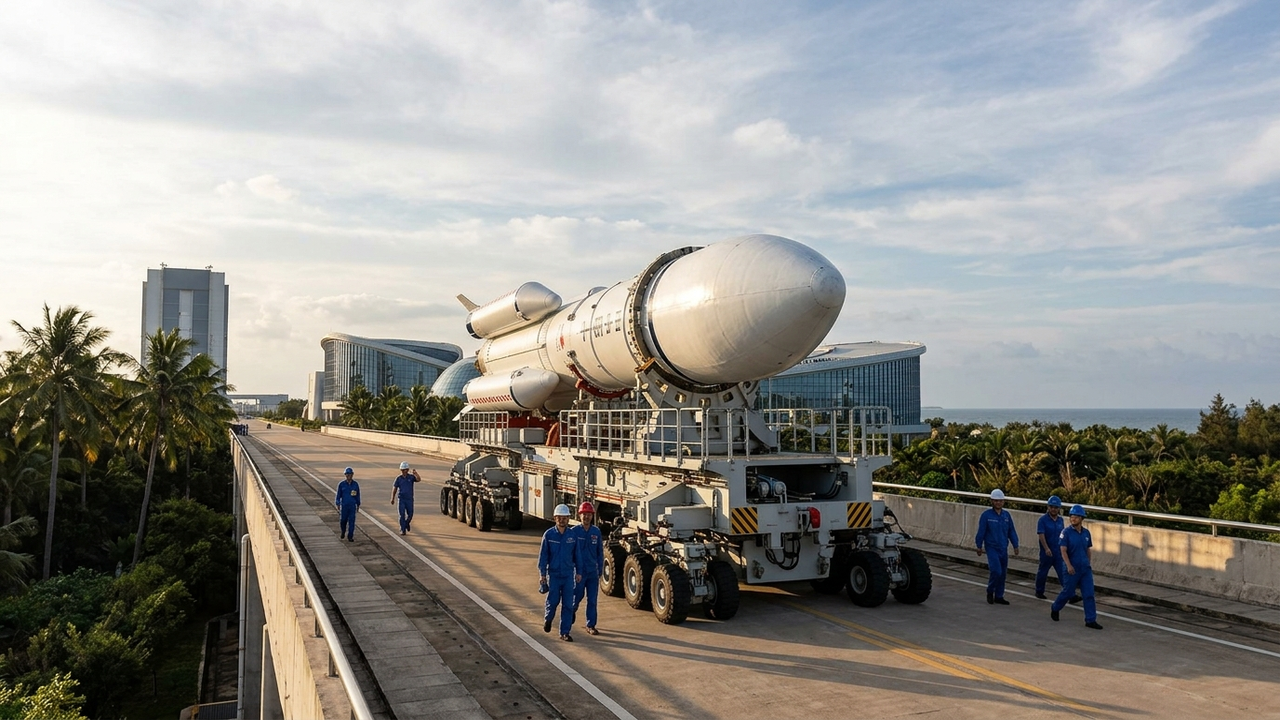
China’s Chang’e-7 lunar probe and its Long March 5 Y14 heavy-lift carrier rocket have been successfully transferred to the Wenchang Spacecraft Launch Site and positioned vertically, marking the completion of final preparations for its upcoming launch. This mission is geared towards a comprehensive exploration of the Moon’s South Pole region, focusing on its topography, material composition, and the space environment. A highlight includes the testing of an innovative flying robot, which will leap from sunlit areas into permanently shadowed craters to search for water ice—a first for lunar exploration.
Technical / Clinical Details
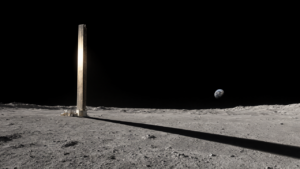
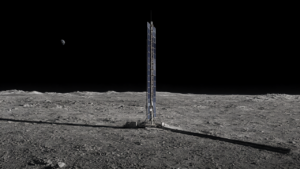
The Chang’e-7 mission comprises a complex multi-component exploration system. The main lander will execute a high-precision soft landing at the lunar South Pole and utilize leg-assisted mobility for localized surveys. Crucially, the mission also carries a ‘lunar hopping robot’ capable of short-distance movements across the lunar surface. This robot is designed to autonomously leap from sun-illuminated areas directly into the interior of permanently shadowed craters, where it will conduct direct searches for water ice. Operating within these permanently shadowed regions presents extreme challenges due to ultra-low temperatures and lack of sunlight, requiring the robot to possess advanced autonomous navigation and environmental sensing capabilities. The Long March 5 Y14 rocket, China’s most powerful launch vehicle, is essential for injecting the Chang’e-7 probe into lunar transfer orbit, with its performance and reliability being key to mission success. Throughout the mission, valuable data on lunar topography, geological evolution, space weathering, and the distribution and quantity of water ice are expected to be collected.
Background & Context
The lunar South Pole region is a primary target for global space exploration, as permanently shadowed craters are predicted to harbor significant quantities of water ice, a critical resource for future lunar bases (for life support systems and rocket propellants). Major spacefaring nations, including the U.S., Europe, and India, are planning or executing missions to the lunar South Pole, making water ice prospecting and utilization a central focus of international space competition. China’s Chang’e program, initiated in the early 2000s, has progressively achieved milestones in lunar landing, rover deployment, and sample return. Building on these successes, Chang’e-7 aims to conduct even more advanced technological demonstrations and scientific investigations, solidifying China’s leadership in lunar exploration technologies on a global scale.
Strategic Significance & Outlook
The success of the Chang’e-7 mission will be a major milestone for China’s lunar program and will profoundly impact the future of human deep-space exploration. Specifically, the flying robot’s exploration of water ice within permanently shadowed craters will significantly enhance the feasibility of In-Situ Resource Utilization (ISRU) technologies, representing a critical step towards the construction of future lunar bases and sustained human presence on the Moon. Furthermore, the demonstration of new technologies like high-precision landing and hopping mobility will provide invaluable insights for the design of future lunar and other celestial body exploration missions. This mission will unequivocally strengthen China’s status as a leading space power, further enhancing its presence in both international space cooperation and competition.
Get our weekly technology intelligence — free
Receive an infographic that lets you judge at a glance whether each field’s analysis report is worth reading.
Subscribe Free — Weekly Tech Intelligence
By subscribing, you’ll receive Troy-Technical’s weekly technology intelligence newsletter.
- Your email and selected fields are used only to deliver the newsletter.
- We never share your information with third parties.
- You can unsubscribe anytime via the link in each email.
See our Privacy Policy for details.
Takes about a minute · Unsubscribe anytime