Background
Perovskite solar cells are widely recognized as “dream solar cells,” offering conversion efficiencies competitive with or surpassing traditional silicon-based photovoltaics, alongside the promise of low-cost manufacturing. Their flexible variants are particularly attractive for emerging applications such as IoT devices, wearable electronics, and building-integrated photovoltaics (BIPV) due to their lightweight and bendable properties. However, a significant challenge lies in their composition: they incorporate lead (Pb), an environmentally hazardous substance, and valuable yet expensive metals like gold (Au) and indium (In). As the adoption of perovskite solar cells scales, the sustainable disposal and recycling of spent devices become critical. The complex structures and diverse material matrices of flexible perovskite devices further complicate efficient recycling, making the development of such technologies an urgent imperative. Kanazawa University’s new technology directly addresses these challenges, offering an innovative solution that harmonizes environmental protection with economic value.
Key Findings
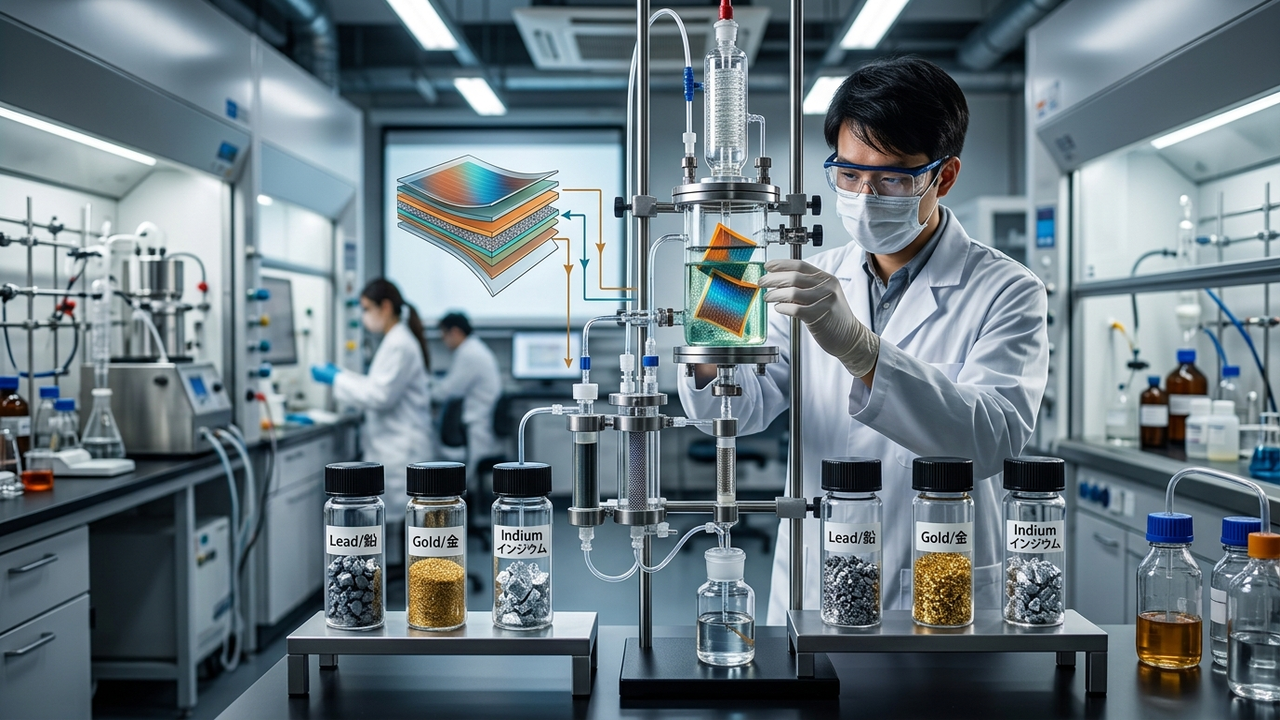
Researchers at Kanazawa University have achieved a significant breakthrough by developing a groundbreaking technology for the highly efficient, one-step separation and simultaneous recovery of critical metals from flexible perovskite solar cells. This innovative process effectively extracts environmentally hazardous lead (Pb) alongside high-value gold (Au) and indium (In). The method leverages a unique combination of low-concentration mixed acid treatment and specialized composite adsorbents, marking a pivotal step toward establishing a sustainable and economically viable recycling pathway for next-generation photovoltaics.
Technical Approach
The developed recycling process targets flexible perovskite solar cells, which are increasingly recognized as a key next-generation clean energy technology. Their inherent bendability, light weight, and high conversion efficiency make them ideal for diverse applications, including IoT devices, wearable electronics, and building-integrated photovoltaics (BIPV).
Recycling Process Details:
- Low-Concentration Mixed Acid Treatment: The first stage involves immersing spent perovskite solar cells in a low-concentration mixed acid solution, typically a blend of nitric and hydrochloric acids. This treatment efficiently leaches out the targeted metal components—lead, gold, and indium—from the device matrix. A significant advantage of this approach is its reduced environmental impact and enhanced operational safety compared to conventional methods that rely on stronger acid concentrations.
- Utilization of Composite Adsorbents: Following the leaching step, the resulting solution, rich in dissolved metal ions, is treated with a specialized composite adsorbent. This unique system integrates cellulose-based adsorbents with chelating resins to selectively capture and recover individual metals in solid form. The cellulose component is primarily engineered for the adsorption of lead and indium, while the chelating resin specifically targets gold, enabling high-purity separation.
- One-Step Simultaneous Recovery: A key innovation of this system is its ability to achieve simultaneous, high-purity separation and recovery of multiple metal species within a single process. This streamlined approach significantly simplifies the overall recycling workflow, contributing to reduced operational costs and increased efficiency.
While specific numerical recovery rates for lead, gold, and indium were not detailed in the initial announcement, the consistent emphasis on “high efficiency” strongly indicates robust performance suitable for practical industrial application.
Strategic Significance and Outlook
This innovative technology holds substantial promise for enhancing the overall sustainability of the perovskite solar cell lifecycle. Its practical application is anticipated to significantly accelerate the commercialization and widespread adoption of perovskite photovoltaics by addressing key environmental and resource concerns. While scaling the technology to process large volumes of devices will be a crucial next step, its broader implications extend to valuable metal recovery from urban mines, thereby contributing significantly to the realization of a circular economy. This breakthrough offers a tangible solution to the environmental and resource challenges inherent in the development and deployment of future energy technologies.
Source: https://www.kanazawa-u.ac.jp/miraichi/186434/
Get our weekly technology intelligence — free
Receive an infographic that lets you judge at a glance whether each field’s analysis report is worth reading.
Subscribe Free — Weekly Tech Intelligence
By subscribing, you’ll receive Troy-Technical’s weekly technology intelligence newsletter.
- Your email and selected fields are used only to deliver the newsletter.
- We never share your information with third parties.
- You can unsubscribe anytime via the link in each email.
See our Privacy Policy for details.
Takes about a minute · Unsubscribe anytime