Key Findings
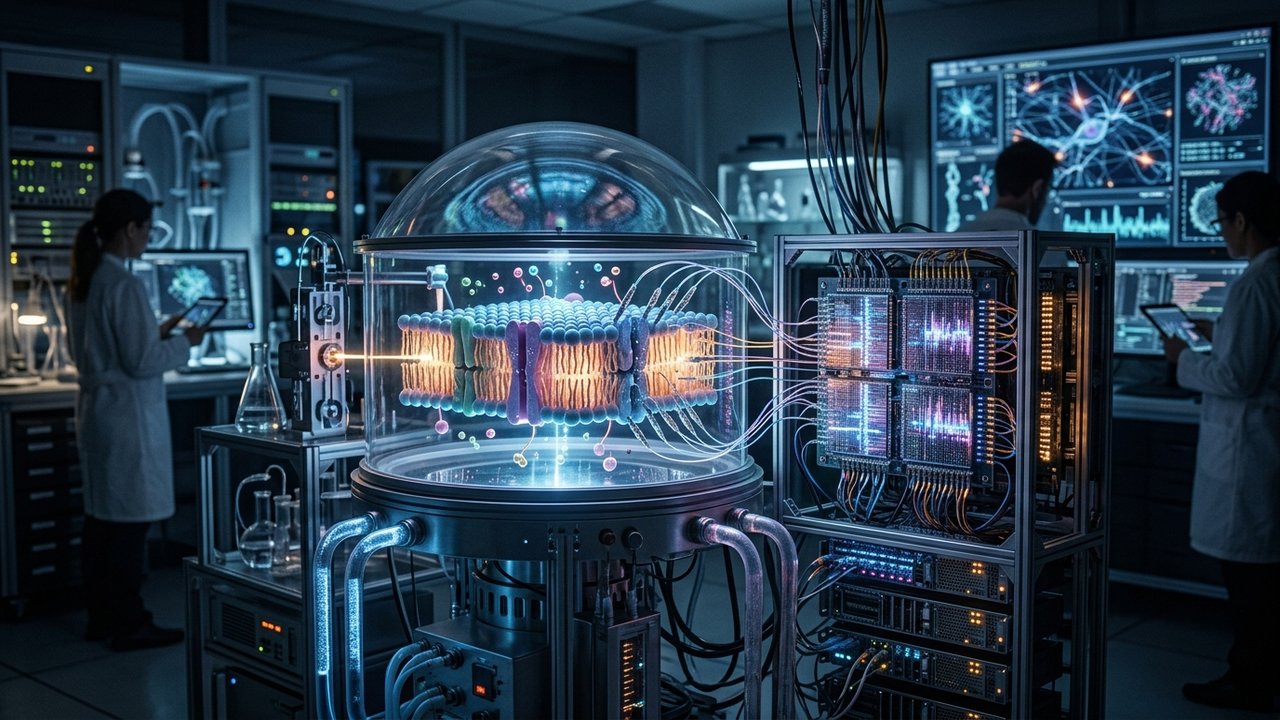
A collaborative international research team, spearheaded by Oak Ridge National Laboratory (ORNL), has made a profound discovery: cell membranes, particularly lipid bilayers, are not merely passive cellular boundaries but play a direct and active role in the processes of memory and learning formation. This groundbreaking insight is poised to make a critical contribution to the advancement of materials science for next-generation neuromorphic computing technologies, which aim to emulate the functionalities of the human brain.
Technical / Clinical Details
The research team employed a combination of advanced simulations and experimental techniques to analyze the dynamics of lipid bilayers and their information processing capabilities. Specifically, they meticulously observed how lipid molecules rearrange in response to external stimuli, such as ion passage or electric fields, and how their physical states change. Remarkably, they demonstrated that these lipid membranes possess the ability to ‘remember’ past stimuli and ‘learn’ to adjust future responses accordingly, akin to synaptic plasticity in neurons. This phenomenon is attributed to subtle changes in the arrangement and packing density of lipid molecules, which serve as a mechanism for retaining information. This suggests that biological systems perform more flexible and continuous information processing compared to conventional computing models that rely on fixed switching states, like transistors.
Background & Context
Modern computing technology, based on the Von Neumann architecture, separates data processing from memory, leading to a ‘memory wall’ bottleneck, particularly in AI and big data processing. In contrast, the human brain utilizes a neuromorphic (brain-like) architecture that integrates information processing and memory, offering high energy efficiency and parallel processing capabilities. The discovery that lipid bilayers are directly involved in memory and and learning provides a novel materials science approach for developing neuromorphic devices. This allows for the design of new hardware using bio-inspired materials, beyond traditional semiconductor materials, potentially leading to a significant leap forward in AI technology.
Strategic Significance & Outlook
This discovery is expected to have a profound impact on the field of neuromorphic computing. In the future, artificial membrane-based devices mimicking the properties of lipid bilayers could lead to more energy-efficient and superior learning computer chips. Potential applications include self-learning sensors, adaptive robots, and more advanced pattern recognition systems. ORNL’s research opens a new frontier in ‘bio-inspired engineering,’ applying biological insights to engineering problems, and has the potential to blur the boundaries between computing and materials science, accelerating the development of truly intelligent machines.
Source: https://www.ornl.gov/news/scientists-discover-learning-and-memory-formation-model-membranes
Get our weekly technology intelligence — free
Receive an infographic that lets you judge at a glance whether each field’s analysis report is worth reading.
Subscribe Free — Weekly Tech Intelligence
By subscribing, you’ll receive Troy-Technical’s weekly technology intelligence newsletter.
- Your email and selected fields are used only to deliver the newsletter.
- We never share your information with third parties.
- You can unsubscribe anytime via the link in each email.
See our Privacy Policy for details.
Takes about a minute · Unsubscribe anytime