Key Findings
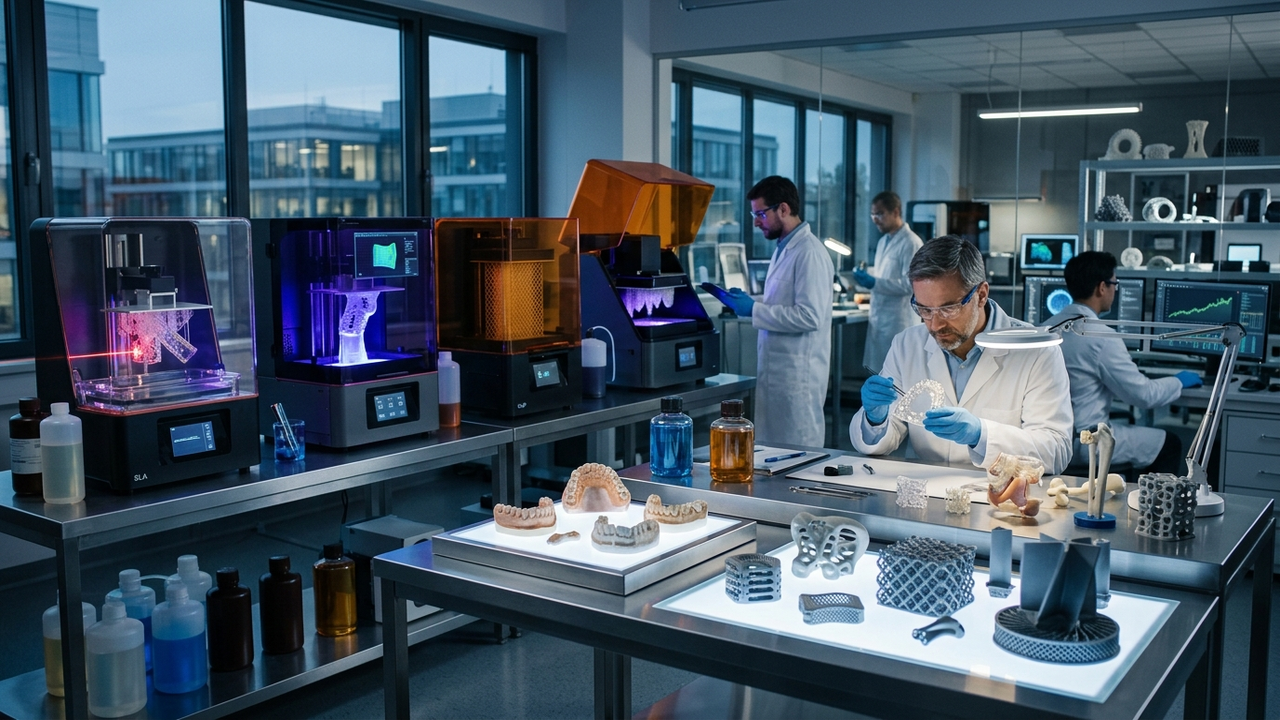
Photopolymerization 3D printing technologies have advanced significantly, offering high-precision additive manufacturing methods that cure liquid photosensitive resins layer by layer using light to create intricate three-dimensional parts. Key technologies such as Stereolithography (SLA), Digital Light Processing (DLP), Liquid Crystal Display (LCD), Continuous Liquid Interface Production (CLIP), and Material Jetting Photopolymer (MJP) have emerged, each providing unique advantages for specific applications.
Technical / Clinical Details
- SLA (Stereolithography): Utilizes a UV laser to cure liquid photopolymer resin. It is renowned for achieving exceptionally high resolution and smooth surface finishes, making it ideal for precise prototyping and complex medical models.
- DLP (Digital Light Processing): Employs a digital projector to cure entire layers at once by projecting a complete image. This method is generally faster than SLA and efficient for medium to large-scale part production.
- LCD (Liquid Crystal Display): Uses an LCD screen as its light source, curing entire layers similarly to DLP. It is a cost-effective option, gaining popularity in personal use and small-scale manufacturing.
- CLIP (Continuous Liquid Interface Production): A breakthrough technology that continuously pulls the object from the resin vat by curing through an oxygen-permeable window. This significantly increases print speed and produces parts with more isotropic mechanical properties, reducing layer lines.
- MJP (Material Jetting Photopolymer): Involves jetting photopolymer resin droplets from an inkjet printhead and curing them with a UV lamp. This method supports multi-material printing, allowing for the creation of parts with varying hardness or colors in a single build.
While these technologies differ in terms of build speed, resolution, and material compatibility, they commonly offer outstanding detail reproduction and superior surface quality.
Background & Context
The manufacturing of high-precision and complex-geometry parts is essential across numerous industries, including dental (e.g., surgical guides, dentures), medical (e.g., anatomical models, hearing aids), aerospace (e.g., lightweight structural components), automotive (e.g., functional prototypes), and jewelry (e.g., master patterns). Traditionally, meeting these requirements involved high costs and extended lead times. Photopolymerization 3D printing technologies address these challenges, maximizing design freedom and enabling the rapid and cost-effective production of customized products, thereby transforming these industries.
Strategic Significance & Outlook
The photopolymerization 3D printing market is projected to expand rapidly, driven by continuous advancements in material science and equipment innovation. Future developments will likely focus on even more functional resin materials (e.g., enhanced biocompatibility, heat resistance, chemical resistance) and further improvements in print speed and resolution. Integration with AI and automation technologies is also expected to boost manufacturing efficiency and quality. These evolutions ensure that photopolymerization 3D printing will play an increasingly central role in diverse industries, from prototyping to final product manufacturing.
Source: https://www.aident3d.com/info/photopolymerization-3d-printing-technologies-103622748.html
Get our weekly technology intelligence — free
Receive an infographic that lets you judge at a glance whether each field’s analysis report is worth reading.
Subscribe Free — Weekly Tech Intelligence
By subscribing, you’ll receive Troy-Technical’s weekly technology intelligence newsletter.
- Your email and selected fields are used only to deliver the newsletter.
- We never share your information with third parties.
- You can unsubscribe anytime via the link in each email.
See our Privacy Policy for details.
Takes about a minute · Unsubscribe anytime