Key Findings
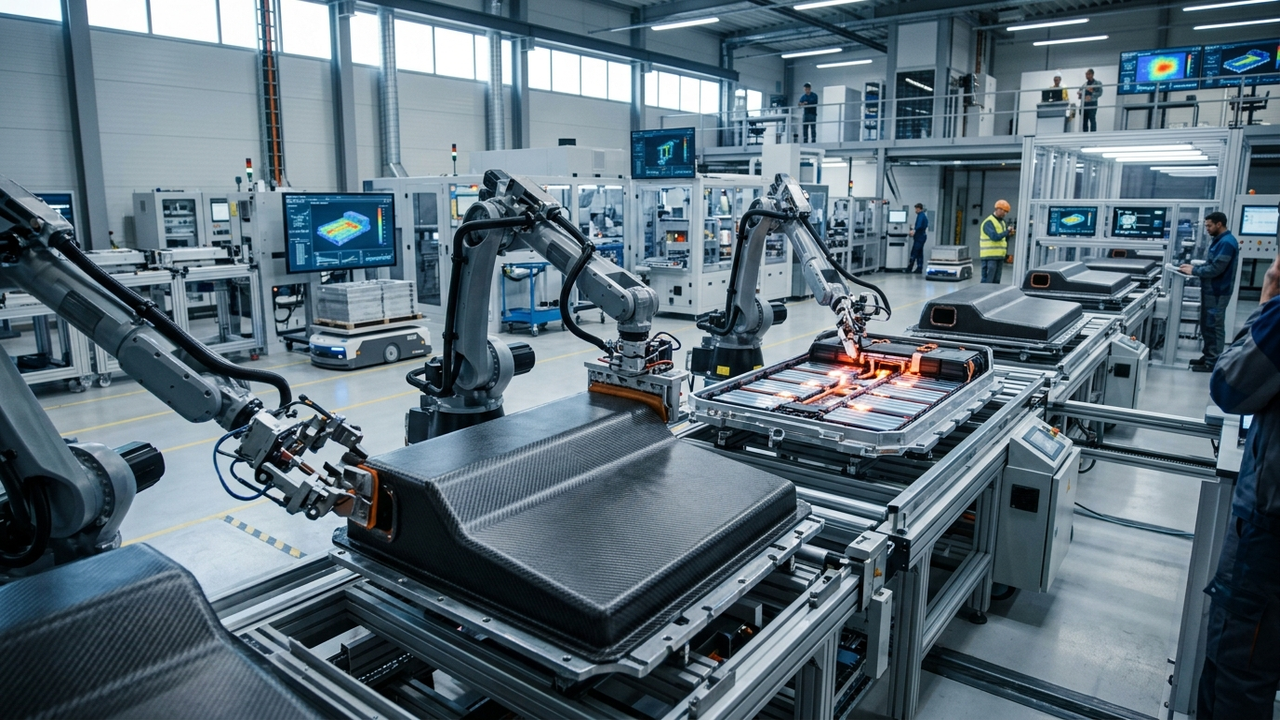
A comprehensive review has been published, detailing the latest advancements in forming technologies, defect control, and digital manufacturing for polymer composite battery pack structures in New Energy Vehicles (NEVs). The analysis spotlights high-speed forming processes for thermoplastic composites, sophisticated multi-material joining techniques, real-time in-line monitoring during manufacturing, and improved material recyclability. These developments promise substantial enhancements in the safety, performance, and manufacturing efficiency of battery packs.
Technical / Clinical Details
The review particularly emphasizes the properties of thermoplastic composites. Unlike traditional thermoset composites, thermoplastics offer shorter molding cycles and the ability to be re-melted and re-formed, significantly accelerating manufacturing processes and boosting recyclability. For instance, Teijin Automotive Technologies is actively developing composite battery pack enclosures, leveraging their lightweight, high-strength, and impact-resistant characteristics to extend NEV range and improve safety. Advanced multi-material joining techniques enable seamless integration with metals and various polymers, expanding the design flexibility of the entire battery pack. Furthermore, the integration of digital manufacturing technologies allows for high-precision, efficient production of complex geometries, alongside early detection and control of defects.
Background & Context
The rapid expansion of the NEV market has intensified demands for superior battery pack performance and safety. Conventional metal battery packs are heavy, impeding overall vehicle lightweighting efforts. Polymer composites, in contrast, offer exceptional specific strength and stiffness, significantly contributing to vehicle mass reduction. Battery pack protection is paramount for crash safety, and composites enhance this by providing excellent energy absorption characteristics. Moreover, increasingly stringent environmental regulations prioritize material recyclability, where thermoplastic composites hold a distinct advantage.
Strategic Significance & Outlook
Moving forward, polymer composite battery pack technology is expected to play a pivotal role in the proliferation and performance enhancement of NEVs. Specifically, high-speed forming, advanced joining techniques, and manufacturing optimization leveraging digital twin technology will drive down production costs and stabilize quality. Further advancements in recycling technologies are essential for achieving a sustainable automotive industry and will contribute to the long-term stability of material supply. Research, development, and industrial application in this field are anticipated to continue expanding vigorously.
Source: https://www.mdpi.com/2079-6439/14/8/94
Get our weekly technology intelligence — free
Receive an infographic that lets you judge at a glance whether each field’s analysis report is worth reading.
Subscribe Free — Weekly Tech Intelligence
By subscribing, you’ll receive Troy-Technical’s weekly technology intelligence newsletter.
- Your email and selected fields are used only to deliver the newsletter.
- We never share your information with third parties.
- You can unsubscribe anytime via the link in each email.
See our Privacy Policy for details.
Takes about a minute · Unsubscribe anytime