Key Findings
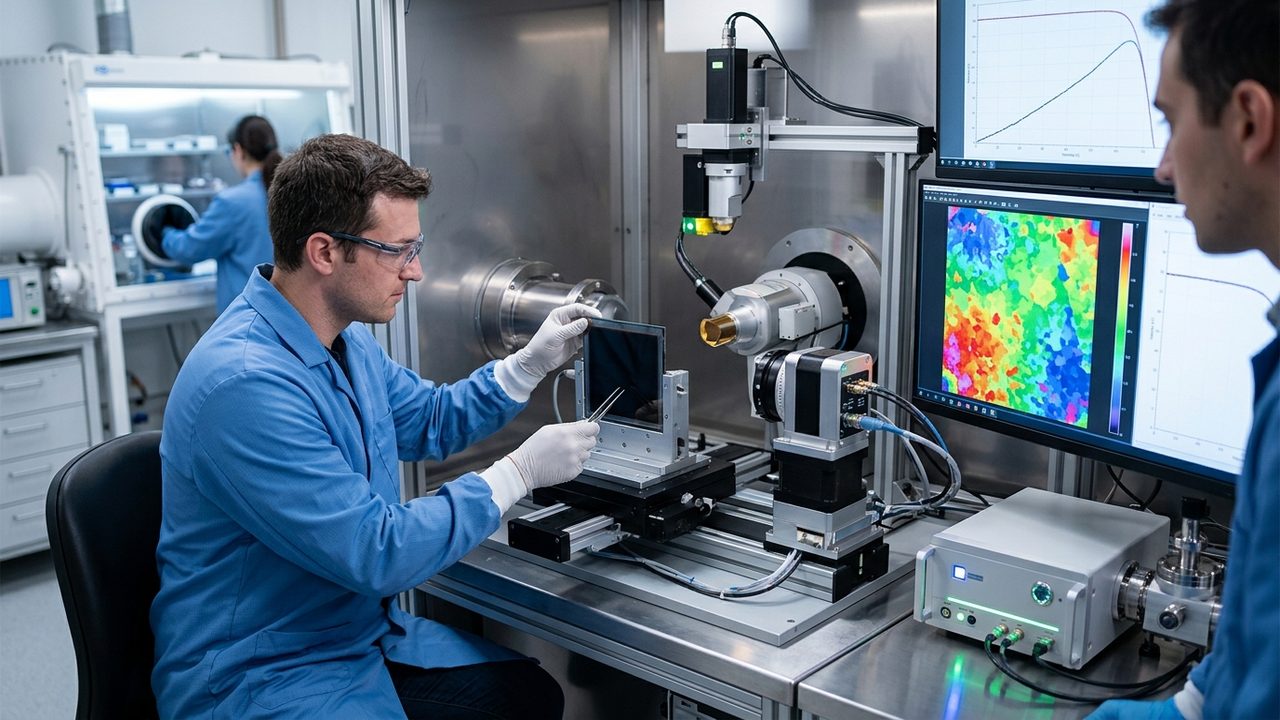
A research team from Ulsan National Institute of Science and Technology (UNIST), in collaboration with the Korea Research Institute of Chemical Technology (KRICT), has developed a groundbreaking technique crucial for enhancing the performance of large-area perovskite solar cells. They introduced a 2-dimensional X-ray diffraction mapping (2DXDM) technique that allows for non-destructive mapping of crystal uniformity across the entire perovskite solar cell film. Leveraging this advanced tool, the researchers successfully identified a manufacturing process that achieved a certified efficiency of 22.75% in a 100cm² perovskite solar module, a practical size for commercial applications. This achievement is paramount in resolving technical bottlenecks associated with the mass production of perovskite solar cells.
Technical Details
The efficiency of perovskite solar cells is highly dependent on the uniformity and quality of the perovskite crystalline layer. In large-area devices, crystal defects and non-uniform growth are primary contributors to efficiency loss. Traditional analytical methods have struggled to provide detailed, non-destructive evaluations of the crystal structure across an entire module. The 2DXDM technique employs X-rays to acquire high-precision information on crystal orientation, grain size, and defect density over a large area without damaging the sample. By using this technique, the research team identified optimal film deposition conditions and annealing treatments that promote uniform crystal growth, resulting in the 22.75% certified efficiency for the 100cm² module, a world-class figure for large-scale devices.
Background and Industry Context
Perovskite solar cells are garnering significant global attention as a next-generation photovoltaic technology due to their potential to achieve high power conversion efficiencies, comparable to or exceeding traditional silicon-based cells, at a lower cost. However, maintaining the high efficiencies achieved in small-area laboratory devices when scaled up to commercially viable large-area modules has been a long-standing challenge, primarily due to difficulties in ensuring manufacturing uniformity and stability. This research provides a powerful diagnostic tool for quality control and process optimization in large-scale manufacturing, effectively removing one of the major barriers to the commercialization of perovskite technology. The South Korean government is also heavily invested in developing renewable energy technologies, and such breakthroughs enhance the nation’s scientific and technological competitiveness.
Future Outlook
The 2DXDM technique developed by UNIST and KRICT has the potential to revolutionize the development and quality control of perovskite solar cell manufacturing processes. By employing this technique, companies can monitor crystal quality in real-time during production and rapidly identify optimized processes. This will accelerate the production of efficient and reliable large-area perovskite modules and contribute to reducing manufacturing costs. The achievement of 22.75% certified efficiency in a 100cm² module indicates that perovskite solar cells are becoming competitive in a wide range of markets, from residential to utility-scale power plants, as well as Building-Integrated Photovoltaics (BIPV) and flexible devices. This accomplishment is expected to play a crucial role in accelerating the global transition to clean energy.
Get our weekly technology intelligence — free
Receive an infographic that lets you judge at a glance whether each field’s analysis report is worth reading.
Subscribe Free — Weekly Tech Intelligence
By subscribing, you’ll receive Troy-Technical’s weekly technology intelligence newsletter.
- Your email and selected fields are used only to deliver the newsletter.
- We never share your information with third parties.
- You can unsubscribe anytime via the link in each email.
See our Privacy Policy for details.
Takes about a minute · Unsubscribe anytime