Background
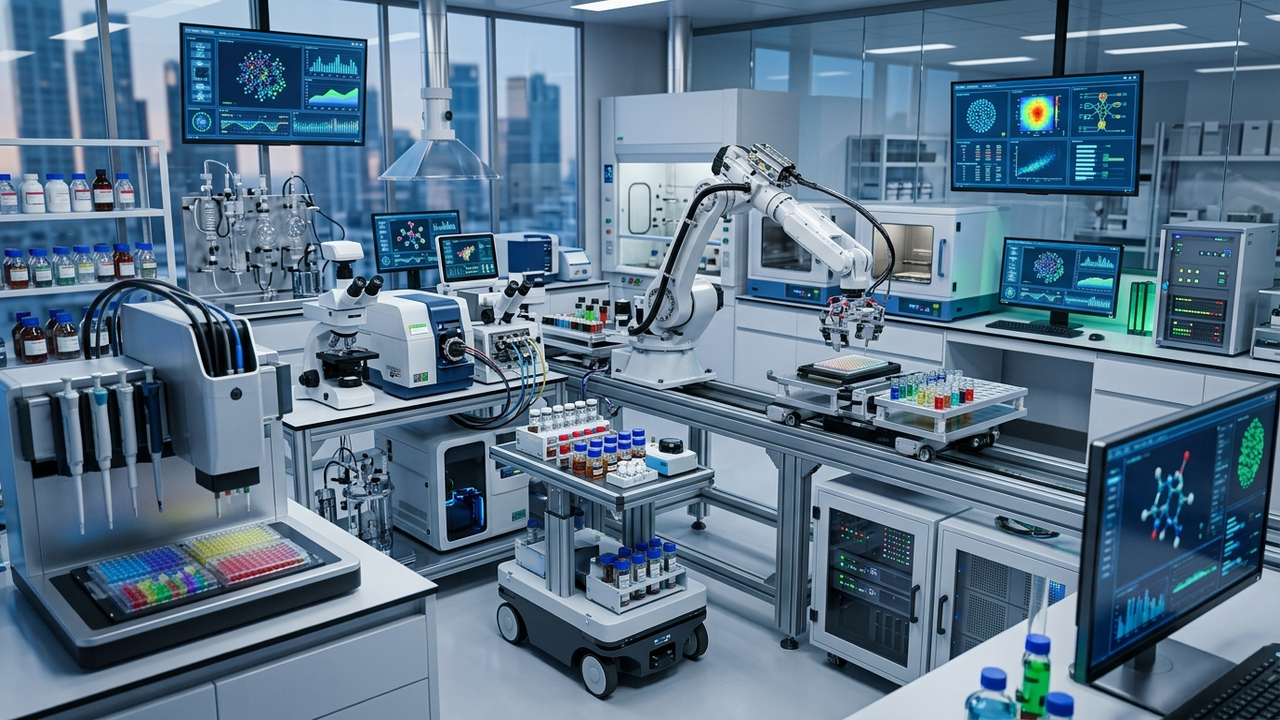
For decades, the arduous process of materials development has been a critical bottleneck, often prolonging the creation of new technologies by many years, if not decades. This inherent delay has significantly impeded our ability to respond swiftly to pressing societal challenges in vital sectors such as clean energy, medicine, and advanced electronics. The advent of Autonomous Laboratories (SDLs) provides a fundamental and transformative solution to this longstanding problem. By drastically improving the speed and efficiency of research and development, SDLs are becoming an indispensable element for enhancing national and international competitiveness. Reflecting this strategic importance, government agencies like the U.S. National Science Foundation (NSF) and the Department of Energy (DOE), alongside leading academic powerhouses such as MIT and UC Berkeley, and technology giants including IBM and Google, are making substantial and concerted investments in SDL research and infrastructure.
Key Findings
Autonomous Laboratories (SDLs) are ushering in a transformative paradigm shift across materials science, dramatically accelerating development through self-directed exploration. This profound evolution is driven by significant advancements in search algorithms, crucial enhancements in robotic hardware, and a systemic expansion of autonomy, collectively leading to an unprecedented boost in research efficiency and speed.
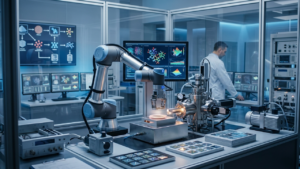
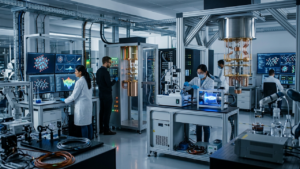
SDLs achieve this by integrating cutting-edge AI technologies—including machine learning, deep learning, and increasingly, generative models—to automate the prediction of material properties, the design of novel structures, and the optimization of chemical reactions. These AI models learn iteratively from vast experimental datasets, intelligently selecting the most informative next experiments, which fundamentally transforms and substantially reduces the traditional trial-and-error paradigm. Complementing this, significant hardware advancements include high-precision robotic arms, sophisticated automated sample handling systems, and diverse synthesis and characterization instruments. These physical components operate in seamless conjunction with AI algorithms, establishing a ‘closed-loop discovery cycle.’ Within this cycle, AI-proposed material designs are physically synthesized, their performance meticulously evaluated, and the resulting empirical data is fed back into the AI models for continuous learning and refinement. This synergistic system empowers the exploration of an exponentially broader material space at a significantly faster pace than conventional human-driven manual experimentation, proving particularly impactful for the rapid development of catalysts, advanced battery materials, polymers, and functional nanomaterials.
Looking forward, SDL technology is poised for continued rapid evolution. The integration of more sophisticated AI algorithms, such as multi-objective optimization, reinforcement learning, and physics-informed AI, is expected to further elevate the systems’ predictive accuracy and autonomy. A key future development involves the standardization of data sharing and interoperability across different SDLs, which will foster unprecedented global collaborative research. This will cultivate an ecosystem where laboratories collectively learn from independently conducted experiments, creating a global knowledge network. Ultimately, this paradigm shift will free materials scientists to dedicate their expertise to more complex, foundational scientific challenges, allocate more time and resources to truly innovative discoveries, and accelerate the market introduction of next-generation materials critical for a sustainable global society.
Source: #
Get our weekly technology intelligence — free
Receive an infographic that lets you judge at a glance whether each field’s analysis report is worth reading.
Subscribe Free — Weekly Tech Intelligence
By subscribing, you’ll receive Troy-Technical’s weekly technology intelligence newsletter.
- Your email and selected fields are used only to deliver the newsletter.
- We never share your information with third parties.
- You can unsubscribe anytime via the link in each email.
See our Privacy Policy for details.
Takes about a minute · Unsubscribe anytime




Comments