Key Findings
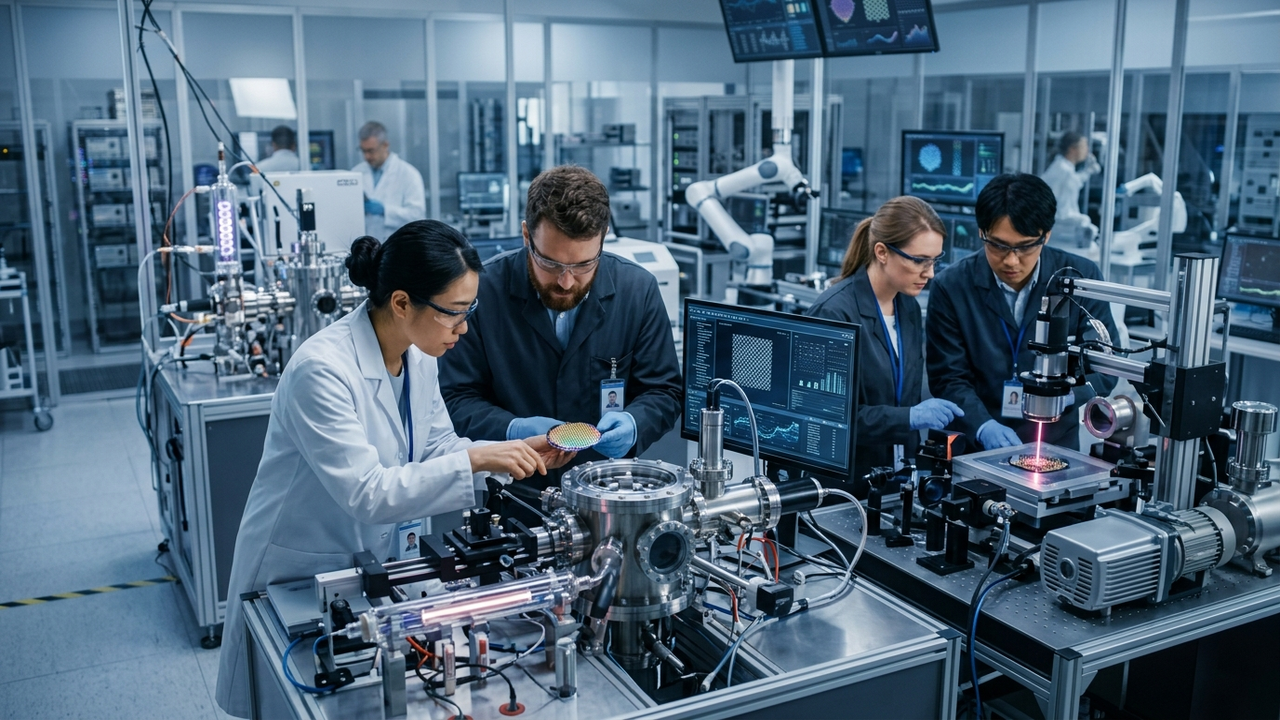
Canada and Japan have announced joint funding for quantum computing research aimed at revolutionizing semiconductor manufacturing technology. The partnership specifically targets advancements in Extreme Ultraviolet (EUV) lithography and the discovery of novel photoresist materials, crucial components for next-generation chip production. At the core of this initiative is an expanded collaboration between Xanadu Quantum Technologies and Mitsubishi Chemical.
Technical/Clinical Details
- Addressing EUV Lithography Challenges: EUV lithography is vital for fabricating intricate semiconductor circuits, but its performance heavily relies on the optical properties of photoresist materials. Quantum computing offers the potential to simulate these materials’ quantum characteristics with higher accuracy, thereby reducing “lithographic blur” and improving resolution.
- Fusion of Quantum Simulation and Materials Science: The collaboration integrates Xanadu’s expertise in quantum simulation with Mitsubishi Chemical’s deep knowledge in materials science. Quantum algorithms will accelerate the design and evaluation of new photoresist materials, aiming to identify high-performance compounds that are challenging to discover using conventional methods.
- Development of Production-Ready Workflows: A key objective of this partnership is to establish a “production-ready software pipeline” that can directly incorporate quantum simulation results into the semiconductor manufacturing process. This aims to facilitate the rapid application of laboratory-scale breakthroughs to actual production lines.
Background & Context
The semiconductor industry is approaching the physical limits of Moore’s Law and urgently seeks innovative technologies for manufacturing ever-finer circuits. While EUV lithography is the current state-of-the-art, its further evolution necessitates leaps in materials science and simulation techniques. Quantum computing is gaining international attention as a tool capable of bringing fundamental changes to this sector.
Strategic Significance & Outlook
This collaborative research between Canada and Japan is poised to resolve bottlenecks in semiconductor manufacturing and accelerate the development of higher-performance computer chips. The alliance between Xanadu and Mitsubishi Chemical could serve as a model for how quantum computing can deliver concrete commercial value in materials science. In the future, this approach is expected to be applied to material discovery and design in other industrial sectors, fostering widespread technological innovation.
Get our weekly technology intelligence — free
Receive an infographic that lets you judge at a glance whether each field’s analysis report is worth reading.
Subscribe Free — Weekly Tech Intelligence
By subscribing, you’ll receive Troy-Technical’s weekly technology intelligence newsletter.
- Your email and selected fields are used only to deliver the newsletter.
- We never share your information with third parties.
- You can unsubscribe anytime via the link in each email.
See our Privacy Policy for details.
Takes about a minute · Unsubscribe anytime







Comments