Key Findings
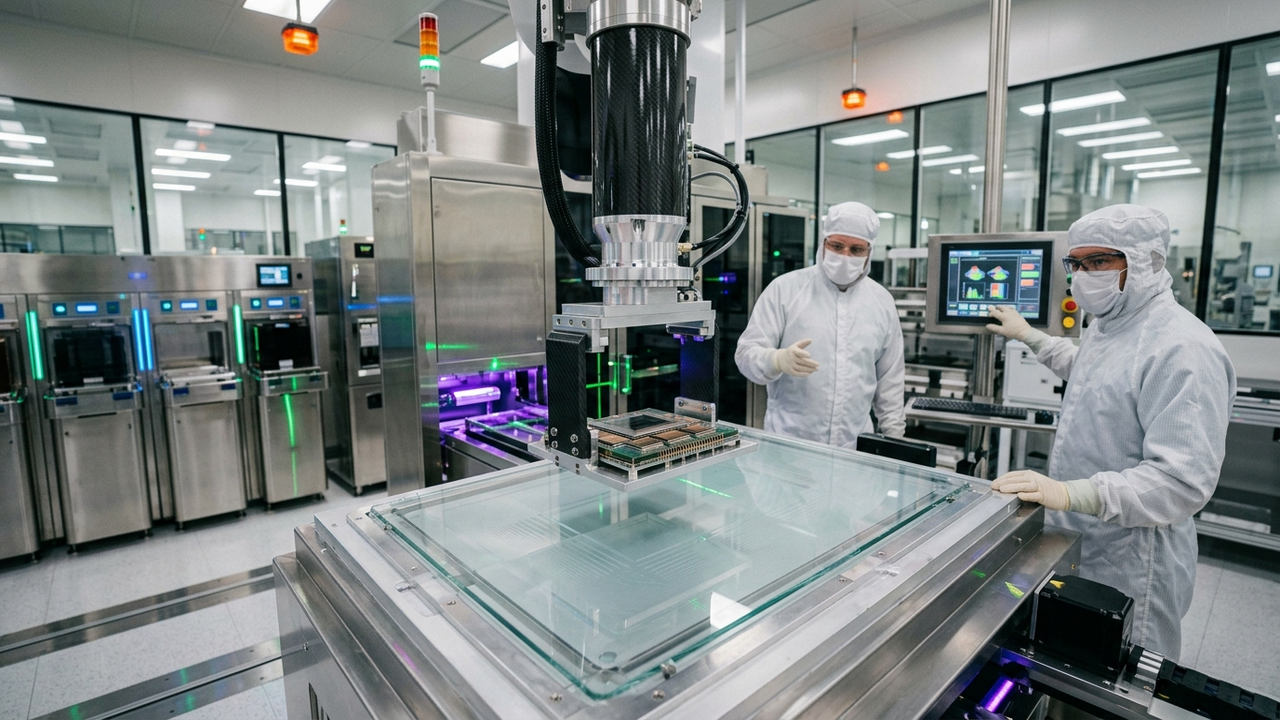
Within the semiconductor industry, the adoption of glass substrates for advanced packaging technology is rapidly accelerating its transition from the prototype stage to full-scale mass production. This swift shift is driven by the unique advantages of glass substrates, which are highly valued for enhancing the performance of semiconductors, particularly for AI (Artificial Intelligence) and High-Performance Computing (HPC) applications. Compared to traditional organic interposers, glass substrates boast superior flatness, high thermal stability, and low dielectric loss. These properties are critical for maintaining signal integrity and achieving efficient thermal management when integrating HBM (High Bandwidth Memory) stacks and multiple chiplets at extremely high densities. Industry sources indicate that several leading IDMs (Integrated Device Manufacturers) and OSATs (Outsourced Semiconductor Assembly and Test providers) have already commenced pilot production using glass substrates, with full market introduction envisioned from 2027 onwards.
Technical Advantages and Overcoming Mass Production Challenges
The primary technical advantages of glass substrates include:
- Exceptional Flatness: Significantly flatter surface compared to organic substrates, enabling high yield for hybrid bonding at ultra-fine pitches and stacking thin chips.
- Superior Thermal Stability: Coefficient of Thermal Expansion (CTE) is close to silicon, reducing thermal mismatch between chips and substrates. This prevents package warpage and connection reliability degradation due to thermal stress.
- Low Dielectric Loss: Excellent high-frequency signal transmission characteristics contribute to faster data transfer speeds and improved signal quality.
- High-Density Through-Glass Vias (TGVs): Allows for the formation of minute TGVs, enabling high-density wiring layers and 3D interconnections.
Previous mass production challenges included handling large glass substrates, achieving low-cost and high-yield TGV formation, and managing thermal stress between glass and chips. However, advancements in material technology, equipment technology, and process technology are overcoming these hurdles, making glass substrates a viable solution for practical use.
Background and Industry Context
As semiconductor performance improvements, traditionally achieved through miniaturization, approach physical limits and costs escalate, advanced packaging technologies like chiplets and 3D stacking have become primary drivers for performance enhancement and cost efficiency. Within this trend, glass substrates are positioned as an ideal platform, particularly for enabling ultra-high-density heterogeneous integration. Governments in the U.S., South Korea, and Japan are also increasing investments in this technology, making it a new focal point in the next-generation semiconductor competition.
Strategic Significance and Outlook
Advanced packaging using glass substrates is expected to be adopted in a wide range of applications, including AI, HPC, next-generation memory (HBM4 and beyond), and high-performance mobile processors. The acceleration of mass production will significantly increase chip design flexibility, enabling the realization of more complex and high-performance System-in-Package (SiP) solutions. Glass substrate technology is poised to drive the next wave of innovation in the semiconductor industry, increasing its presence significantly in the coming years as a foundational technology supporting the development of data-driven societies.
Source: #
Get our weekly technology intelligence — free
Receive an infographic that lets you judge at a glance whether each field’s analysis report is worth reading.
Subscribe Free — Weekly Tech Intelligence
By subscribing, you’ll receive Troy-Technical’s weekly technology intelligence newsletter.
- Your email and selected fields are used only to deliver the newsletter.
- We never share your information with third parties.
- You can unsubscribe anytime via the link in each email.
See our Privacy Policy for details.
Takes about a minute · Unsubscribe anytime




Comments