Key Findings
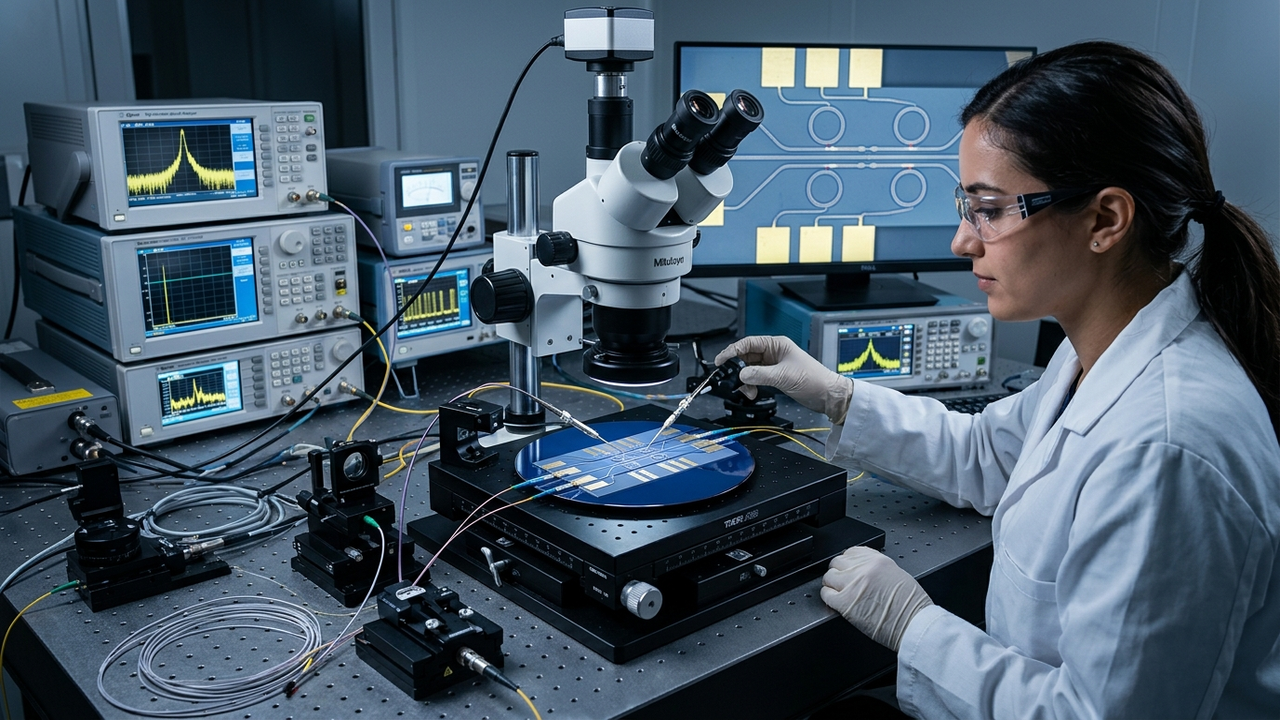
A novel study has demonstrated a breakthrough in tunable bidirectional frequency mode conversion using a heterogeneously integrated thin-film lithium niobate (TFLN) coupled-cavity modulator on a silicon substrate. This technology enables precise photon manipulation, including 50/50 frequency beam splitting and near-perfect frequency swapping, which are crucial operations for frequency-bin qubits in quantum information science. This represents a significant step forward for the realization of scalable integrated quantum photonic circuits.
Technical Details
The coupled-cavity modulator leverages heterogeneous integration, directly combining TFLN with a silicon-on-insulator (SOI) platform. Lithium niobate is renowned for its excellent electro-optic properties, allowing for high-speed and efficient modulation of optical signals. However, its bulk form presents significant challenges for large-scale integration. By fabricating TFLN in a thin-film configuration and integrating it onto a silicon substrate, the researchers have overcome these integration hurdles, achieving both high integration density and superior performance.
Specifically, by tuning the cavity structure, the device can precisely convert frequency modes of incoming light. This capability is expected to enable applications such as efficient manipulation of frequency-encoded photons in quantum computing and information transfer between different frequency bands in quantum communication. The experiments successfully demonstrated high conversion efficiency and low crosstalk, also highlighting the potential for co-integration with other photonic components like integrated photon-pair sources, spectral filters, active tuning elements, and single-photon detectors.
Background & Context
Frequency-bin qubits are attracting considerable attention in quantum information science due to their robustness and high capacity. However, the development of scalable and efficient integrated photonic circuits for manipulating these qubits remains a major challenge, particularly concerning material incompatibility and the complexity of circuit scaling. This heterogeneous integration of TFLN with silicon photonics offers a promising solution by combining silicon’s mature manufacturing processes with TFLN’s superior electro-optic characteristics.
Strategic Significance & Outlook
This technology is poised to become a foundational element for building next-generation quantum computers and quantum networks. It is expected to accelerate the realization of complex quantum operations on a single chip, contributing to the development of more practical quantum devices. In the long term, this approach could open new avenues for larger-scale frequency-bin quantum photonic circuits, entanglement generation, and various quantum gate operations, pushing the boundaries of quantum information processing.
Source: https://arxiv.org/abs/2608.26028
Get our weekly technology intelligence — free
Receive an infographic that lets you judge at a glance whether each field’s analysis report is worth reading.
Subscribe Free — Weekly Tech Intelligence
By subscribing, you’ll receive Troy-Technical’s weekly technology intelligence newsletter.
- Your email and selected fields are used only to deliver the newsletter.
- We never share your information with third parties.
- You can unsubscribe anytime via the link in each email.
See our Privacy Policy for details.
Takes about a minute · Unsubscribe anytime





Comments