
Background & Context
Kidney disease is often asymptomatic in its early stages, leading to diagnosis typically only after significant progression, making early detection of paramount importance. Current diagnostics primarily rely on blood and urine tests (e.g., creatinine, eGFR) that often indicate abnormalities only when kidney function is already substantially compromised. Microneedle technology has attracted considerable interest in diagnostics and monitoring due to its minimal invasiveness and reduced patient discomfort. The integration of MOFs with microneedles represents a transformative advancement, dramatically improving the stability and lowering the detection limits of biosensors. This research aligns with the growing trends of personalized medicine and remote patient monitoring, offering an innovative solution especially pertinent for chronic disease management.
Key Findings
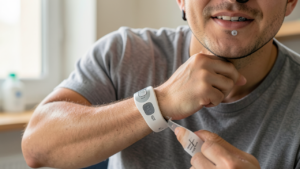
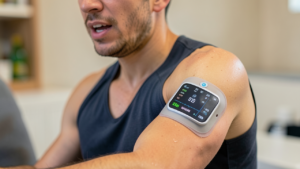
This groundbreaking microneedle patch, developed by researchers from Srikanth Singamaneni’s lab at Washington University in St. Louis, offers a novel approach for the early detection of kidney disease. Applied to the skin, it rapidly, safely, and with high sensitivity captures and quantifies the Neutrophil Gelatinase-Associated Lipocalin (NGAL) antibody, a critical biomarker for kidney injury, directly from the interstitial fluid. A significant breakthrough is the integration of metal-organic framework (MOF)-coated microneedles, which enables the stable, refrigeration-free preservation of detected NGAL antibodies for up to four weeks. This capability holds significant potential to facilitate long-term kidney function monitoring at home and in point-of-care (POCT) settings, thereby expanding opportunities for early intervention.
Technical / Clinical Details
The developed microneedle patch features an array of microscopic needles, micrometers in size, designed to painlessly penetrate the superficial skin layer (stratum corneum) to access interstitial fluid. These microneedles are surface-modified with metal-organic frameworks (MOFs), advanced functional materials known for their high porosity and tailorable structures. MOFs efficiently adsorb and pre-concentrate specific biomarkers like the NGAL antibody. Furthermore, the MOFs’ protective environment shields captured antibodies from biochemical degradation, maintaining their structural integrity for extended periods—up to four weeks—at room temperature. This crucial feature means that even if immediate analysis is not possible, samples can be reliably analyzed later in a central laboratory setting. The system’s high sensitivity allows it to detect subtle increases in NGAL levels even at the earliest stages of kidney disease, offering an opportunity to identify the condition and initiate interventions to slow disease progression significantly earlier than conventional kidney function tests.
Strategic Significance & Outlook
The success of this MOF-coated microneedle patch heralds a paradigm shift in kidney disease diagnosis and monitoring. By enabling convenient, regular at-home monitoring of kidney health, patients can actively participate in their disease management, and healthcare professionals can implement more proactive interventions. Future research will likely focus on adapting this technology for detecting biomarkers of other diseases and developing multiplexed sensors capable of simultaneously quantifying multiple biomarkers. The refrigeration-free characteristic is especially advantageous for widespread adoption in resource-constrained settings, potentially bolstering global health initiatives. This innovative, non-invasive device is expected to be a significant breakthrough in the early detection and management of chronic diseases globally.
Source: https://www.eurekalert.org/news-releases/1141732
Get our weekly technology intelligence — free
Receive an infographic that lets you judge at a glance whether each field’s analysis report is worth reading.
Subscribe Free — Weekly Tech Intelligence
By subscribing, you’ll receive Troy-Technical’s weekly technology intelligence newsletter.
- Your email and selected fields are used only to deliver the newsletter.
- We never share your information with third parties.
- You can unsubscribe anytime via the link in each email.
See our Privacy Policy for details.
Takes about a minute · Unsubscribe anytime


Comments