
Background
In the highly dynamic Intensive Care Unit (ICU) environment, continuous and precise patient monitoring is critical due to rapidly fluctuating patient conditions. However, conventional monitoring methods—such as frequent blood draws and invasive catheters—are often uncomfortable, pose infection risks, and have inherent limitations in providing truly real-time information. Wearable sweat sensors present a compelling solution to these challenges. This technological advancement is a confluence of recent breakthroughs in materials science, microelectronics, biosensor design, and artificial intelligence. With an increasing global emphasis on preventive medicine and early intervention, the integration of wearable technology in the ICU promises to profoundly enhance the quality of medical care, patient safety, and comfort.
Key Findings
Patient monitoring within Intensive Care Units (ICU) is undergoing a revolutionary paradigm shift with the advent of wearable sweat sensors, inaugurating an era of non-invasive, continuous real-time monitoring. This groundbreaking technology leverages the understanding that sweat serves as a rich, accessible reservoir of biochemical data, accurately reflecting systemic physiological status. Crucially, the integration of advanced artificial intelligence (AI) algorithms and machine learning models with these sensors unlocks the capability to extract personalized “biochemical fingerprints” from sweat data. This enables the ultra-early diagnosis of critical conditions such as sepsis and organ failure, paving the way for timely, life-saving interventions and potentially dramatically improving patient outcomes.
Technical Details
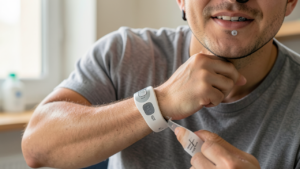
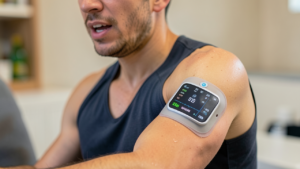
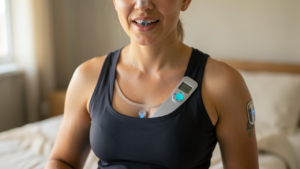
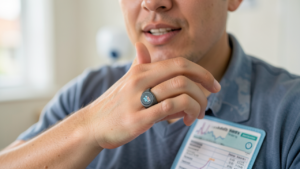
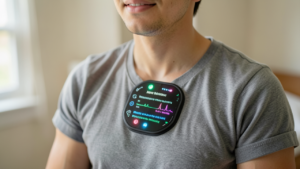
Wearable sweat sensors are discreet, patch-like devices designed for direct application to the skin. They integrate sophisticated microfluidic channels with arrays of electrochemical or optical biosensors. Sweat, collected and transported through these microfluidic systems, contains vital analytes including key electrolytes such as sodium (Na+), chloride (Cl-), and potassium (K+), alongside critical metabolites like glucose and lactate. Fluctuations in the concentrations of these biomarkers directly reflect physiological stress and pathological states. For example, persistently elevated lactate levels can be an early indicator of tissue hypoxia or impending sepsis, while significant electrolyte imbalances may signal renal dysfunction or severe dehydration. The continuous stream of data from these sensors is rigorously analyzed by advanced AI models. These models are specifically trained to identify subtle deviations from healthy physiological baselines and to recognize characteristic patterns associated with specific disease onset, thereby forming unique “biochemical fingerprints.” Model training leverages extensive datasets of historical patient data and state-of-the-art machine learning techniques to ensure high sensitivity and specificity in predicting critical conditions.
Outlook
The introduction of wearable sweat sensors in the ICU is poised to fundamentally transform patient management paradigms. Their ultra-early diagnostic capabilities empower clinicians to detect nascent signs of sepsis and organ failure significantly sooner, enabling more rapid, life-saving interventions. This proactive approach is anticipated to lead to shorter ICU stays, reduced treatment costs, and substantially improved patient prognoses. Future development will prioritize rigorous validation of efficacy and reliability through large-scale, multi-center clinical trials, with the ultimate objective of integrating these sensors into standard ICU monitoring protocols. Beyond critical care, these sensors hold immense potential for broader applications in other acute care settings and for the remote monitoring of chronic diseases, thus extending their transformative impact on healthcare far beyond the ICU.
Source: https://www.eurekalert.org/news-releases/1141352
Get our weekly technology intelligence — free
Receive an infographic that lets you judge at a glance whether each field’s analysis report is worth reading.
Subscribe Free — Weekly Tech Intelligence
By subscribing, you’ll receive Troy-Technical’s weekly technology intelligence newsletter.
- Your email and selected fields are used only to deliver the newsletter.
- We never share your information with third parties.
- You can unsubscribe anytime via the link in each email.
See our Privacy Policy for details.
Takes about a minute · Unsubscribe anytime



Comments