Key Findings
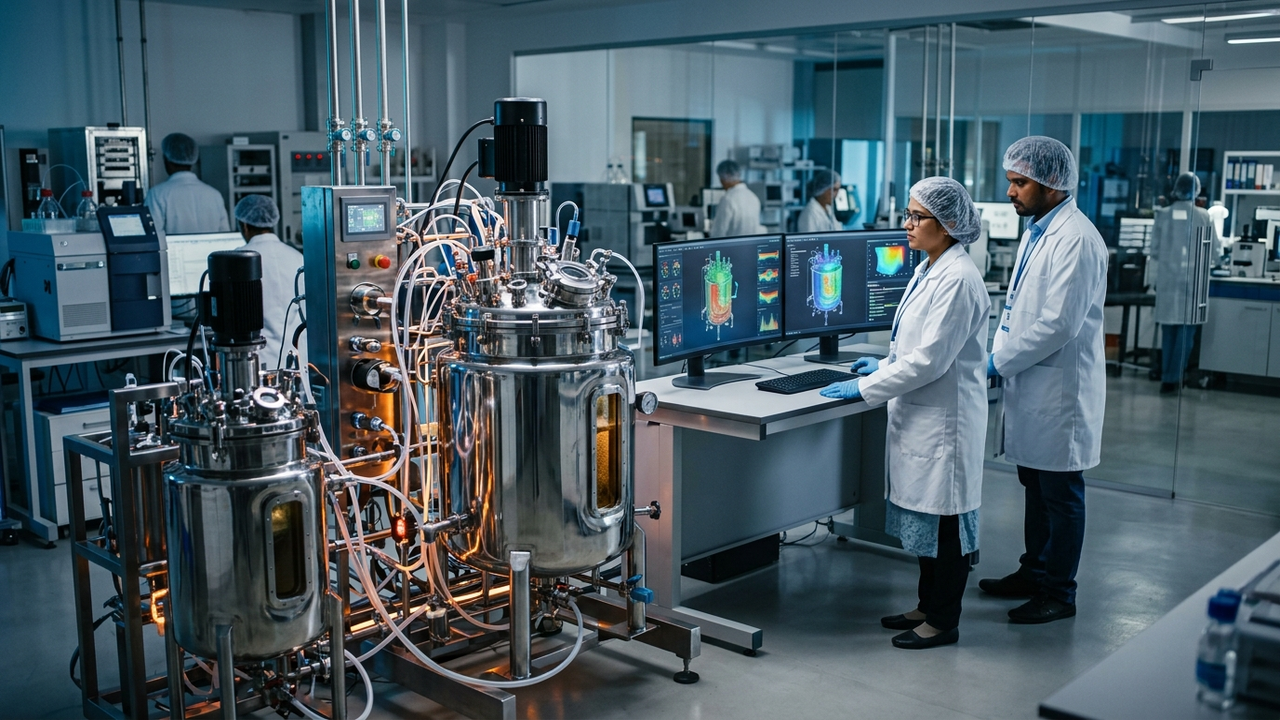
The Indian pharmaceutical industry is rapidly accelerating its adoption of digital bioprocessing tools to dramatically enhance manufacturing efficiency and quality. Central to this transformation is ‘digital twin’ technology, which simulates bioreactor conditions and predicts changes in process parameters. This technology is highly valued for its ability to significantly mitigate the inherent risks associated with scaling up complex biologics. Major Indian pharmaceutical companies such as Biocon, Serum Institute of India, and Dr. Reddy’s are actively integrating Process Analytical Technology (PAT) with Manufacturing Execution Systems (MES) and Distributed Control Systems (DCS) frameworks. This digitalization drive is strongly supported by robust government initiatives like the National Biopharma Mission.
Technical / Clinical Details
A digital twin precisely replicates a physical bioreactor in a virtual space. Based on real-time data collected from sensors (e.g., temperature, pH, dissolved oxygen, cell density, nutrient concentrations), this virtual model is continuously updated to accurately reflect the current state of the bioprocess. This allows researchers and engineers to simulate various operating scenarios without conducting physical experiments, predicting how changes in process parameters might affect product quality and yield. For instance, it enables prior evaluation of how minor adjustments in culture conditions impact cell growth rates or the production efficiency of target proteins, helping to identify optimal operating parameters. This capability allows for early identification and resolution of unforeseen issues during manufacturing scale-up (e.g., inefficient heat and mass transfer, cell stress), reducing costly physical trial and error. PAT enables real-time quality monitoring and process control, while MES/DCS frameworks support the digital twin strategy by integrating and managing manufacturing data, providing automated workflows and traceability.
Background & Context
While India has played a crucial role in the global supply of generic drugs, it has recently focused on bolstering its biopharmaceutical development and manufacturing capabilities. Biologics, owing to their complex molecular structures and manufacturing processes, demand high technical proficiency and stringent quality control. To enhance global competitiveness, improving manufacturing efficiency, reducing costs, and rapidly responding to regulatory requirements are indispensable. The adoption of digital bioprocessing, particularly digital twins, is positioned as a strategic solution to these challenges. Government programs like India’s National Biopharma Mission strongly support the growth of the domestic biopharmaceutical industry through enhanced R&D capabilities, infrastructure development, and talent training, with digitalization being one of its core pillars.
Strategic Significance & Outlook
The accelerated adoption of digital bioprocessing tools in the Indian pharmaceutical industry is a critical step for the country to become a global leader in biopharmaceutical manufacturing. As AI and machine learning models become more sophisticated, digital twins will enable even more advanced predictive analytics and autonomous process control. This will shorten the development time for manufacturing processes and accelerate time-to-market, allowing India to rapidly supply innovative biologics worldwide. Furthermore, digital twin technology is expected to facilitate knowledge sharing and process standardization across manufacturing facilities, enhancing the resilience of the entire supply chain. Ultimately, this technological innovation holds immense potential to significantly improve health outcomes for patients in India and globally through the provision of high-quality, affordable biologics.
Get our weekly technology intelligence — free
Receive an infographic that lets you judge at a glance whether each field’s analysis report is worth reading.
Subscribe Free — Weekly Tech Intelligence
By subscribing, you’ll receive Troy-Technical’s weekly technology intelligence newsletter.
- Your email and selected fields are used only to deliver the newsletter.
- We never share your information with third parties.
- You can unsubscribe anytime via the link in each email.
See our Privacy Policy for details.
Takes about a minute · Unsubscribe anytime








Comments