Key Findings
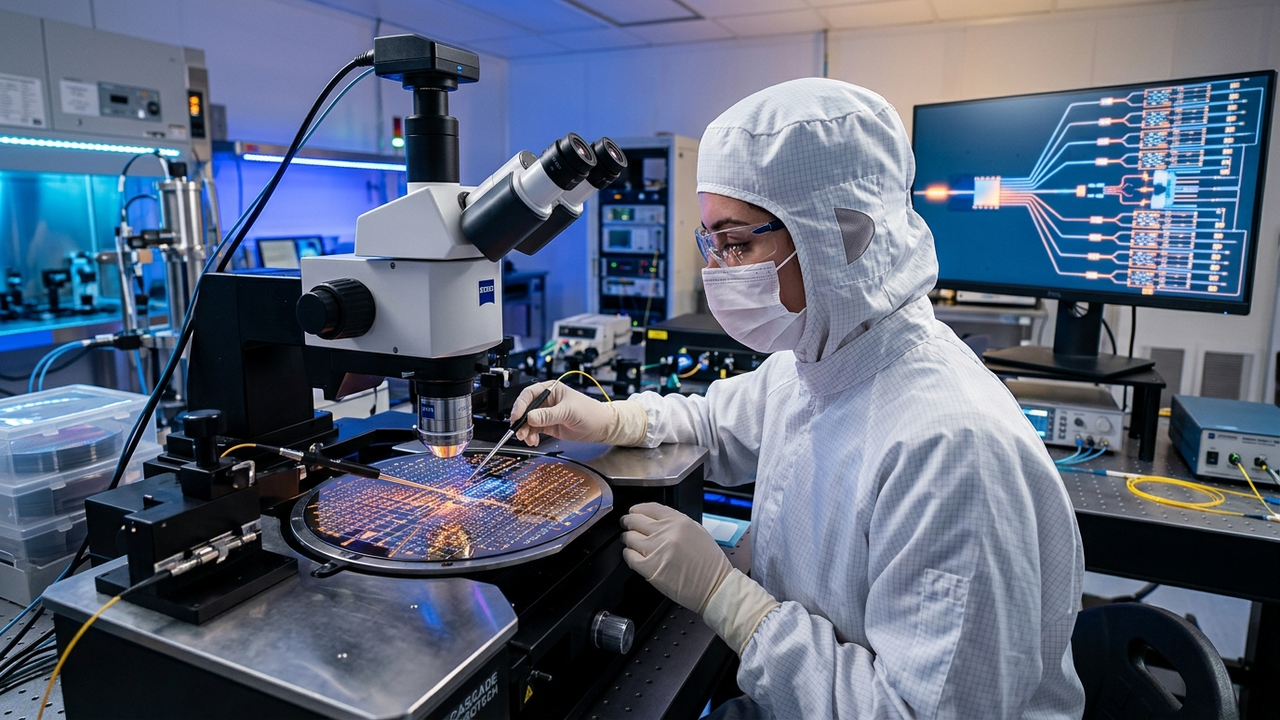
Photonic Integrated Circuits (PICs) are undergoing rapid advancements in miniaturization and increasing per-chip functionality, driven by significant progress in design, simulation, and manufacturing technologies. This evolution positions PICs as the next frontier in advanced optoelectronic devices, revolutionizing fields such as high-speed communication via optical fibers and efficient optical amplifiers.
Technical and Business Details
- Miniaturization and Functional Integration: Similar to electronic semiconductor chips, PICs integrate multiple optical components—including lasers, modulators, detectors, and waveguides—onto a single chip. This integration significantly reduces the physical size and power consumption of systems while enhancing overall performance.
- Evolution in Design and Simulation: The development of state-of-the-art CAD tools and simulation techniques allows for rapid iteration and optimization of complex PIC designs. This accelerates the development cycle, enabling faster market introduction of innovative devices with improved functionalities.
- Manufacturing Process Advancements: The maturation of manufacturing technologies across various material platforms, such as silicon photonics, indium phosphide (InP), and lithium niobate (LiNbO3), is enhancing the manufacturability and cost-efficiency of PICs. Silicon photonics, in particular, leveraging existing CMOS infrastructure, is key to widespread deployment.
- Expanding Applications: PICs are currently demonstrating their potential across a wide range of applications, including data center interconnects (DCI), 5G/6G communication networks, sensing technologies like LiDAR, medical diagnostics, and quantum computing.
Background and Industry Context
The exponential growth in data generation, coupled with the emergence of new technologies such as AI, IoT, and cloud computing, has pushed conventional electronic communication infrastructures to their limits. Optical communication, with its high bandwidth, low loss, and immunity to electromagnetic interference, is identified as a primary solution to these challenges. PICs deliver these advantages in a compact, integrated form factor, thereby laying the groundwork for next-generation communication and computing platforms.
Strategic Significance and Outlook
The continuous evolution of PICs is expected to dramatically improve the efficiency and performance of optical communication, leading to further miniaturization, lower power consumption, and enhanced capabilities. Specifically, increased optoelectronic integration and convergence with AI hardware are anticipated to create new market opportunities and accelerate the proliferation of optical technologies from data centers to edge devices. Consequently, photonics will become an increasingly indispensable component of modern society’s digital infrastructure.
Get our weekly technology intelligence — free
Receive an infographic that lets you judge at a glance whether each field’s analysis report is worth reading.
Subscribe Free — Weekly Tech Intelligence
By subscribing, you’ll receive Troy-Technical’s weekly technology intelligence newsletter.
- Your email and selected fields are used only to deliver the newsletter.
- We never share your information with third parties.
- You can unsubscribe anytime via the link in each email.
See our Privacy Policy for details.
Takes about a minute · Unsubscribe anytime





Comments