Key Findings
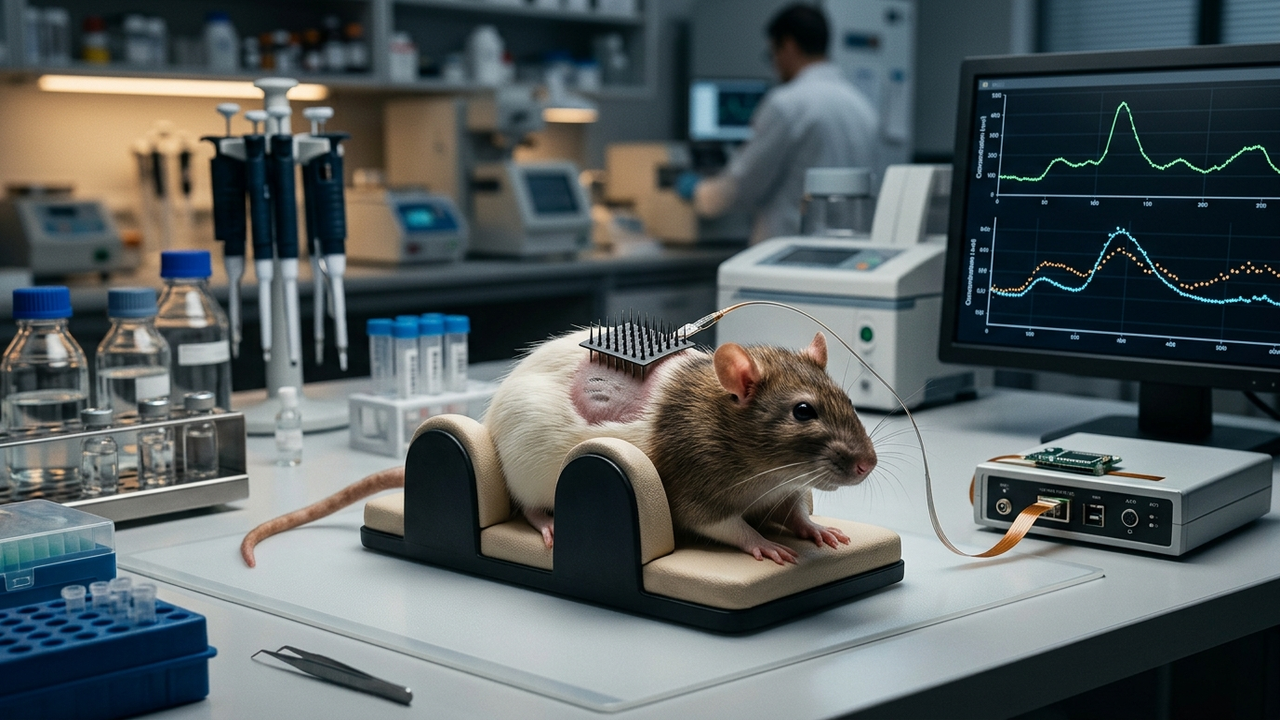
A study published on ResearchGate reports the successful qualitative and quantitative detection of glucose, uric acid, and cholesterol in rat skin interstitial fluid (ISF) using porous microneedles (MN). This technology opens new avenues for non-invasive and highly sensitive biomarker monitoring, holding significant potential to substantially reduce patient burden in disease diagnostics.
Technical & Clinical Details
Interstitial fluid (ISF) circulates between blood and cells and is gaining attention as a novel and promising source for disease diagnosis and prognosis, rich in biomarkers. However, efficient and non-invasive methods for ISF collection have been a challenge. The porous microneedle patch developed in this study can be easily applied to the skin without pain, utilizing capillary action to efficiently extract ISF. Specifically, the performance of the porous microneedle glucose sensor was thoroughly evaluated, achieving a very high sensitivity of 22.99 ± 0.72 µA mM⁻¹ over a physiologically relevant glucose concentration range of 0–15 mM. This level of sensitivity enables high-accuracy measurements for glucose monitoring in diabetes patients. Favorable results were also obtained for uric acid and cholesterol detection, suggesting the potential for multiplex functionality to monitor multiple metabolic biomarkers with a single device.
Background & Context
For the management of chronic diseases such as diabetes, continuous and accurate monitoring of biomarkers like blood glucose is essential. However, traditional blood collection methods are invasive, imposing physical and psychological burdens on patients. Microneedle technology has garnered attention as an innovative approach that allows for non-invasive sample collection with minimal pain, as the fine needles only penetrate the outermost layers of the skin. The ability of this technology to detect multiple biomarkers from ISF with high sensitivity will greatly contribute to improving patients’ quality of life, simplifying monitoring, and advancing personalized medicine.
Strategic Significance & Outlook
ISF-based biosensors using porous microneedles hold the potential to revolutionize many areas of diagnostic medicine. In the future, this technology is expected not only to be commercialized as continuous glucose monitoring (CGM) devices for diabetes patients but also to be applied to non-invasive monitoring of other disease biomarkers, such such as those for cardiovascular diseases, kidney disease, and metabolic disorders. Furthermore, research and development will focus on sensor miniaturization, integration into wearable devices, and improving long-term stability. This is anticipated to accelerate the widespread adoption of self-monitoring at home and point-of-care testing (POCT) in resource-limited areas, significantly contributing to the advancement of preventive and personalized medicine.
Get our weekly technology intelligence — free
Receive an infographic that lets you judge at a glance whether each field’s analysis report is worth reading.
Subscribe Free — Weekly Tech Intelligence
By subscribing, you’ll receive Troy-Technical’s weekly technology intelligence newsletter.
- Your email and selected fields are used only to deliver the newsletter.
- We never share your information with third parties.
- You can unsubscribe anytime via the link in each email.
See our Privacy Policy for details.
Takes about a minute · Unsubscribe anytime

Comments