Key Findings
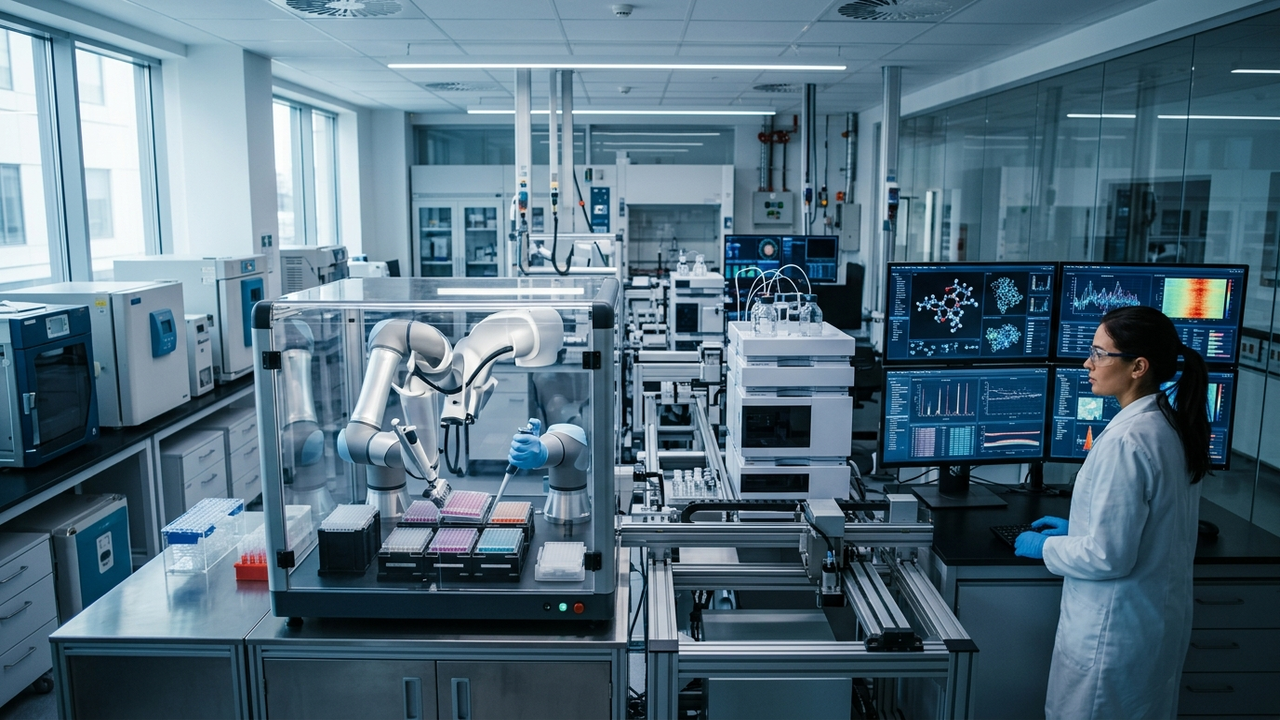
Discussions are advancing regarding the feasibility of autonomous closed-loop experimentation in pharmaceutical R&D. This article highlights criteria for assessing the suitability of this advanced approach and identifies practical bottlenecks hindering its implementation. The A-Lab team at Lawrence Berkeley National Laboratory emphasizes that the objective of autonomous labs is not to entirely replace human expert analysis but rather to augment human capabilities and significantly boost experimental efficiency. However, it was noted that further technological improvements are essential for autonomous labs to become fully trustworthy systems, particularly concerning challenges in X-ray Diffraction (XRD) data analysis, a key area relevant to materials science.
Technical / Clinical Details
Closed-loop experimental systems function through an iterative cycle where AI generates hypotheses, robots autonomously execute experiments, sensors collect data, and AI analyzes results to self-determine the next experimental steps. In pharma R&D, this approach is beginning to be applied in the synthesis, screening, and optimization of drug candidates. However, similar to materials science, automatic analysis and interpretation of complex data (e.g., XRD patterns) pose significant challenges. XRD data provides crucial material information such as crystal structure, phase composition, and crystallinity, but its interpretation requires advanced expertise and, at times, manual fine-tuning. Current AI models still struggle to make robust judgments at the same level as human experts when confronted with noisy data or unexpected results.
Background & Context
In both the pharmaceutical and materials science sectors, reducing the lead time and cost of new product development is a constant top priority. The introduction of autonomous labs is generating considerable excitement as an innovative solution to this challenge. Major research institutions and corporations in the U.S. and Europe are investing hundreds of millions of dollars to accelerate the development of autonomous labs. Nevertheless, constructing systems that combine high-precision robotics, reliable AI models, and sophisticated data analysis capabilities remains a significant technical hurdle. Automated data analysis, in particular, is essential for ensuring the reliability and reproducibility of experimental results, and breakthroughs in this area will determine the practical viability of autonomous labs.
Strategic Significance & Outlook
The future of autonomous labs hinges on overcoming bottlenecks such as XRD data analysis. Advancements in AI models, especially the integration of Explainable AI (XAI) and Physics-Informed AI (PINN), will enhance data interpretation transparency and reliability. Furthermore, the construction of larger, standardized datasets and the promotion of data sharing under open science principles will further boost AI model learning capabilities. In the future, autonomous labs are expected to function as ‘human-in-the-loop’ systems in pharma R&D, where humans focus on more strategic decision-making and complex problem-solving. This is anticipated to accelerate the discovery rate of new drugs and materials, contributing more rapidly to solving societal challenges on a global scale, and establishing new paradigms for scientific collaboration and innovation.
Source: https://sakaradigital.com/blog/self-driving-labs-closed-loop-experimentation-pharma/
Get our weekly technology intelligence — free
Receive an infographic that lets you judge at a glance whether each field’s analysis report is worth reading.
Subscribe Free — Weekly Tech Intelligence
By subscribing, you’ll receive Troy-Technical’s weekly technology intelligence newsletter.
- Your email and selected fields are used only to deliver the newsletter.
- We never share your information with third parties.
- You can unsubscribe anytime via the link in each email.
See our Privacy Policy for details.
Takes about a minute · Unsubscribe anytime





Comments