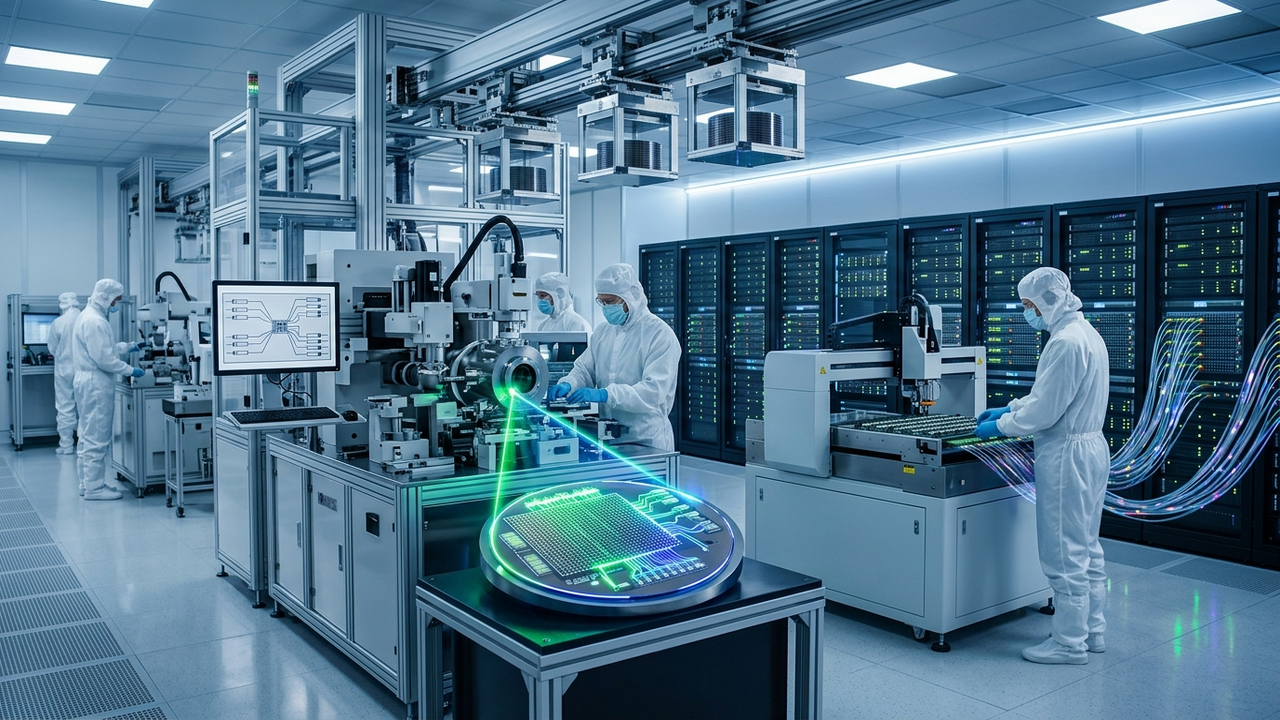
TSMC, the world’s largest semiconductor foundry, has unveiled a groundbreaking projection: silicon photonics will command more than half of the total optical transceiver market by 2027. This dramatic shift is attributed to the explosive demand from AI infrastructure, which is rapidly accelerating the deployment of optical links between processors, switches, and data center systems. This anticipated dominance signals a new era for high-speed, high-capacity data communication.
Technical / Clinical Details
- Silicon photonics is a technology that generates, modulates, routes, and detects optical signals on a silicon chip, enabling data transmission at speeds and power efficiencies vastly superior to traditional electrical signals. In AI data centers, where massive data movement between GPU clusters and large Neural Processing Units (NPUs) is indispensable, silicon photonics acts as a key bottleneck resolver.
- TSMC’s CO-UPE (Co-packaged Optics – Ultra-high-speed Photonic Engine) platform stands at the forefront of this technological revolution. It involves integrating the optical engine directly within the same package as high-performance logic chips like CPUs and GPUs. This approach dramatically shortens electrical signal transmission distances, leading to significant reductions in signal loss and power consumption.
- CO-UPE is being developed in close synergy with TSMC’s advanced packaging technologies, SoIC (System-on-Integrated Chips) and CoWoS (Chip-on-Wafer-on-Substrate). This enables the efficient integration of photonic integrated circuits (PICs) with high-performance logic and memory chips, pursuing ultimate system performance and power efficiency.
- The forecast that silicon photonics will capture over 50% of the optical transceiver market by 2027 suggests this technology will become the de facto standard for data communication in the AI era, accelerating a shift away from traditional III-V semiconductor-based optical devices.
Background & Context
The evolution of AI is forcing a fundamental transformation in data center architectures. Training and inference for generative AI and large language models (LLMs) require processing petabytes to exabytes of data per second, pushing conventional electrical interconnects to their bandwidth and power consumption limits. Silicon photonics is emerging as one of the most promising technologies to overcome this “power wall” and “data bottleneck,” attracting significant attention from leading semiconductor manufacturers and cloud providers. TSMC’s projection will undoubtedly influence future data center design and semiconductor manufacturing strategies.
Strategic Significance & Outlook
If TSMC’s prediction materializes, the adoption of silicon photonics is likely to expand beyond data centers to a wide array of fields, including High-Performance Computing (HPC), edge AI, and even automotive LiDAR. Innovative integrated solutions like the CO-UPE platform will enhance overall system performance while simultaneously reducing cooling requirements and operational costs, contributing to the construction of sustainable AI infrastructure. Over the next few years, the standardization of this technology and the growth of its ecosystem are expected to accelerate, leading to more vendors introducing silicon photonics-based products to the market.
Get our weekly technology intelligence — free
Receive an infographic that lets you judge at a glance whether each field’s analysis report is worth reading.
Subscribe Free — Weekly Tech Intelligence
By subscribing, you’ll receive Troy-Technical’s weekly technology intelligence newsletter.
- Your email and selected fields are used only to deliver the newsletter.
- We never share your information with third parties.
- You can unsubscribe anytime via the link in each email.
See our Privacy Policy for details.
Takes about a minute · Unsubscribe anytime




Comments