Key Findings
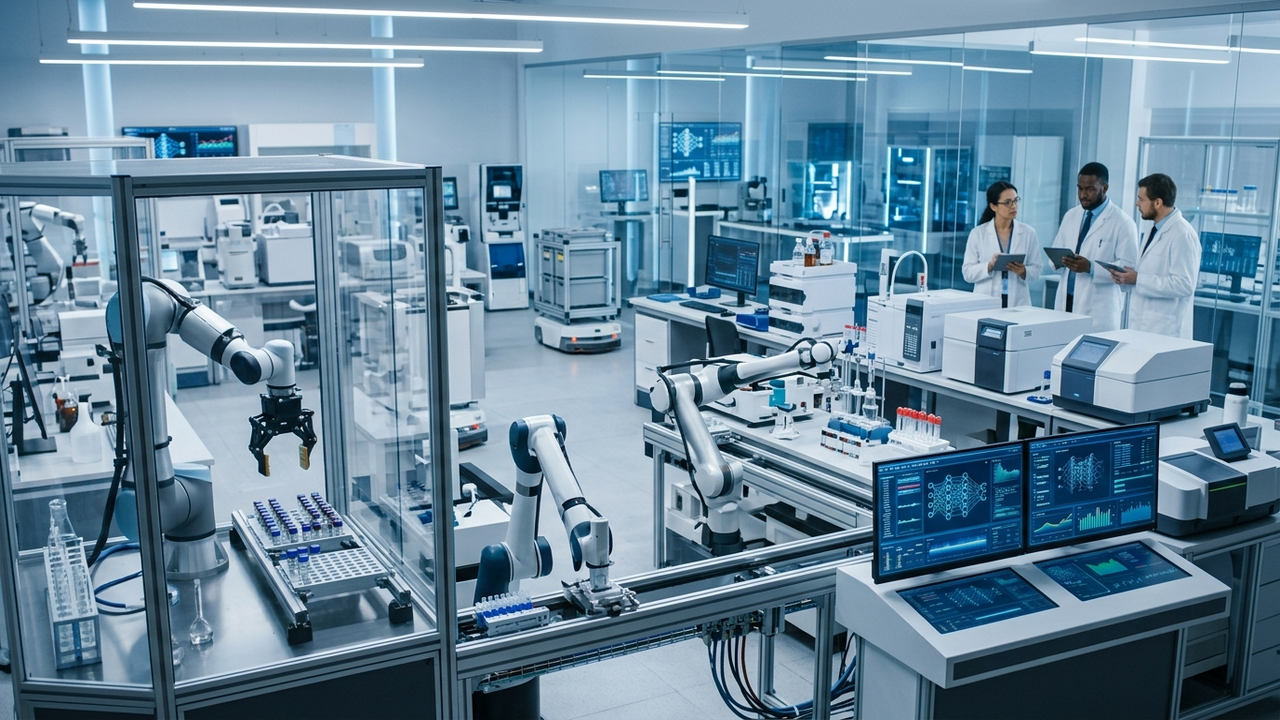
The integration of autonomous laboratories and closed-loop AI is fundamentally transforming the economics of scientific discovery, particularly in the fields of chemistry and materials science. These systems, by linking active-learning algorithms with robotic synthesis tools, autonomously generate and validate new materials around the clock, drastically cutting the costs and time associated with traditional R&D processes.
Technical Details and Applications
The core of an autonomous laboratory is its ‘closed-loop’ cycle: AI plans experiments, robots execute them, results are analyzed in real-time, and this information then guides the next optimized experimental steps. Advanced organizations like the Acceleration Consortium are leading this technology, efficiently screening millions of possibilities to discover molecules and materials with specific functionalities. For instance, a partnership between Benchling Automation and Ginkgo Bioworks has successfully reduced the time to discover optimized microbial strains and increased bioproduction yields by up to 25%. This technology minimizes physical waste, eliminates errors associated with manual labor, and enables rapid iteration cycles far exceeding human capabilities. Moreover, the data collected by the AI continuously refines the models, leading to the ongoing generation of higher-value, structured datasets.
Background and Industry Context
The discovery of new materials and drugs is typically a high-cost, time-consuming process, often involving extensive experimentation and trial-and-error. This has long been a significant barrier to innovation. As leading nations worldwide strive to enhance their scientific and technological competitiveness, improving this ‘economics of discovery’ has become an urgent priority. The combination of autonomous laboratories and AI is emerging as a decisive solution to this challenge, enabling companies to bring innovations to market more quickly and efficiently. This represents a new value creation opportunity stemming from the convergence of materials informatics and Industry 4.0.
Future Outlook
This ‘new economics of discovery’ is set to be a key trend shaping the future of science and technology. In the future, autonomous laboratories are expected to evolve beyond mere experimental automation into full ‘science agents’ where AI independently generates and validates scientific hypotheses. This is anticipated to accelerate innovations that address societal challenges, such as improving battery material performance, developing CO2 capture technologies, and discovering new therapeutics. In industry, this will prompt a restructuring of R&D departments, establishing efficient innovation models that yield more discoveries with fewer resources. This will enhance international competitiveness and create new business opportunities for sustainable growth.
Source: https://exponentialindustry.com/blog/2026-09-08-autonomous-labs-closed-loop-discovery/
Get our weekly technology intelligence — free
Receive an infographic that lets you judge at a glance whether each field’s analysis report is worth reading.
Subscribe Free — Weekly Tech Intelligence
By subscribing, you’ll receive Troy-Technical’s weekly technology intelligence newsletter.
- Your email and selected fields are used only to deliver the newsletter.
- We never share your information with third parties.
- You can unsubscribe anytime via the link in each email.
See our Privacy Policy for details.
Takes about a minute · Unsubscribe anytime






Comments