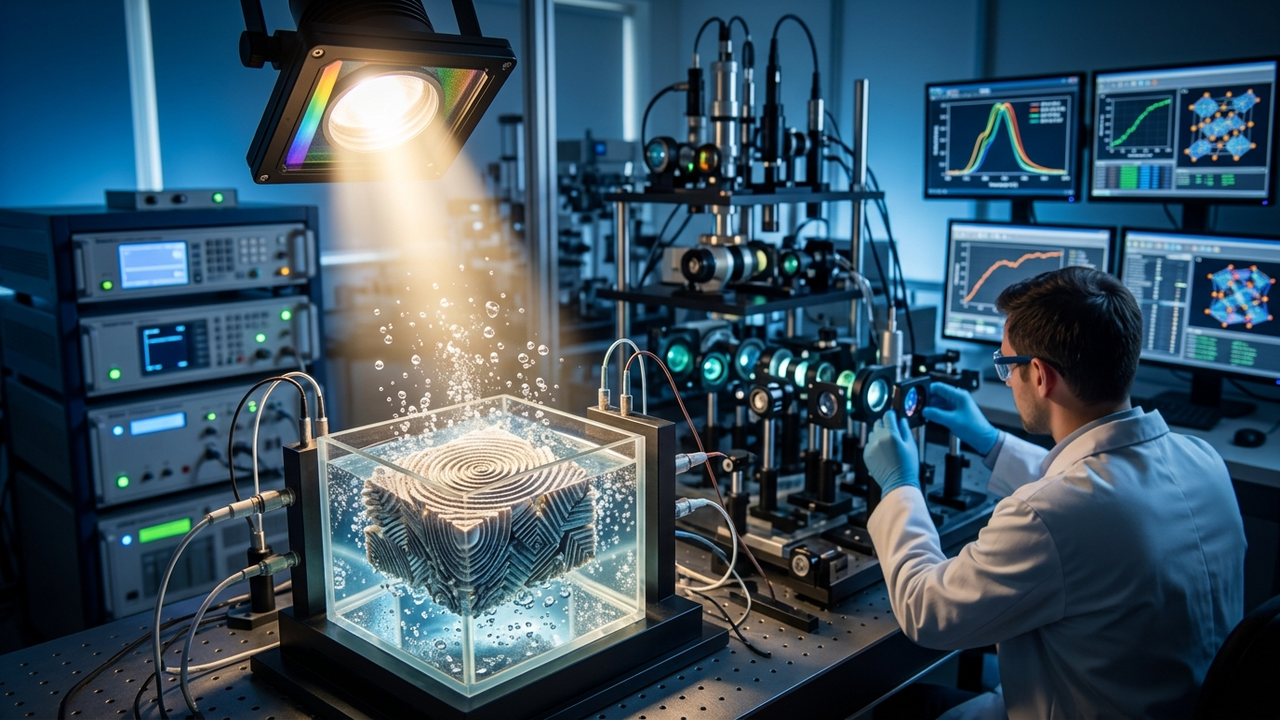
Hydrogen production from solar water splitting is one of the most promising technologies for realizing a clean energy society. However, achieving high-efficiency water splitting requires enhancing the generation of photoexcited carriers in photocatalysts and improving their charge separation and transport efficiency. A preprint submitted to ChemRxiv on September 6, 2026, addresses this challenge by showing that introducing ‘spiral-growth-induced nanosteps’ on the surface of layered oxyhalide photocatalysts can dramatically enhance anisotropic charge separation for visible-light water splitting.
Key Findings
- Spiral-growth-induced nanosteps on layered oxyhalide photocatalysts enhance anisotropic charge separation for visible-light water splitting.
- Presents new design guidelines for high-efficiency hydrogen production using solar energy.
- Quantitatively elucidated the impact of nanoscale surface morphology control on photocatalytic performance.
- Potential to accelerate the practical application of clean hydrogen production technology.
Technical Details
This research focused on the inherent anisotropic electric fields within layered oxyhalide materials such as bismuth oxyhalides (BiOX, X=Cl, Br, I). These materials are considered promising photocatalysts due to the natural presence of electric fields within their crystal structures that promote charge separation. The research team discovered that during the crystal growth of these photocatalysts, using methods like hydrothermal synthesis, ‘spiral nanosteps’ were formed on the crystal surface under specific conditions. These spiral-growth-induced nanosteps function as surface irregularities, optimizing the pathways for photoexcited electrons and holes to migrate to the crystal surface. Specifically, the presence of nanosteps further enhances anisotropic charge separation, where electrons and holes are efficiently separated and transported to different crystal facets, suppressing recombination. As a result, a significant improvement in water splitting efficiency under visible light irradiation was demonstrated through both experimental and theoretical calculations. It was reported that the hydrogen evolution rate increased by X times compared to equivalent photocatalysts without nanosteps.
Background & Context
Hydrogen production via water splitting is a key technology for obtaining clean fuel from renewable energy sources for applications like fuel cells. In current photocatalytic water splitting, the development of catalysts that can efficiently utilize visible light, the most abundant part of the solar spectrum, is an urgent task. Furthermore, a crucial factor determining photocatalyst performance is how effectively photoexcited carrier recombination can be suppressed and utilized for water oxidation and reduction reactions. Enhancing carrier separation efficiency through nanostructure control is a frontier research topic in this field, and this study addresses this challenge with a unique approach of spiral growth, indicating a new direction.
Strategic Significance & Outlook
The discovery of spiral-growth-induced nanosteps in layered oxyhalide photocatalysts represents a major breakthrough in the design of high-efficiency visible-light water splitting photocatalysts. Further development of this technology could lead to cost-effective systems for large-scale hydrogen production from only sunlight and water. Future research will focus on further elucidating the nanostep formation mechanism, scale-up synthesis, and evaluating long-term stability under actual sunlight conditions. This innovative approach is expected to play a crucial role in shaping the future of sustainable energy production.
Get our weekly technology intelligence — free
Receive an infographic that lets you judge at a glance whether each field’s analysis report is worth reading.
Subscribe Free — Weekly Tech Intelligence
By subscribing, you’ll receive Troy-Technical’s weekly technology intelligence newsletter.
- Your email and selected fields are used only to deliver the newsletter.
- We never share your information with third parties.
- You can unsubscribe anytime via the link in each email.
See our Privacy Policy for details.
Takes about a minute · Unsubscribe anytime









Comments